  1. Home
  2. Computing
  3. News

This microLED advancement is exactly what AR and VR needs

Add as a preferred source on Google

Recent advances in microLED technology could significantly improve AR glasses and VR headsets in the future, according to some new research from MIT.

The report claims that vertical stacking could allow for microscopic pixels that provide full color in just 4 microns.

AR Glasses appear over an enlarged view of a stacked microLED display.
Image used with permission by copyright holder

Head-mounted displays have, so far, relied on the same type of screens found in smartphones, tablets, and laptops. But these stacked microLEDs could challenges the way VR headsets are built in the future — and greatly expand their visuals.

Recommended Videos

Stacked microLEDs can increase resolution compared to the current method of placing red, green, and blue sub-pixels side by side to create each full-color pixel.

The resulting microLED display could theoretically have a resolution of 5,000 pixels per inch (PPI). That’s about 10 times the pixel density of your smartphone. While this resolution would serve no purpose on a screen held at arm’s length, it should greatly improve the quality of displays that are about an inch from your eye. VR displays can suffer from the screen door effect where the pixel grid pattern is apparent.

MicroLED displays also enjoy higher efficiency and improved contrast compared to LCD panels that require backlighting. Even mini-LED backlighting can’t compare since the light source is about one hundred times larger. That’s why you can sometimes see blooming around high-contrast areas in a mini-LED display.
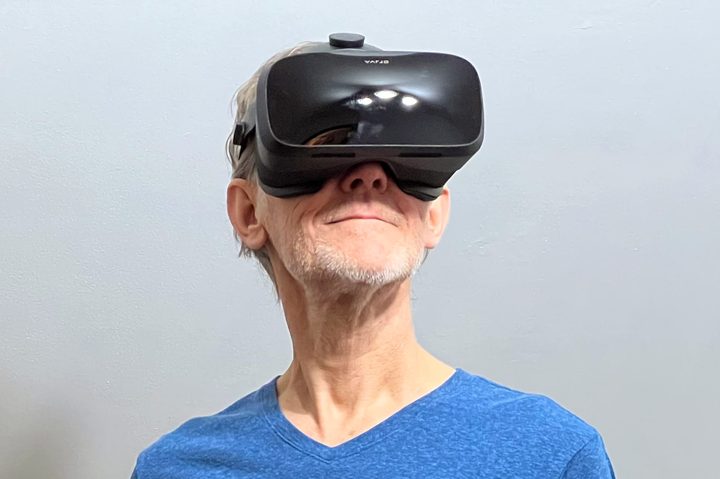
Alan Truly smiles in this closeup, while wearing the Varjo Aero VR headset.
Photo by / Tracey Truly / Digital Trends

The only competing technology that might be able to match the contrast and density is full-color microLED; however, OLED degrades much more rapidly over time.

MIT researchers are making good progress on vertically stacked microLED displays, having demonstrated a working stacked pixel. They’ve also designed a manufacturing process that reduces waste despite the challenges of working at such a small scale. The next hurdle is to develop a system that can individually control a vast array of these full-color microLEDs.

The transition from the lab to manufacturing is almost impossible to predict, but this is undoubtedly good news for the future of AR glasses and VR headsets.

Alan Truly
Alan Truly is a Writer at Digital Trends, covering computers, laptops, hardware, software, and accessories that stand out as…
Macbook Neo stress test shows Apple could’ve made it run cooler with a simple fix
This simple mod makes the MacBook Neo faster.
Apple MacBook Neo with users hands on it

Apple's MacBook Neo arrived as a shock to the industry. It is the new cheap MacBook that is designed to be silent, efficient, and affordable. But a new stress test suggests that it could have been noticeably better with a very simple change.

As per a recent test, the addition of a basic copper plate to the cooling setup can improve both thermals and performance by a meaningful margin. And the frustrating part? It isn't some complex engineering overhaul and is relatively straightforward.

Read more
The Mac Pro is dead at Apple, and I’ll miss the cheese-grater powerhouse
RIP Mac Pro. The Mac Studio is taking the throne, and we're okay with that.
Electronics, Computer, Pc

Apple has officially discontinued the Mac Pro. It’s been removed from Apple’s website, and Apple has confirmed to 9to5Mac that there are no plans to release a future version. The buy page now redirects to Apple’s Mac homepage, where the Mac Pro no longer exists.

Why did Apple kill the Mac Pro?

Read more
March Madness, Revisited: The AI Model Did Well. But Mad Things Still Happen
Stills from NCAA games.

(NOTE: This article is part of an ongoing series documenting an experiment with using AI to fill the NCAA brackets and see how it fares against years of human experience. The original article is as follows.)

A week ago, I wrote about entering an NCAA tournament pool with a more disciplined process than I usually use.

Read more