Nvidia’s Turing-based RTX GPUs are some of the most powerful you can get your hands on today, but the next-generation is on its way. It appears that the company has begun testing its next-generation Ampere architecture, and a new series of leaked benchmarks are showing some promising results.
Several Geekbench 5 benchmarks were spotted by a Twitter user and then picked up by PCGamesN that detail some significant performance results and specifications for Nvidia’s upcoming GPU.
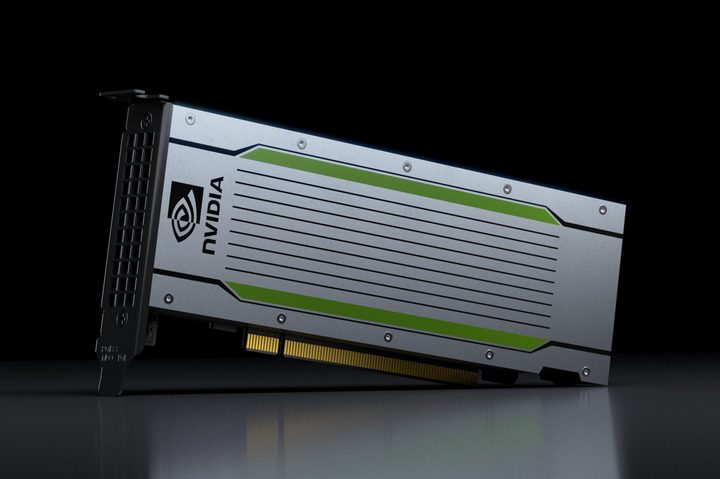
Nvidia appears to have tested two Ampere GPUs with the codename of Fat Man and Little Boy, and what’s curious about these leaked early benchmarks is that the cards were tested on a non-high end system running an Intel Z370 Coffee Lake motherboard, according to PCGames N.
The more powerful card, Fat Man, has a whopping 60% more streaming multiprocessors compared to the current GeForce RTX cards with a total of 118. If Nvidia maintains its current core-to-SM ratio from today, that will translate to 7,552 CUDA cores for Fat Man.
The card also comes 24GB of video RAM, matching what’s available on the premium Titan RTX card from today. Fat Man was tested with an unusually low boost clock speed of 1.11GHz.
PCGames N estimated that Fat Man to be capable of more than 33.5 TFLOPs at that clock speed. If Nvidia increases the speed on the card at launch, Fat Man’s computational capabilities could go even higher, making it a card that would be suitable for high end data analysis, deep learning applications, and artificial intelligence.
It’s unclear if Nvidia will be using Ampere for a rumored GeForce RTX 3080 launch, but it was previously speculated that the architecture may not be targeted at gamers, at least not initially given the massive amounts of video memory.
The less powerful Little Boy features 108 SMs but comes with double the memory of Fat Man. It’s clocked at 1.01 GHz in the leaked Geekbench test result. This should translate to roughly 6,912 CUDA cores and nearly 28 TFLOPs of compute power. Though not a direct apples-to-apples comparison of TFLOP performance, Microsoft recently revealed its new Xbox Series X comes tops out with 12 TFLOPs of compute power.

The TFLOP estimates assume that Nvidia will double its floating point units on Ampere, which would double the TFLOP performance. If Ampere doesn’t come with double the FP units, then the cards may max out with 17 TFLOPs and 14 TFLOPs, according to TechRadar.
Given that we still don’t know much about Ampere’s overall architecture, the CUDA core calculations as well as TFLOP approximations can drastically change when the cards are unveiled. And according to previous rumors, the Ampere graphics cards could potentially match AMD’s 7nm manufacturing process, giving it even higher efficiency than Turing.
With Nvidia’s annual GPU Technology Conference (GTC) slated to happen next month, where the company is expected to unveil Ampere.