
Nvidia has just announced the upcoming release of two new graphics cards: The Nvidia GeForce RTX 3090 Ti and the RTX 3050.
The announcement was made during Nvidia’s CES 2022 keynote. We now know more about the specifications of the insanely high-end RTX 3090 Ti and the budget RTX 3050.
RTX 3090 Ti

The upcoming RTX 3090 Ti will likely be the shining star of the Ampere generation of Nvidia cards, though the provided details were sparse. Even more powerful than its predecessor, the RTX 3090, this is a GPU aimed at enthusiasts and professionals who are willing to accept the price tag and simply want the best possible performance the current technology can offer.
Here’s what Nvidia confirmed about the highly rumored RTX 3090 Ti: It will feature a whopping 24GB of 21Gb/s GDDR6X memory, as well as bandwidth of 1TB/s. Nvidia also mentioned that the card will have 320 Tensor cores, 40 shader cores, and 78 ray tracing (RT) cores. Those were all the certain details provided by Nvidia, and what follows is based on previous rumors.
Numerous leaks in the past months have revealed extra information about the card, such as its CUDA core count, clock speed, and price.
But even just based on the minimal confirmed specifications alone, there is no doubt that the new RTX 3090 Ti has every chance to find itself atop the list of the best graphics cards.
RTX 3050
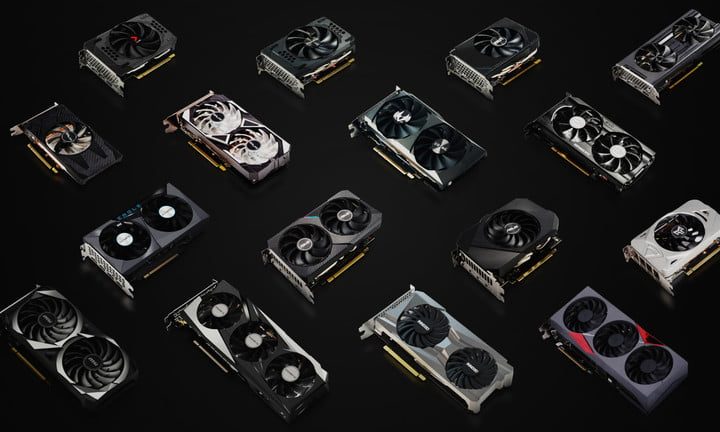
The upcoming RTX 3050 is about as far from the RTX 3090 Ti as a card within the same generation can possibly be. This is an affordable GPU aimed at less-demanding gamers on a tighter budget. Even still, don’t be fooled by the (confirmed) $250 price tag — this card will undoubtedly be a step up for many gamers currently in need of a GPU.
Nvidia mentioned the popularity of the old GTX 1050, which the company claimed could play games at the time at 60 frames per second.
So, where’s the need for an upgrade? Well, according to Nvidia, modern games are more demanding, citing the GTX 1050’s inability to handle titles like Control and Guardians of the Galaxy.
That’s where the RTX 3050 comes in. It has 8GB of GDDR6 memory, second-generation RT cores, and third-generation tensor cores. Nvidia promises that the card will support ray tracing and DLSS.
Much like with the RTX 3090 Ti, there’s still a lot that Nvidia hasn’t disclosed about this GPU. Previous leaks suggest that the unit will also have a 128-bit memory bus and 2,560 CUDA cores, but we’ll have to wait and see for more information from Nvidia.
Nvidia’s new releases are certain to fill some gaping holes in the market caused by the ongoing GPU shortage. While the price tag for the RTX 3090 Ti is likely to be extremely steep, the card may still cost less at retail than an RTX 3080 Ti costs at scalper prices. As for the RTX 3050, although it may seem lacking in comparison to the beastly RTX 3090 Ti, this card should still prove to be an upgrade to countless people who have been unable to upgrade from the GTX generations of cards.
The RTX 3050 has been confirmed to release on January 27 to a variety of retailers, but Nvidia hasn’t said when the RTX 3090 Ti will be up for sale, although Nvidia promised more information later in January. Regardless of the release date, the question is how many people are going to be able to snap them up when they first hit the shelves.


