
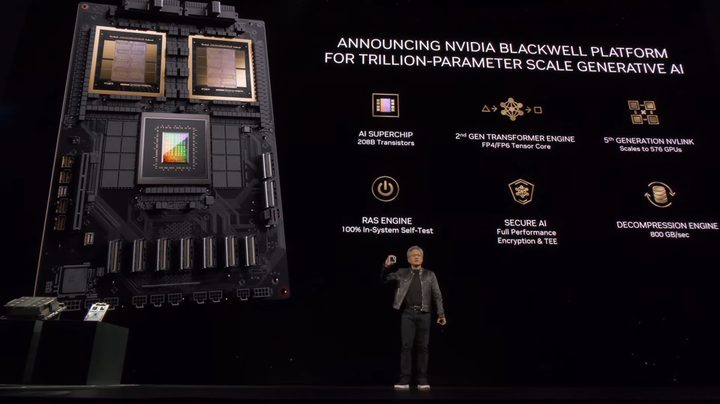
We finally have our first taste of Nvidia’s next generation of GPUs, named Blackwell. Sure, they’re built for enterprises, and no, they won’t run Cyberpunk 2077 (at least not officially). But this is the first look we’ve have at what Nvidia is cooking up for its RTX 50-series GPUs, which are rumored to launched sometime in the next year.
The GPU we have today is the B200 — Blackwell 200, if you can spot it — that comes packed with 208 billion transistors. The architecture is built on TSMC’s 4NP node, which is an enhanced version of the 5nm node. It’s a little surprising given that Nvidia’s Ada Lovelace GPUs are built with TSMC’s 4N node — one refinement step away from 4NP. Nvidia notes that it’s using a custom version of this process, however.

Nvidia laid out six parameters that set Blackwell apart. The first is that custom 4NP process, which Nvidia is using to connect two GPU dies across a 10TB-per-second interconnect. Second is an updated Transformer Engine. Nvidia says the architecture can handle double the model size of last-gen Ada Lovelace, and it supports a new 4-bit floating point instruction set.
There’s also fifth-generation NVLink, allowing enterprises to hook up Blackwell GPUs in sizes of 576 GPUs in a single fleet. Nvidia is throwing in a couple of AI security features as well, including confidential computing capabilities and a RAS (reliability, availability, and serviceability) engine to ensure maximum uptime for its data center GPU.

That’s great if you’re running a data center, but it’s the sixth and final pillar that gets me excited. Nvidia says the B200 has a dedicated decompression engine. This is focused on enterprise right now, but we’ve seen how big of a difference dedicated decompression hardware can make in gaming as well. If Nvidia carries this engine over to its gaming GPUs, and supports the proper formats, it could make a massive difference once you’re able to throw a Blackwell graphics card in your gaming PC.
All eyes are on the end of the year, or potentially early next year, for Nvidia’ Blackwell gaming GPUs to show up. For now, enterprise customers have access to the B200 through the HGX B200 — a server board that combines eight B200 GPUs — and the GB200, which brings together the B200 GPU with Nvidia’s Grace CPU. Nvidia is offering that part through the GB200 NVL72, which brings together a dizzying 72 B200 GPUs and 36 Grace CPUs.


