
After a lot of hype and speculation, Nvidia kicked off its GeForce special event to reflect on the past 20 years of computer graphics and announce some of its most powerful and oft-rumored products. At the event, Nvidia introduced its second generation of ray tracing technologies, with the flagship RTX 3080 GPU. Nvidia claims these new cards deliver some of the biggest generational improvements in Nvidia history.
The company also unveiled an affordable midrange GeForce RTX 3070, which succeeds the popular RTX 2070, as well as the RTX 3090, a massive GPU designed for extreme enthusiasts and a graphics card that CEO Jensen Huang lovingly dubbed the “BFGPU” due to its massive size and performance.
The announcement was so popular that as of the start of the event, more than 160,000 fans had their eyes glued to the company’s Twitch page, and that number quickly grew as the event continued. Here’s everything that was announced by Nvidia:
RTX ray tracing comes to Fortnite

Nvidia CEO Jensen Huang kicked off the event by declaring the company’s love for computer graphics in a video stream from his kitchen.
“Thank you all for joining us,” he said. “Historically, we’re going to talk about computer graphics, and the work we’re doing to push the boundaries. We love computer graphics and have advanced it incredibly in the time of Nvidia as the technology advanced.”
Huang announced that Fortnite will support ray tracing, and Epic will enable support for the technology in its games.
Killing the lag

Nvidia introduced new tools to help reduce the latency as it targets a new generation of more powerful e-sports gamers. The new Nvidia Reflex technology helps reduce latency by analyzing the CPU and GPU pipeline, and the result is that refresh rates can be boosted to 360Hz on compatible G-Sync displays from Alienware, MSI, and Acer, the company claimed. The Nvidia Reflex Latency Analyzer tool will work to help gamers understand any lags between input devices — like a mouse — and what is displayed on screen.
In effect, this helps to reduce latency below 30 milliseconds, whereas most gamers experience latency up to 100 milliseconds. The result is a more competitive gaming session that will help you attack your targets.
Nvidia Reflex will be arriving in September with Nvidia’s game-ready drivers. Titles like Valorant, Fortnite, Apex Legends, and more will support this.
Made for broadcasters and streamers
Highlighting the changes of the global pandemic and how people are working from home now, Nvidia introduced some new technologies to turn your humble PC and the webcam into a professional streaming studio. Leveraging the power of artificial intelligence, Nvidia’s Video Broadcast tool removes audio noise, layers in virtual background effects, and also introduces automatic framing with camera tracking technology. All this can be done using a standard webcam and an RTX GPU, Nvidia claimed.
“For the 20 million live streamers we have something really cool and videocast turns any room into a broadcast studio,” the company said. “Video broadcast runs A.I. algorithms trained by deep learning on Nvidia’s DGX supercomputer, one of the most powerful in the world.”
In a demo, Nvidia staff showed how Video Broadcast, which will be available come September, helps to reduce noises like a hair dryer, which can be important as more family members work and learn from home in close spaces. It also adds a green screen, blurs the background, and allows the webcam to track your movement for a more professionally produced video experience.
Machinima app
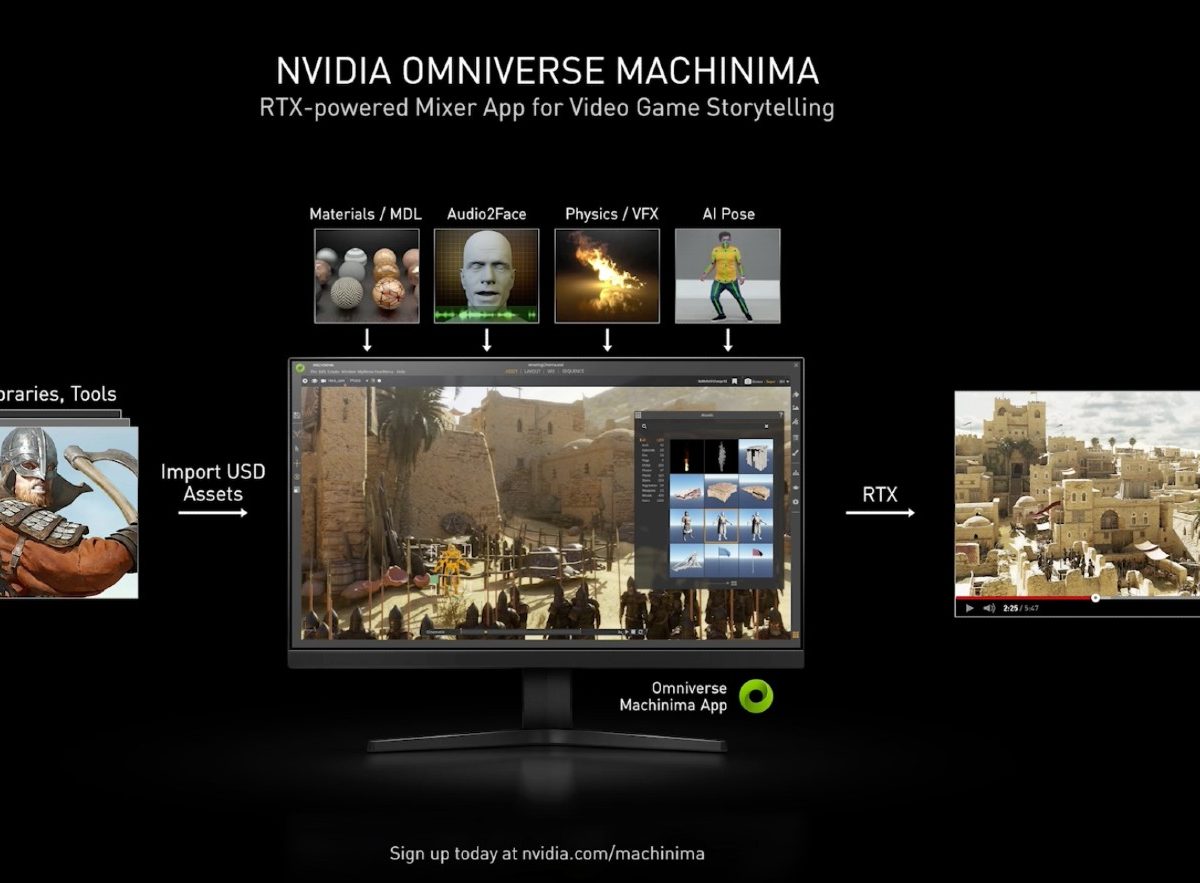
“A new form of art has emerged from gaming called machinima,” Huang said. “Artists are using game assets to create cinematics. There have been tens of billions of views on YouTube — most are shorts, some are even recreating entire classic movies.”
To foster this creativity, Nvidia announced its Omniverse Machinima software, which will be available in October.
“It’s an app built on our omniverse 3D workflow collaboration platform,” Nvidia claimed. “Omniverse is a universal design tool asset exchange with a viewer, based on photorealistic path tracing. The engine is designed to be physically accurate simulating light physics material and artificial intelligence.”
The new RTX Ampere lineup

Nvidia announced its new RTX graphics processor built on the Ampere architecture, a change from the Turing architecture found on the RTX 2000 series. The new platform is built on Samsung’s 8nm process with 28 billion transistors. The new Ampere RTX 3080 GPU comes with 30 shader TFLOPs, up from 11; 58 ray tracing TFLOPs, up from 34; and 238 tensor TFLOPs, compared to 89.
“We use every engineering lever to squeeze every drop of performance out of the system,” Huang proclaimed. “From architecture, custom process design, circuit design, logic design, packaging, custom I/O, memory, power and thermal design, PCB design, software, and algorithms. Thousands of engineers per generation, billions of dollars, full-stack engineering, and extreme craftsmanship is the hallmark of our GPUs.”

Performance and energy efficiency is double that of Turing, and works with DLSS 2.0 to de-noise as scenes are rendered in real time with cinematic quality. Nvidia claimed that the more ray tracing is done, the greater the performance.
“You can see dramatic visual quality jump of Ampere,” Huang said. “Marbles on Turing runs at 720p at 25 frames per second. Marbles on Ampere runs a 1440p at 30 frames per second, more than four times the performance.”
Nvidia announced titles like Cyberpunk will be coming with ray tracing support with DLSS 2.0.
The star of the show: RTX 3080 flagship
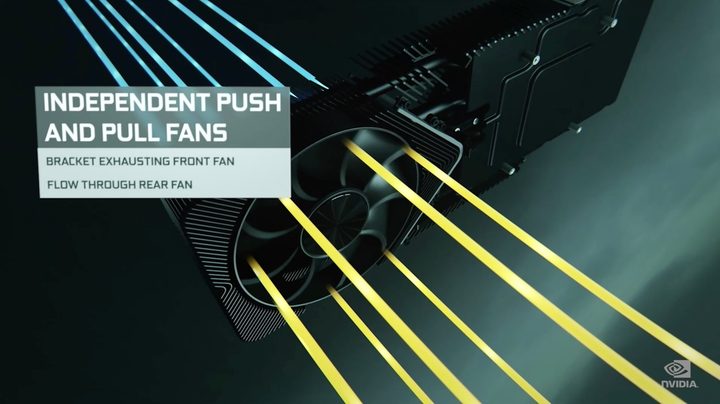
The flagship GPU this year will be the GeForce RTX 3080, powered by Ampere, which comes with a radical new design to help manage thermals. Described as a huge generational leap, the RTX 3080 is the star of the show today, and this GPU promises significant improvements to ray tracing performance. Priced at just $799 and coming in with twice the performance of the Turing-based RTX 2080 — Nvidia did not disclose which benchmarking tools were used to get this metric — the RTX 3080 could be seen as a GPU designed for enthusiasts but with mainstream pricing.
Consistent with earlier leaks, the RTX 3080 comes in a dual-fan design to aid in cooling, which helps to pull in cool air and push out warm air. There are two independently controlled fans, Huang said. This is three times quieter and keeps the GPU 20 degrees cooler than the previous design. It can cool 90 watts more than Turing, Nvidia claimed.
Better thermal management will help the card’s powerful performance. As expected, the RTX 3080 ships with 10GB GDDR6X of video memory and features 30 shader teraflops, 58 raytracing teraflops, and 238 tensor teraflops. The card supports the Gen 4 PCI Express standard, and Nvidia is also bundling in its new RTX I/O to help improve game loading times on its GPUs. There are three components in play here for the new RTX I/O, including new APIs for fast loading and streaming directly from SSD to GPU memory, GPU lossless decompression, and collaboration with Microsoft for direct storage for Windows.
The RTX 3080 comes with a 320-bit memory bus, has a bandwidth of 760 GB/s, and ships with 8,704 CUDA cores. The stated TDP for this card is 320 watts. The RTX 3080 has a boost clock speed of 1,710 MHz.
“It is wonderfully crafted, and it will look beautiful in your PC,” Huang said. The PCB design is described to be 50% smaller than the previous generation, and the card now supports HDMI 2.1 PCIe 4.0.

With Ampere, Nvidia is using new G6X memory, the world’s fastest graphics memory. Nvidia stated that it had collaborated with Micron for the G6X video RAM on the card, which according to the memory partner is capable of delivering a bandwidth of up to 1TB per second. The RTX 3080 will be priced at $699 when it becomes available on September 17.
Mid-range GeForce RTX 3070

Even though the RTX 3070 is a midrange card, it will still pack in plenty of performance. Factoring in its $499 price when it becomes available in October, this card really will be a “bargain” for many gamers, as Nvidia claimed that the Ampere-based RTX 3070 delivers better performance than the flagship RTX 2080 Ti card, which is a premium $1,200 Turing-based GPU that launched two years ago.
Stepping down to the RTX 3070, you’ll find just 8GB of video GDDR6 RAM, down from the 10GB G6X RAM on the RTX 3080. The card comes with 20 shader teraflops, 40 ray tracing teraflops, and 163 tensor teraflops, and 5,888 CUDA cores. Like the flagship RTX 3080, you’ll find that the RTX 3070 was built ion Samsung’s 8nm node. The card comes with a boost clock speed of 1,730 MHz and features a 256-bit memory bus.
The mid-range card starts at $499 and is available in October, and Nvidia claimed that the new Ampere card is even faster than the RTX 2080 Ti — the flagship Turing card that was priced at $1,200.
“It’s a work of art,” Huang said, and the RTX 3070 comes with 20 shader teraflops, 40 RT teraflops, and 163 tensor cores for AI processing along with 8GB of G6 memory. And with a TDP of 320 watts, this card will also consume less power than the RTX 3080.
In terms of improvements, Nvidia claimed that the RTX 3070 comes with twice the shader, twice the tensor core, twice the RT cores with double the performance, Nvidia said — it is a triple-double when compared to the previous generation RTX 2070.
In Nvidia’s livestreamed presentation, an image of the RTX 3070 revealed the new 12-pin power connector that was rumored for the new GPU lineup ahead of the unveiling.
To take advantage of the improved performance of the RTX 3080 and RTX 2070, Nvidia stated that more ray tracing titles are incoming, including a new Call of Duty game that will launch on November 13.
The new Titan GPU for 8K gaming: RTX 3090

The RTX 3090 will be the successor to the Titan RTX. When Nvidia debuted the Titan, it was available only in limited quantities, but demanded surprised them. The RTX 3090 is built for creatives, broadcasters, and gamers who need more performance. Huang playfully described the RTX 3090 as a “BFGPU” due to the performance and size of this massive card, and he even called it “ferocious” and a “beast.”
This card comes with a boost clock speed of 1,700 MHz and a whopping 10,496 CUDA cores built on Samsung’s 8N process node. It has a 384-bit memory bus and a bandwidth of 936GB/S, nearly double the 512GB/s bandwidth on the RTX 3070. To give the RTX 3090 its performance, this card comes with 24GB of GDDR6X memory and a power requirement of 350 watts.
For gamers, this translates to being able to play games in high 8K resolution at 60 frames per second for the first time.
The card supports 36 shader teraflops, 69 ray tracing teraflops, and 285 tensor teraflops, and it comes with a massive 24 gigabytes of G6X memory. The RTX 3090 will be available on September 24 for $1,500.
A walk down memory lane
Reflecting on the progress that the venerable GPU has gone through in the last 20 years, Nvidia claimed that its second-generation RTX technology helped improved GPU processing by a stunning 100,000-fold.
“If the last 20 years was amazing,” Huang said. The next 20 will seem nothing short of science fiction.”


