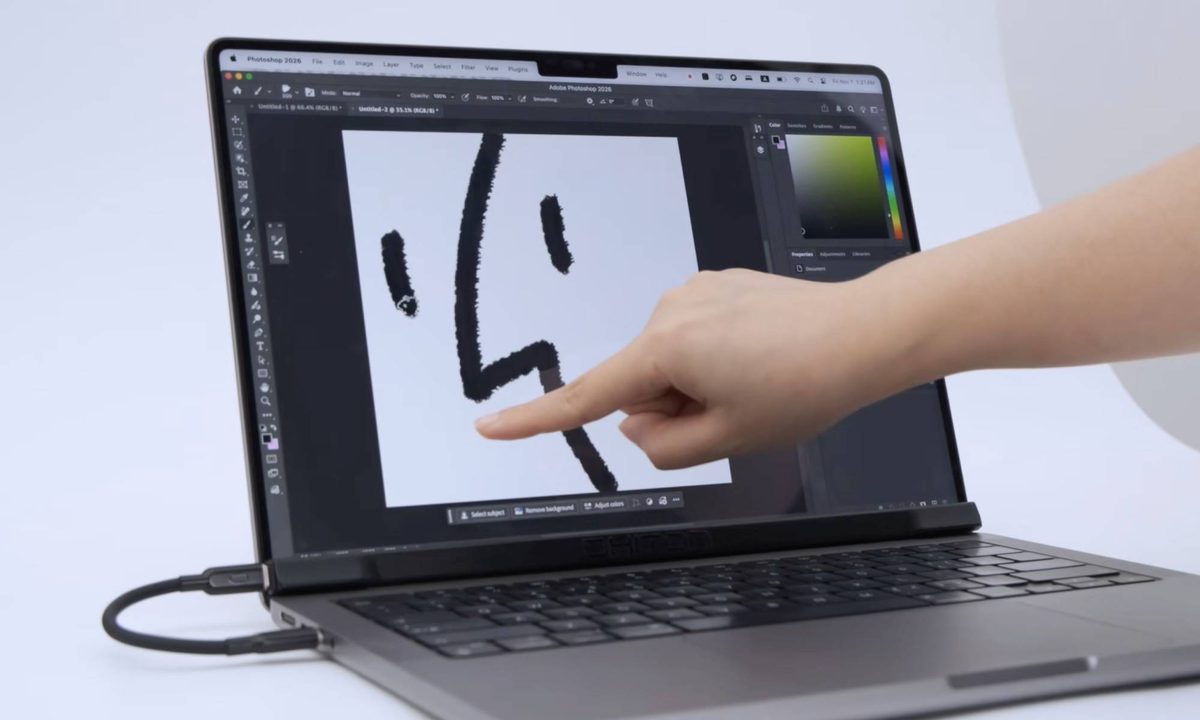
Apple’s OLED MacBook Pro seems to be one step closer to hitting store shelves. According to a Korean blog post, production of OLED panels for the purported MacBook models has already begun, by none other than Samsung.
What’s even more interesting is that the display manufacturing process is said to be running ahead of schedule (initially planned for the second quarter of this year). If that’s true, Apple has already finalized the display technology, size, and other specifications, right on time for the rumored 2026 launch.

The manufacturing breakthrough behind Apple’s OLED Macs
The blog post mentions that Samsung’s display division has begun “mass production of the 8.6th-generation OLED panels” at the advanced production line in Asan, South Korea. The assembly line uses larger glass substrates (compared to those used for smartphone OLEDs), allowing Samsung to cut multiple laptop-sized panels from a single sheet.
This would help the company improve manufacturing efficiency, production yields, and lower overall costs, all of which are critical factors for a company manufacturing OLED laptop panels. Using the new fabrication technique, the assembly line will make advanced tandem OLED laptops panels (with support for touch input).
We’ve already seen the technology on Apple’s latest-generation iPad Pro models. It features two layers of OLED panels stacked on top of one another, resulting in higher peak brightness (especially when compared to single-stack OLED panels) and lower power consumption. Further, having two panels instead of one also increases the screen’s lifespan.

The tipster also mentions that “the first delivery in this line will be for the new Apple MacBook Pro,” implying that Apple has negotiated with Samsung to supply panel units for its OLED MacBooks first. However, it also means the panels could show up on other laptops as well (probably after the company has fulfilled its initial commitment to Apple).
If you’ve been waiting for an OLED MacBook Pro, you should be able to get your hands on one by the end of this year. Given that the company is rumored to launch the M5 Pro and M5 Max MacBook Pro models by the end of January, the next MacBook Pro, featuring the OLED touchscreen, should likely be based on an M6 chip.