
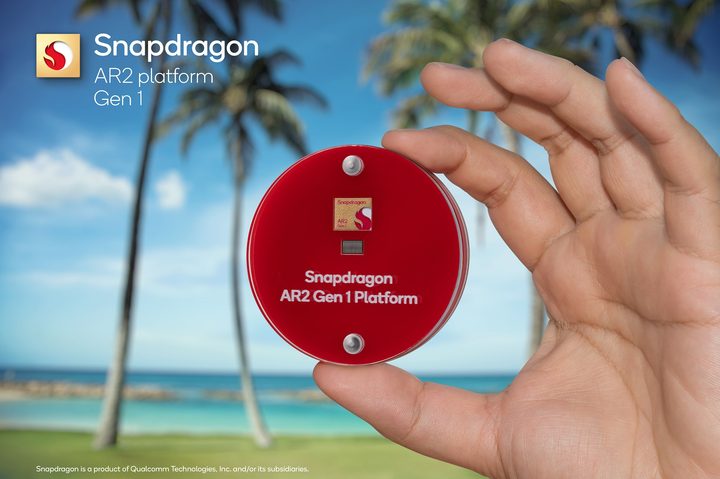
Qualcomm just announced a new chipset, the Snapdragon AR2 Gen 1, reaching a major milestone in AR glasses development. What sets the Snapdragon AR2 Gen 1 apart from earlier chips that have been used for augmented reality devices, is that this processor is specifically designed for thin and lightweight AR glasses.
The Snapdragon AR2 Gen 1 takes a different approach than that used in early systems, sharing tasks across three chips which solves multiple problems that have been limiting the functionality of AR glasses.
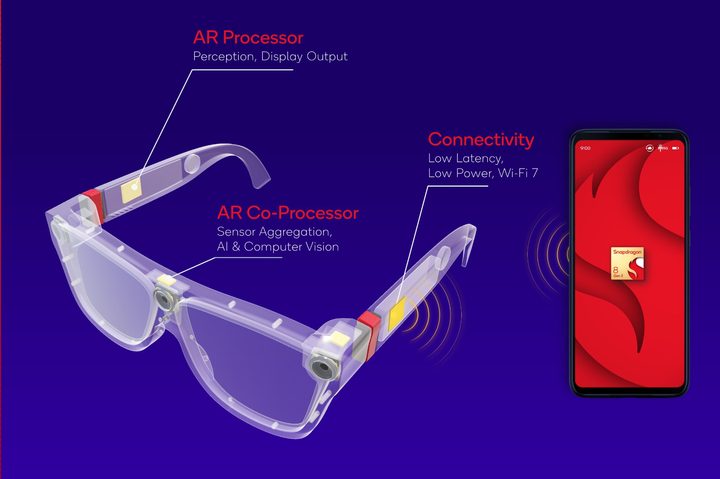
The AR2 Gen 1 consists of a chipset with a processor, co-processor, and connectivity chip that can also interact with a smartphone chip for additional processing power. To allow for a higher performance design with a bigger thermal envelope, the chips are distributed around the AR glasses, one on each earpiece and one in the nose bridge.
The Qualcomm Snapdragon AR2 Gen 1 is made using a 4nm manufacturing process for higher speed, lower latency, and much lower power requirements. This new design is twice as efficient as the XR2 chip that powers most standalone VR headsets while having twice the performance in AR-specific tasks. It also supports Wi-Fi 7 using FastConnect 7800 which should provide good bandwidth for pairing AR glasses with a smartphone powered by a Snapdragon 8 Gen 2 processor for extra performance.
Qualcomm shared a reference design of AR glasses showing that the distribution of these chips greatly simplifies wiring. This has been a big design issue with AR glasses that feature multiple tracking cameras and imaging cameras, used for identifying planes, recognizing objects, and responding to hand-gesture commands. Qualcomm’s reference design reduced wires by 45% and cut the size of the circuit board that fits in the earpiece by 40%.
Manufacturing AR glasses is a much greater challenge than VR headsets since the size and weight constraints are much tighter while the device has to handle more processing. Computer-generated graphic overlays must be rapidly scaled and oriented to appear to fit within your real-world environment with a high enough fidelity to be useful and appealing. Voice and hand gestures must be recognized for user input also, and rapid response is necessary to make the use of AR glasses worthwhile.
Qualcomm’s Snapdragon AR2 Gen 1 might be the missing ingredient to make all of this possible in the near future. The company is anticipating AR glasses that can operate as standalone devices to arrive as early as the second half of 2023 powered by the Snapdragon AR2 Gen 1. The exact launch dates for these next-generation AR glasses are not known but Qualcomm shared that 12 manufacturers are already working on AR devices powered by the Snapdragon AR2 Gen 1, including Lenovo, LG, Nreal, OPPO, Pico, Qonoq, Rokid, Sharp, TCL, Tencent, Vuzix, and Xiaomi.


