  1. Home
  2. Computing
  3. News

Digital Trends may earn a commission when you buy through links on our site. Why trust us?

AR glasses will have a dedicated Qualcomm chip in 2023

Add as a preferred source on Google

Qualcomm just announced a new chipset, the Snapdragon AR2 Gen 1, reaching a major milestone in AR glasses development. What sets the Snapdragon AR2 Gen 1 apart from earlier chips that have been used for augmented reality devices, is that this processor is specifically designed for thin and lightweight AR glasses.

The Snapdragon AR2 Gen 1 takes a different approach than that used in early systems, sharing tasks across three chips which solves multiple problems that have been limiting the functionality of AR glasses.
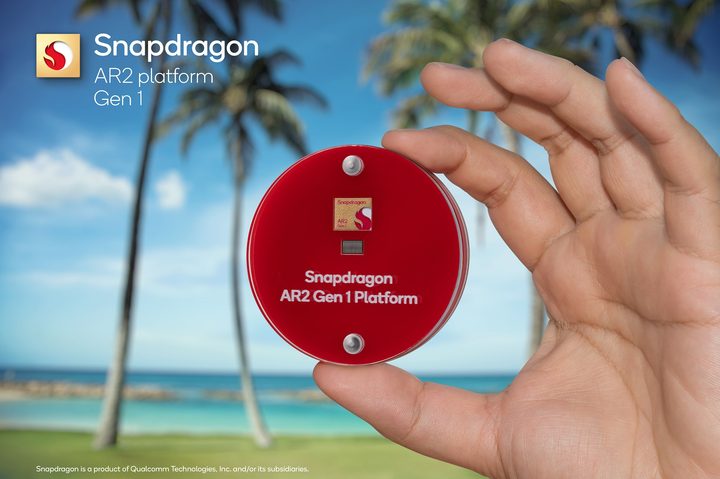
A Qualcomm Snapdragon AR2 Gen 1 chip case is held in hand.
Image used with permission by copyright holder

The AR2 Gen 1 consists of a chipset with a processor, co-processor, and connectivity chip that can also interact with a smartphone chip for additional processing power. To allow for a higher performance design with a bigger thermal envelope, the chips are distributed around the AR glasses, one on each earpiece and one in the nose bridge.

Recommended Videos

The Qualcomm Snapdragon AR2 Gen 1 is made using a 4nm manufacturing process for higher speed, lower latency, and much lower power requirements. This new design is twice as efficient as the XR2 chip that powers most standalone VR headsets while having twice the performance in AR-specific tasks. It also supports Wi-Fi 7 using FastConnect 7800 which should provide good bandwidth for pairing AR glasses with a smartphone powered by a Snapdragon 8 Gen 2 processor for extra performance.

Qualcomm shared a reference design of AR glasses showing that the distribution of these chips greatly simplifies wiring. This has been a big design issue with AR glasses that feature multiple tracking cameras and imaging cameras, used for identifying planes, recognizing objects, and responding to hand-gesture commands. Qualcomm’s reference design reduced wires by 45% and cut the size of the circuit board that fits in the earpiece by 40%.
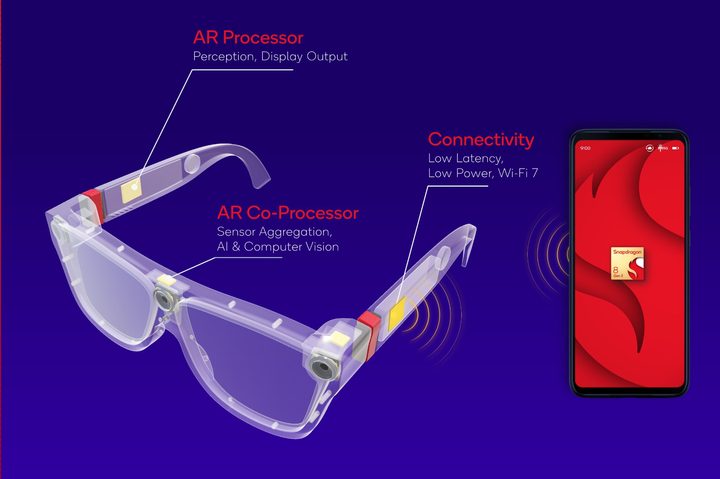
Qualcomm Snapdragon AR2 Gen 1 AR glasses reference design shows distributed chip placement.
Image used with permission by copyright holder

Manufacturing AR glasses is a much greater challenge than VR headsets since the size and weight constraints are much tighter while the device has to handle more processing. Computer-generated graphic overlays must be rapidly scaled and oriented to appear to fit within your real-world environment with a high enough fidelity to be useful and appealing. Voice and hand gestures must be recognized for user input also, and rapid response is necessary to make the use of AR glasses worthwhile.

Qualcomm’s Snapdragon AR2 Gen 1 might be the missing ingredient to make all of this possible in the near future. The company is anticipating AR glasses that can operate as standalone devices to arrive as early as the second half of 2023 powered by the Snapdragon AR2 Gen 1. The exact launch dates for these next-generation AR glasses are not known but Qualcomm shared that 12 manufacturers are already working on AR devices powered by the Snapdragon AR2 Gen 1, including Lenovo, LG, Nreal, OPPO, Pico, Qonoq, Rokid, Sharp, TCL, Tencent, Vuzix, and Xiaomi.

Alan Truly
Alan Truly is a Writer at Digital Trends, covering computers, laptops, hardware, software, and accessories that stand out as…
A Google Pixel laptop might be on its way, but does anyone actually want one?
A new Google laptop might be coming, and I hate to be the bearer of bad news, but the odds are not in its favor.
Google Pixelbook in silver.

It looks like a new member is joining the Pixel family, adding to its resurgent smartphone lineup. Code analysis of the latest Android beta points toward a new Pixel laptop that Google might be planning to launch in the near future. Google last launched a laptop, the Pixelbook Go, in 2019, an affordable version of the Pixelbook it put on the shelves back in 2017.

Both the Pixelbook and Pixelbook Go, along with the earlier Chromebook Pixel models, were not what you would call a smash hit with the audience or a runaway commercial success. Ultimately, they triggered Big G's departure from the laptop segment and a shift in focus toward Pixel smartphones.

Read more
AI is entering the Skynet debate moment in the social media hype circles
AI might end the world - but first, it’ll trend on social media
Representative Image

A growing wave of online voices warning about the dangers of artificial intelligence—often dubbed “AI doom influencers” - is reshaping how the public and policymakers view the technology. According to a report by The Washington Post, these influencers, including researchers, tech leaders, and content creators, are increasingly highlighting worst-case scenarios, from mass job loss to existential risks posed by advanced AI systems.

While critics argue that some of this messaging borders on alarmism, the conversation is no longer confined to speculation. Real-world developments in AI are beginning to mirror some of the concerns being raised, blurring the line between hype and legitimate risk.

Read more
You won’t believe it, but Motorola actually makes a terrific head-turner of a laptop
Motorola’s Moto Book 60 Pro is surprisingly stylish, and the pricing makes it even better
Moto Book 60 Pro in PANTONE Bronze Green

Motorola is not the name I expect to see on a genuinely good laptop. A stylish phone? Sure. A foldable with some personality? Absolutely. But a thin-and-light notebook that actually feels well judged on both design and value was a genuine surprise. And yet, the Moto Book 60 Pro is one of the more quietly impressive laptops in its segment.

With the broader laptop market being in a mess, Motorola's laptops feel refreshing. It is capable, attractive, and still approachable at a time when pricing elsewhere has become increasingly rough.

Read more