
“Why you can trust Digital Trends – We have a 20-year history of testing, reviewing, and rating products, services and apps to help you make a sound buying decision. Find out more about how we test and score products.“
External GPUs have ambition. Plug it in with a single cord, and you’ll transform your laptop into a top-tier gaming rig. In theory.
Razer has made these enclosures for years now, but its newest entry blends the best of its previous attempts into one sleek package. The Core X Chroma has the larger size and wattage capability of the X model, but reintroduces RGB lighting and USB ports. Taking the place of the Core V2, this new external GPU is the best of the breed.
Light it up
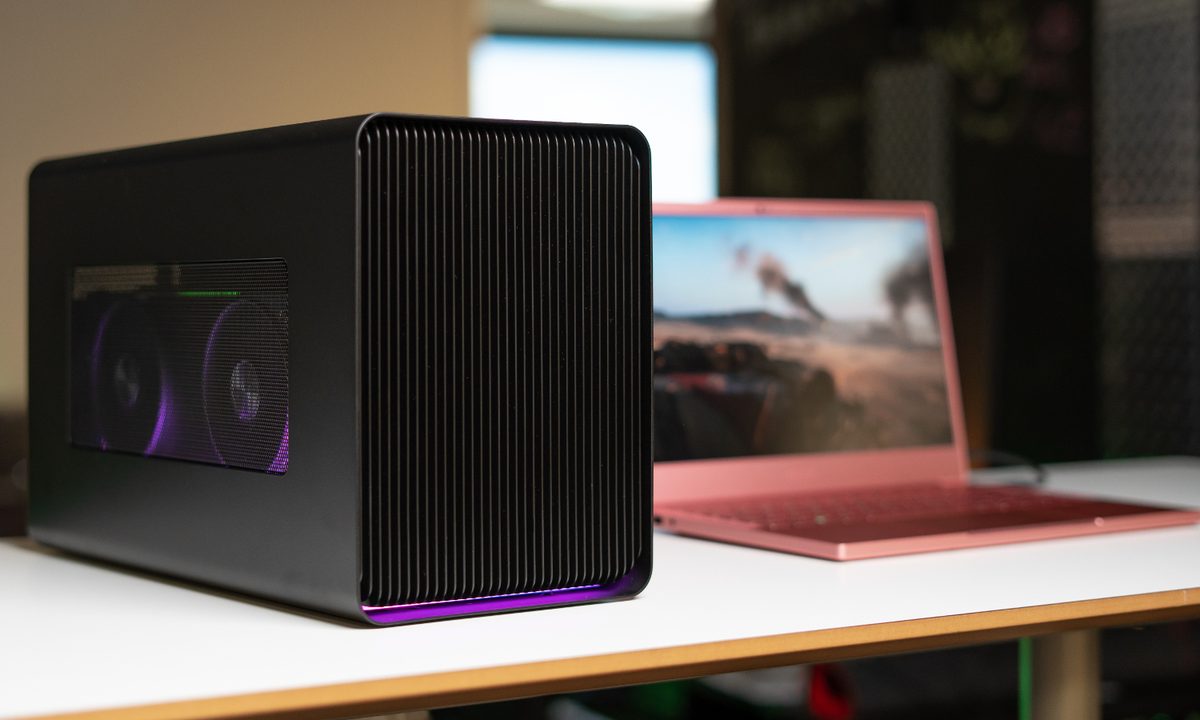
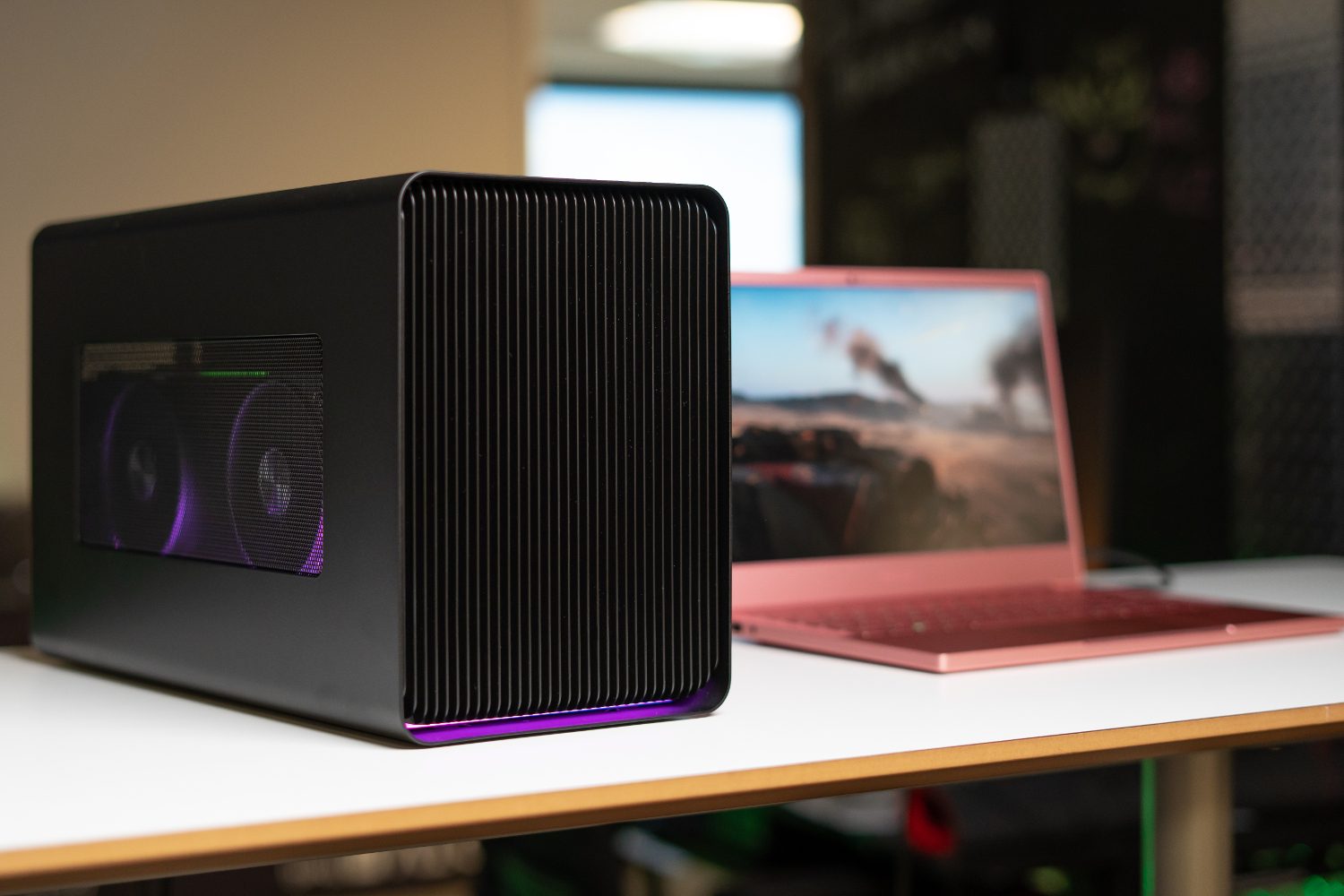
The Razer Core X Chroma looks identical to the previous Core X. Its black, machined aluminum and sturdy panels are designed with a fit and finish befitting Razer laptops.
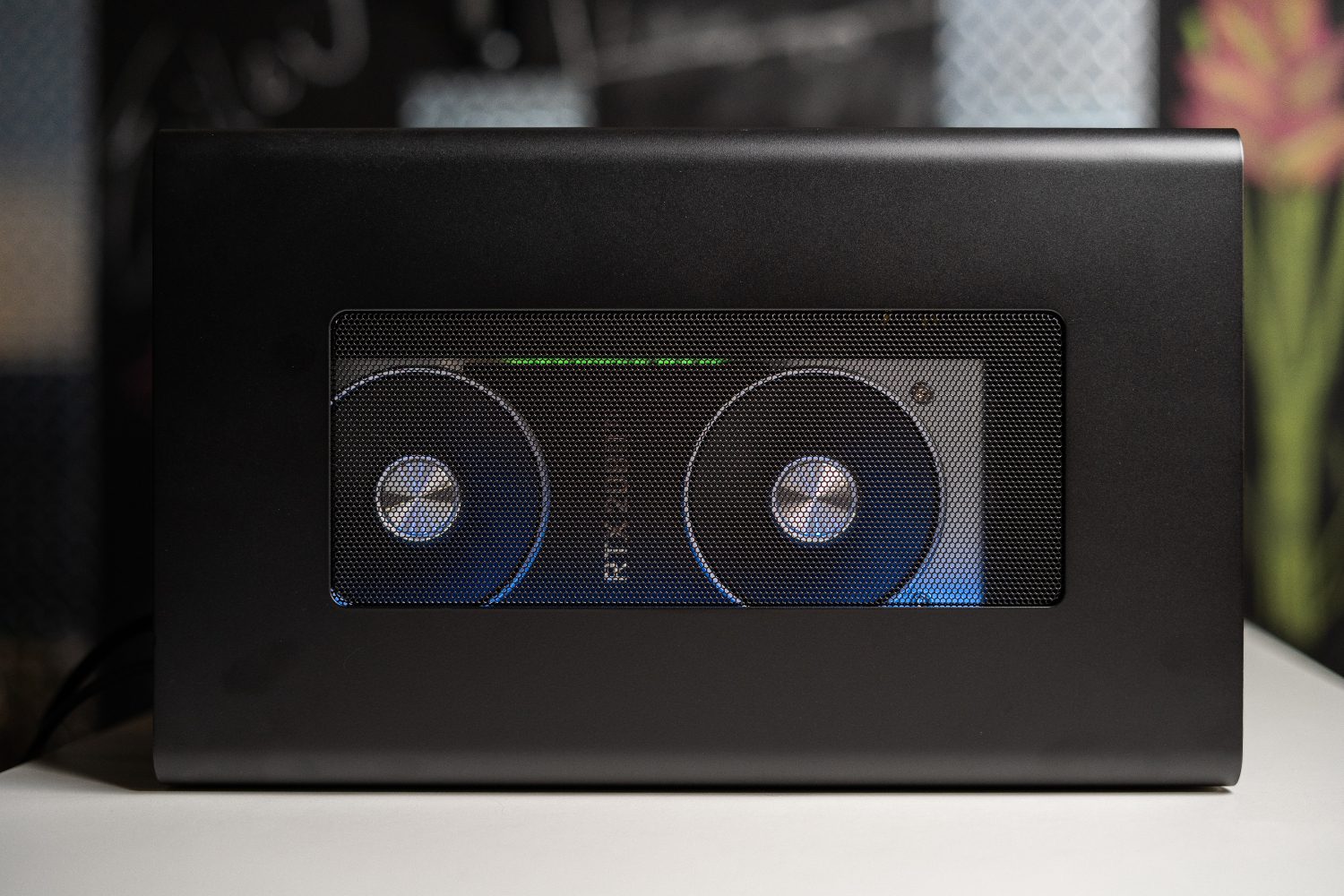
It’s the same size, as well. About a foot long and a half a foot tall, it’s not unlike a small desktop tower sitting flat on your desk. Last year’s Core V2 was considerably smaller, but the Core X has a slightly larger 400-watt power supply, opposite the stock 120mm fan. The tray still easily slides out using the handle on the back. From there you have easy access to the PCIe slot. It’s a smart, simple design — as long as you don’t mistake the latch as a handle and accidentally lift it right out of the enclosure.
A Razer product without RGB just never felt quite right, but that’s been rectified. You’ll find Chroma lights, meaning they can be customized and programmed with Razer’s Synapse software. It’s the same lighting we saw on the Razer Core V2, and really shows of your GPU. Some light leaks under the bottom of the front panel, providing a nice, subtle, simple glow.

RGB lights might be the headline feature, but the more important update to the Core X Chroma is the extra USB ports on the back. Along the Thunderbolt 3 port used for connecting to your system, there are now two USB-A 3.2 ports, as well as HDMI and an additional USB-C. This matches what you get on the Core V2 and is a big step up over the original Core X, which only has a USB-C port.
These ports turn the Core X into a USB hub. You can have your monitor, mouse, keyboard, and external SSD all plugged into the Core X. You’re just one Thunderbolt 3 port away from accessing all these peripherals. It makes for a clean desk setup, and connecting is wonderfully simple.
But how does it perform?
The Razer Core X — and all external GPUs — face hurdles in performance. You can’t expect the same power you’d get from your RTX 2080 Ti when it’s plugged directly into a motherboard. There’s a significant percentage drop in performance, which should always be accounted for when considering an external GPU.
We tested the Core X Chroma in a couple of different scenarios. First, we slotted in an RTX 2080 Ti and hooked it up to a Razer Blade 15 gaming laptop. In that scenario, we saw a 31% decrease in performance compared to a desktop setup, both in 3DMark benchmarks and in gameplay. You can expect a similar drop no matter what card you choose. Games like World of Warcraft or Civilization VI, which tax the CPU a bit more than the GPU, see that difference cut down a bit.
In the case of our RTX 2080 Ti, the performance in the Core X Chroma was more comparable to an RTX 2080 Max-Q mobile card, though it depends on the game or benchmark. It’s 27% better in 3DMark’s TimeSpy benchmark than an RTX-powered laptop, while it’s actually beaten slightly by that same laptop in the older Fire Strike benchmark.
We also tried the Core X Chroma with a much smaller laptop, the Razer Blade Stealth. It turned a system that could barely get by in Fortnite into a monster gaming rig. The Stealth saw a 8% decrease in performance behind the Razer Blade, most notably because of the slower U-series processor. Even so, we dropped into Battlefield V and easily pushed 80 FPS (frames per second) on Ultra detail at 4K resolution.
None of this is any different than previous versions of the Core, though. The basic technology hasn’t changed. Still, playing Battlefield V in 4K on a tiny laptop feels amazing. Any laptop with a Thunderbolt 3 port will work, as will just about any graphics card you might have laying around, including brand new RTX 20-series cards or AMD’s Radeon VII.
One thing Razer did improve was stability. Plug-and-play was one of the big innovations of Thunderbolt 3 and the first crop of external GPUs. Since then, it’s only improved. The second I plugged in the USB-C, the fans whirled up, the RGB lights began to glow, and Windows 10 instantly recognized the card. After downloading some drivers and doing a quick restart, everything felt smooth. I could unplug and reconnect the Core X at will.
Proceed with caution
You’ll pay $400 for the Razer Core X Chroma, while the standard Core X is $300. That’s more expensive than a lot of options, especially those that include a graphics card inside. The Gigabyte Aorus Gaming Box, for example, includes a powerful RTX 2070 inside for just $649, while the Blackmagic eGPU is $699 and includes a weaker Radeon Pro 580.
The Razer Core X Chroma doesn’t fix any of the inherent issues with external graphics cards. They tack on an extra premium that makes the value slide compared to a traditional desktop gaming rig. The expense of modern GPUs only makes that premium more painful. The Core X Chroma’s $400 price is on top of a video card that’s going to set you back $300, $600, perhaps even $1,200 — if you opt for Nvidia’s RTX 2080 Ti.
What do you get for the premium? A dream. PC gamers have long wanted a do-it-all solution that combines excellent portability with desktop-like power. The Core X Chroma, and its siblings, finally deliver that, especially if you ever already got a Thunderbolt 3-powered laptop. You’ll feel a tingle of awe when you plug in your XPS 13 and play Battlefield V at 4K. It’s pure magic.


