
Space Exploration Holdings (aka SpaceX) filed an application with the Federal Communications Commission on Tuesday to launch a satellite system that would provide gigabit Wi-Fi internet across the globe. These satellites will be non-geostationary, meaning they will have different orbital velocities than the earth. They will also broadcast internet connections to fixed receivers on the ground through the Ku and Ka frequency bands.
If you’re not familiar with Ku and Ka, they are a portion of the electromagnetic spectrum in the microwave range of frequencies. Ku consists of the 12GHz to 18GHz portion while Ka is the 26.5Ghz to 40GHz portion. Ka resides directly above the main K band whereas Ku resides directly underneath the K band. Both are typically used by communications satellites.
The application was published by the FCC on Thursday, and reveals that SpaceX intends to launch a massive fleet consisting of 4,425 satellites, and that’s not including the in-orbit spares that will be used when primary satellites fail. Overall, the fleet will be operating on 83 orbital planes at altitudes ranging from 690 miles to 823 miles above Earth.
More specifically, the application shows that SpaceX plans to make an initial deployment of 1,600 satellites first, which will be divided up into 50 satellites per orbital plane, with a total of 32 planes in use at an altitude of 714 miles. After that, SpaceX will deploy 2,825 satellites across 32 planes at 670 miles up (50 per plane), eight planes at 702 miles (50 per plane), five planes at 792 miles (75 per plane), and six planes at 823 miles (75 per plane).
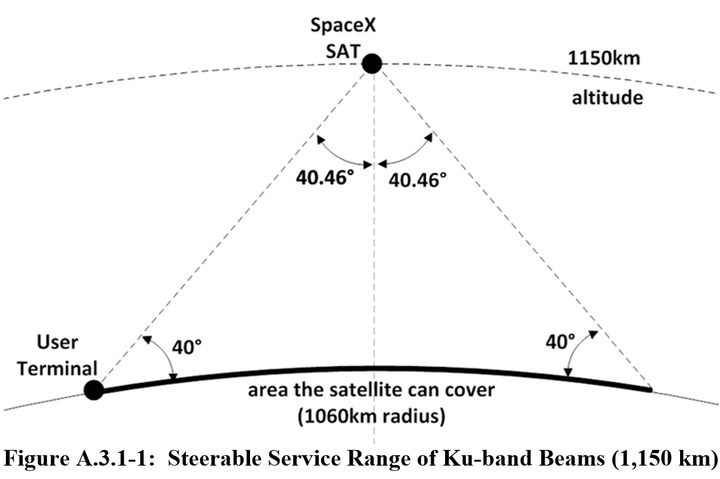
While this constellation of satellites has the potential of providing the entire planet with gigabit Wi-Fi, the Fixed Satellite Service proposed by SpaceX would at first only be provided in the United States, Puerto Rico, and the U.S. Virgin Islands. However, the system can provide service to all locations 70 degrees north and 55 degrees south for at least 75 percent of a 24-hour period.
“Once fully deployed, the SpaceX System will pass over virtually all parts of the Earth’s surface and therefore, in principle, have the ability to provide ubiquitous global service,” the company states in its application (PDF). “Because of the combination of orbital planes used in the SpaceX System, including the use of near-polar orbits, every point on the Earth’s surface will see, at all times, a SpaceX satellite at an elevation no less than 40 degrees, with increasing minimum elevation angles at lower latitude.”
On a whole, the size of the SpaceX satellite constellation is insane. Right now, there are 1,419 active satellites orbiting Earth, 576 of which stem from the United States alone (286 commercial, 132 government, 146 military). Even more, there are around 2,600 satellites floating in space that no longer work, trashing up Earth’s front yard. Add those two numbers together, and the SpaceX fleet is insanely huge given it’s to be deployed by a single company.
The plan is that the broadband service provided by these satellites will actually launch once SpaceX uploads the first 800 units into orbit. Again, their reach will cover the United States, Hawaii, Puerto Rico, the Virgin Islands, and part of Alaska. When that will be is anybody’s guess right now, as the application needs to be approved, the satellites built and launched, the receiving bases built, and a service established.


