
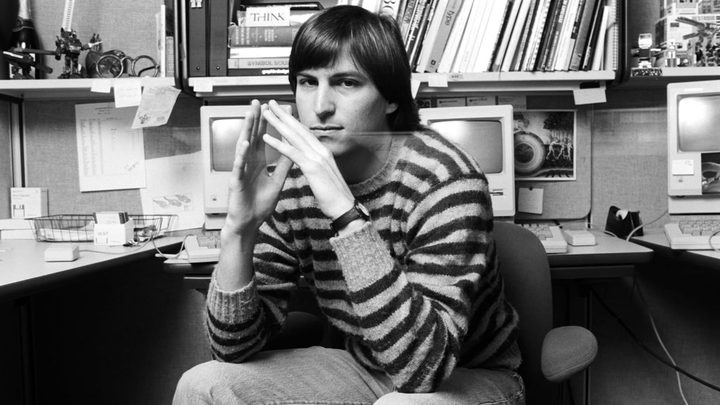
The generative AI revolution began long before ChatGPT made its debut in November 2022. Computer Science researchers and sci-fi authors alike have been imagining the potential of thinking, feeling computers from the days of pulling literal bugs out of mainframes. Visionary Apple co-founder Steve Jobs was just as enamored with that ideal, as he describes in this 1985 video recording, almost 40 years ago.
When Steve Jobs could predict Generative AI few decades forward ! #GodLevel pic.twitter.com/5kUNn18R5L
— Vijay Shekhar Sharma (@vijayshekhar) September 16, 2023
In the clip above, which has been resurfaced on X (formerly Twitter), Jobs first reveals his minor jealousy toward Alexander the Great for having the legendary philosopher Aristotle for a tutor. “I think I would have enjoyed that a great deal,” he quipped, but, “through the miracle of the printed page, I can at least read what Aristotle wrote without an intermediary.” But even with access to Aristotle’s writings, Jobs noted that he couldn’t actually ask any questions of the philosopher — and expect a reply.
“My hope is that, in our lifetimes,” Jobs continued, “we can make a tool of a new kind, an interactive client… When the next Aristotle is alive, we can capture the underlying world view of that Aristotle in a computer. And someday a student will be able to not only read the words Aristotle wrote but ask Aristotle a question. And get an answer.”
Unfortunately, Steve Jobs lost his fight against Pancreatic cancer in 2011, a decade before the debut of ChatGPT. However, the company that he created is continuing his vision for interactive computing, and plans to launch its Apple Intelligence service later this summer, coinciding with the release of iOS 18, iPadOS 18, and MacOS Sierra.
“This is a moment we’ve been working towards for a long time,” Senior Vice President of Software Engineering Craig Federighi said at WWDC 2024. “Apple Intelligence is the personal intelligence system that puts powerful generative models right at the core of your iPhone, iPad, and Mac. It draws on your personal context to give you intelligence.”
The generalized AI agent will enable users to streamline any number of daily tasks, from helping to write, edit, and refine text across Mail, Notes, Safari, and Pages to quickly spin up AI-generated images. It will reportedly also be able to summarize the contents of rambling email chains and find photos of specific groups and individuals within the camera roll using written prompts, among a host of additional functions. Whether some of its more advanced features will be hidden behind paywalls remains to be seen.


