  1. Home
  2. Computing
  3. Legacy Archives

UK regulator finds average broadband half advertised speeds

Add as a preferred source on Google
Image used with permission by copyright holder

Many a broadband customer has been excited to pay extra money and upgrade their service to new high-bandwidth technologies that promise they’ll be able to download movies and music in just seconds. However, a nearly equal number of broadband customers have also been dismayed when, once everything is hooked up, they rarely seem to get anywhere near the amount of bandwidth their ISPs claim to be selling them. Now the UK’s telecommunications regulator, Ofcom, has released research looking at nearly a dozen broadband packages that represent about 90 percent of broadband subscribers in the UK. The results? The average download speed available to broadband users is still less than half the “up to” speeds advertised by most providers.

“It is encouraging that new technologies are being rolled out across the UK and faster speeds are being achieved,” said Ofcom head Ed Richards, in a statement. “However, the research shows that ISPs need to do more to ensure they are giving customers clear and accurate information about the services they provide and the factors that may affect the actual speeds customers will receive.”

Recommended Videos

Ofcom’s research represents the first time the agency has looked at so-called fiber-to-the-cabinet services. Although the study found that fiber- and cable-based services were generally able to offer average download speeds closer to advertised speeds—BT’s fiber service managed 78 percent of advertised speeds, while Virgin’s cable service managed from 90 to 96 percent of advertised speeds—the results were still disheartening, with many services not even found to provide half the bandwidth they claim to be selling. And performance during peak hours (8 to 10pm on weekdays) declined to even lower levels. BT’s Infinity service offered the best upload speeds of the bunch, with average upload speeds of 8 Mbps, “significantly higher” than any other measured service.

Copper-based services like DSL fared even worse, with DSL packages claiming to offer up to 20 Mbps connections averaging just 6.9 Mbps, or 29 percent of the advertised speed, and “very few” (about three percent) of customers achieving speeds even close to advertised bandwidth.
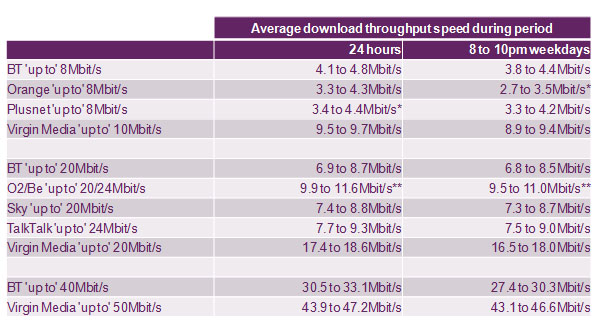
Image used with permission by copyright holder
Geoff Duncan
Former Contributor
Geoff Duncan writes, programs, edits, plays music, and delights in making software misbehave. He's probably the only member…
The maker of ChatGPT wants to make open-source projects less of a security bargain
OpenAI launches Patch the Planet for open-source security, with over 30 open-source projects on board.
openai-chatgpt-os

OpenAI has launched Patch the Planet, a new initiative aimed at fixing one of the internet's quietest problems – the chronically underfunded security of open-source software.

Patch the Planet pairs OpenAI's most security-capable AI models with Trail of Bits, a security firm that has committed its entire research organization to the effort, alongside support from HackerOne and Calif.

Read more
I sifted through the Prime Day chaos to find the best Apple deals actually worth buying
Apple's about to hike prices. Prime Day 2026 is your last chance to save up to $150 on MacBooks, AirPods, and iPads.
Prime Day Deals on Apple Products

Apple is set to increase the prices for its upcoming iPhones and MacBooks, as the company can no longer offset the rising RAM and storage costs. That means, if you are looking to upgrade your aging device, you should buy the current-generation Apple products rather than wait for the new ones.

And since Amazon Prime Day is offering good discounts on the latest iPhones, iPads, MacBooks, and other Apple accessories, this is the perfect time to buy them. Here are my favorite Amazon Prime Day deals for Apple products. 

Read more
This sneaky photo trick gets AI chatbots to ignore their safety rules
Florida International University researchers built a method that nearly doubled the rate of harmful responses from a tested AI model using nothing but pixel-level edits in an image.
JaiLIP AI chatbot exploit image

A photo that looks completely ordinary to you could carry a hidden instruction to trick an AI chatbot into ignoring its safety rules, according to new research out of Florida International University. The study found that pixel-level alterations in an image that are invisible to the human eye can be enough to confuse the model reading the image and lead it to generate responses it would normally block.

Hacking what the AI sees

Read more