
  1. Home
  2. Computing
  3. News

You can now send emails directly from ChatGPT on the web

You can now draft, edit, and send emails directly inside ChatGPT on the web

Add as a preferred source on Google
Person using ChatGPT on a MacBook.
Unsplash

If you have ever drafted an email in ChatGPT and then had to copy it across to Gmail or Outlook to actually send it, you can now skip that extra step.

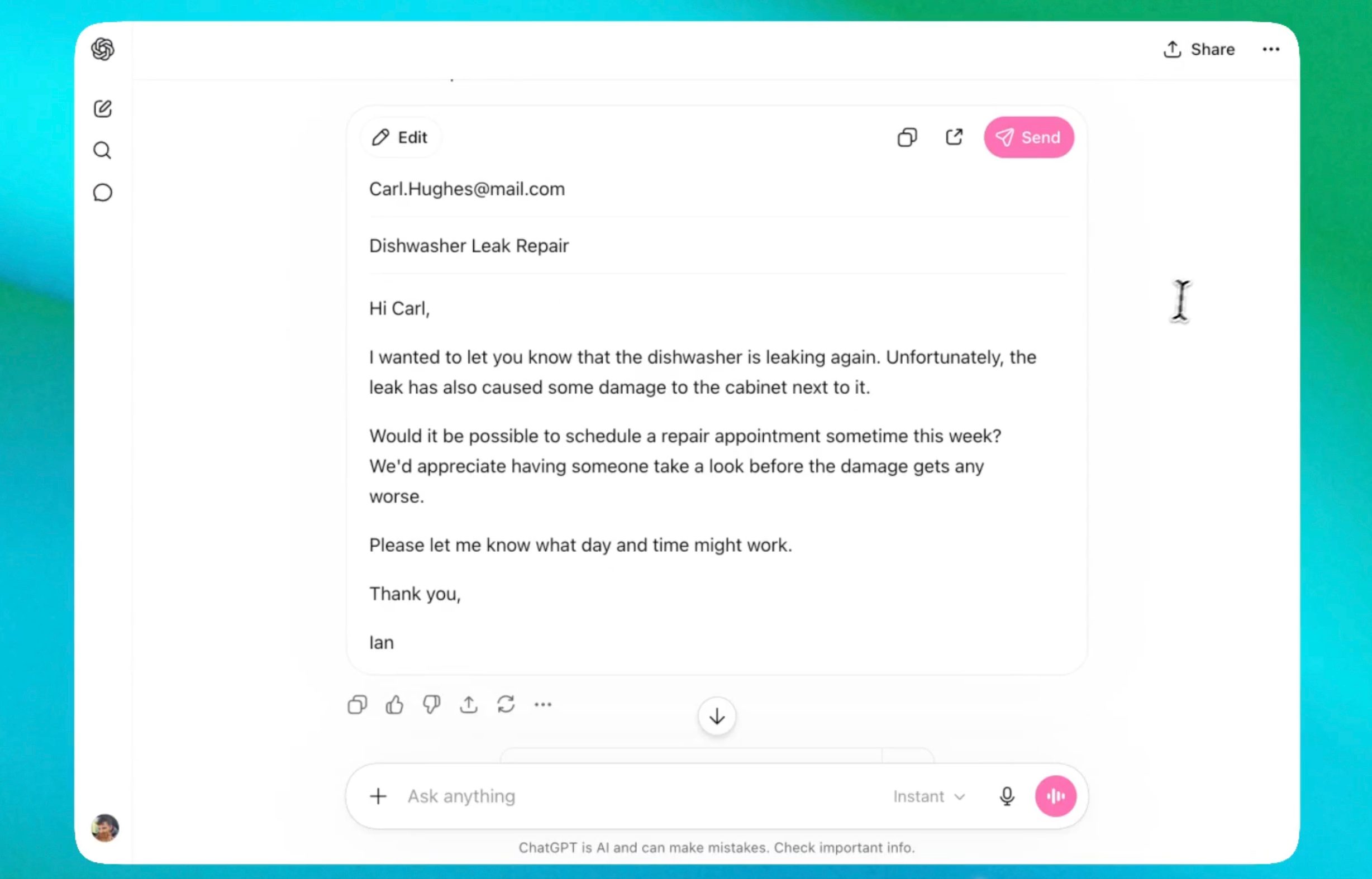
OpenAI has rolled out the ability to send emails directly from writing blocks in ChatGPT on the web, keeping the whole process inside a single conversation from start to finish.

Draft it. Tweak it. Send it.

You can now send emails directly from writing blocks in ChatGPT on the web, without leaving the conversation. pic.twitter.com/GoQtlSFGFG

— ChatGPT (@ChatGPTapp) June 5, 2026

ChatGPT writing blocks now let you send emails

Writing blocks are a formatting feature that ChatGPT introduced late last year. When you ask ChatGPT to draft an email, instead of returning a plain chat response, it presents your email in a clean, separate block that looks and feels closer to a real email editor.
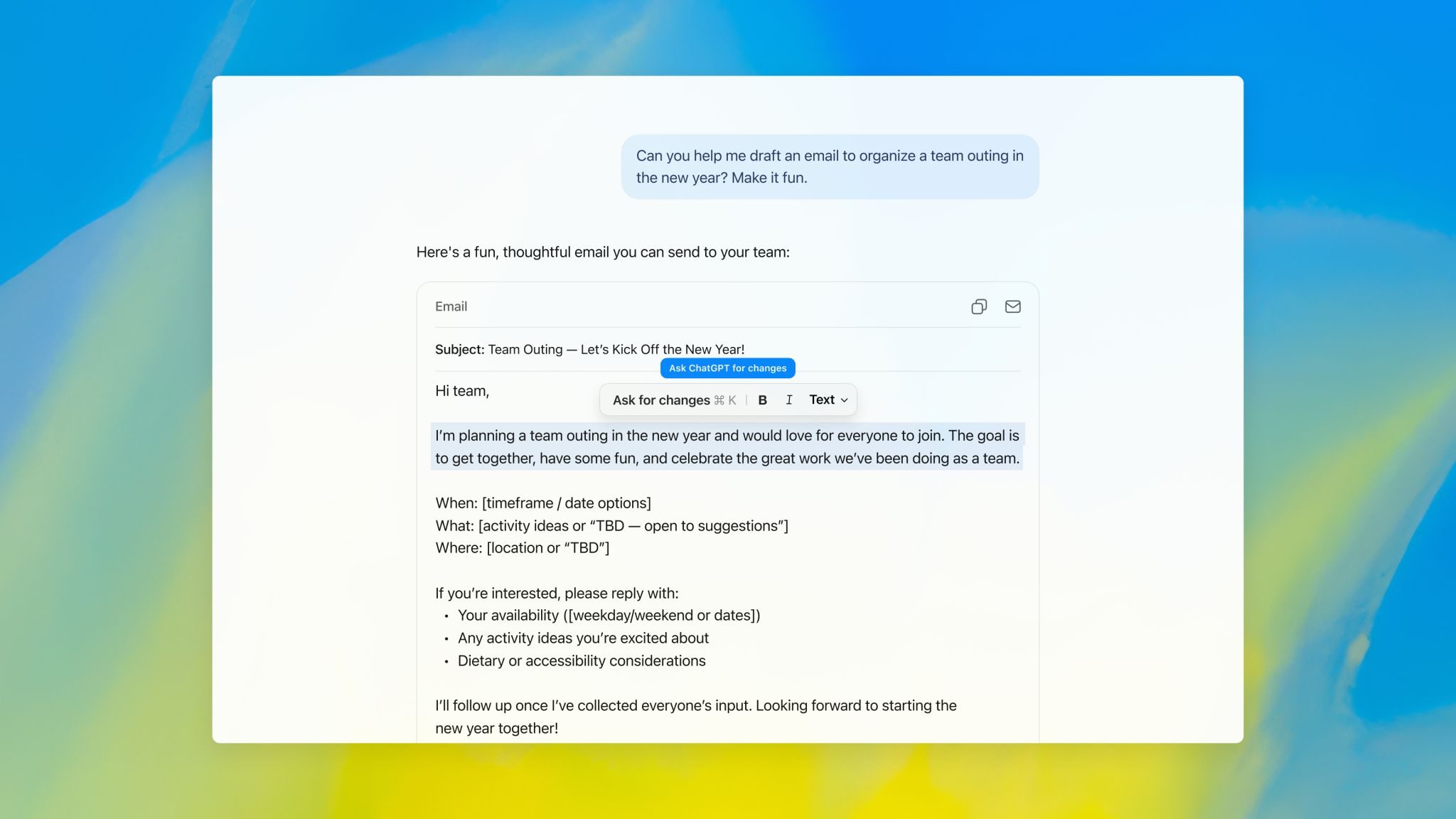
You can highlight any line and ask for changes, accept or reject suggestions one by one, and edit text directly inside the block without copying anything elsewhere. The latest update takes that one step further by letting you hit send without ever leaving the chat.

Is it safe to send emails through ChatGPT?
Before you go all in on sending emails through ChatGPT, there is one thing to keep in mind. A recent lawsuit filed in California claims OpenAI shared user prompts, chat queries, and identifying information with Google and Meta tracking tools without proper consent. The case alleges that it violated California privacy law and federal wiretap rules. So maybe hold off on drafting anything too sensitive in there.

What else is ChatGPT up to lately?

That said, OpenAI is not slowing down on new features. ChatGPT is getting smarter at remembering things about you by learning from your chat history over time and retaining that information so your conversations feel more personalized.

Recommended Videos

On the productivity side, ChatGPT for Excel and Google Sheets has officially moved out of beta and is now available globally, letting you build workbooks, clean data, and write formulas in plain language without needing to be a spreadsheet expert.


Manisha Priyadarshini
Manisha Priyadarshini is a tech and entertainment writer with over nine years of editorial experience.
Claude’s Sonnet 5 is built to do more on its own and cost you less
Better than its predecessor, nearly as good as the flagship, and meaningfully cheaper than both.
Art, Floral Design, Graphics

Every major AI lab is racing to prove its models can work autonomously with minimal hand-holding; we’re now seeing pricing emerge as the next battleground. 

Anthropic just fired its latest shot, Claude Sonnet 5, a model the company says performs nearly as well as its flagship Opus 4.8 at a fraction of the cost.

Read more
Apple Creator Studio adds AI tools across Final Cut Pro, Logic Pro and Pixelmator Pro
Final Cut Pro gets AI captions, Auto Mask and better Pixelmator Pro workflows in Creator Studio update
Computer Hardware, Electronics, Hardware

Apple has introduced a major update to Apple Creator Studio, adding new AI features, deeper Pixelmator Pro integration, and workflow upgrades across Final Cut Pro, Logic Pro, Keynote, Pages, Numbers, Motion, Compressor, Freeform, and Final Cut Camera.

The update makes Creator Studio more useful across Mac, iPad, and iPhone, especially for people who move between video editing, image editing, presentations, documents, spreadsheets, and music production.

Read more
AI browsers like Perplexity Comet can be tricked into spilling your password through BioShocking exploit
Six AI browsers were found leaking saved passwords and many of them haven't fixed it yet.
MacBook Air in hand, Comet browser loaded—let’s see what Perplexity’s AI can really do

Security researchers just found a strange way to trick AI browsers into handing over your passwords. They managed to trick AI browser agents into exposing sensitive data like saved passwords, session cookies, and private tokens by disguising the theft as part of a harmless "game."

The technique is called BioShocking, named after the popular video game BioShock, where a brainwashed character is manipulated into believing a false reality. Once an AI browser falls for the same trick, it stops following its own safety rules entirely.

Read more