  1. Home
  2. Emerging Tech
  3. News

Alphabet’s Wing drones now have FAA approval to deliver packages in the U.S.

Add as a preferred source on Google
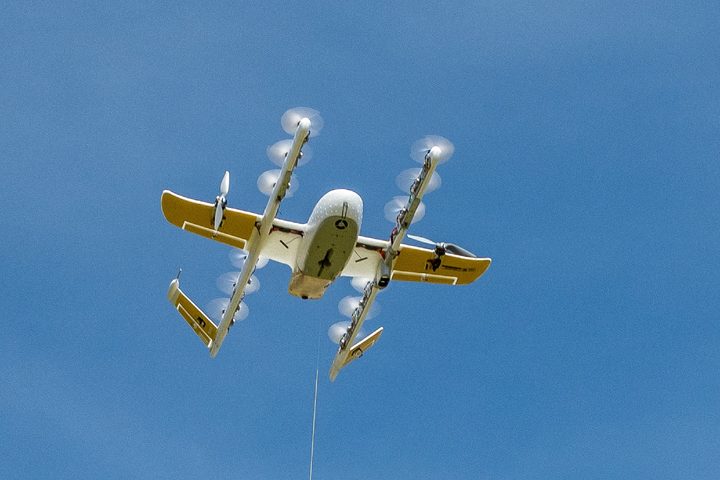
Image used with permission by copyright holder

Alphabet Wing, the drone delivery startup owned by Google’s parent company, announced that it has become the first company to receive Air Carrier Certification from the United States Federal Aviation Administration (FAA). This lets Wing begin commercial deliveries from local businesses to homes in the U.S. — including the crucial ability to fly over civilians and beyond the visible line of sight of drone operators.

Operations will start “over the coming weeks” in the Blacksburg and Christiansburg areas of Virginia, where Wing will run a commercial delivery pilot as part of the Integrated Pilot Program (IPP) later in 2019. This means that the U.S. will officially join Canberra, Australia, where Wing already operates a commercial air delivery service. It is also poised to start trials in Europe, delivering to homes in Helsinki, Finland.

Recommended Videos

“This is a significant first step in a process that will ultimately allow Wing to build a business that uses delivery drones to transport important items to be people when they need them the most, more quickly, safely and conveniently, and with a low carbon footprint,” a spokesperson for Wing told Digital Trends. “The thousands of deliveries we’ve done to the hundreds of testers we’ve been delivering around the world have proven the value of our technology — whether it be delivering pharmacy items to the elderly, or a meal to parents whose children are sick, or a hot coffee to shift workers and others on tight schedules.”

Wing has been working for six years toward its mission of building small, lightweight aircraft, along with a navigation system able to safely deliver small packages on demand. To date, the company’s drones have flown more than 70,000 test flights and made more than 3,000 deliveries to doorsteps, driveways, and backyards of customers in Australia, where the service is currently operational.

Wing’s spokesperson told us that the company has been working with the FAA since April 2017 to establish a safety case, and demonstrate that its aircraft, personnel, operations, and procedures meet the necessary safety standards. Over the coming months, the next step will involve engaging with businesses and community members in Blacksburg and Christiansburg to answer questions, solicit feedback, and showcase the technology.

Hopefully, it won’t be too long after that before similar drone deliveries roll out across the United States.

Luke Dormehl
I'm a UK-based tech writer covering Cool Tech at Digital Trends. I've also written for Fast Company, Wired, the Guardian…
Edge browser on mobile gets a huge upgrade that makes it a worthy pick over Chrome
Edge mobile gets smarter just before Chrome’s big Gemini moment
Microsoft Edge on a phone

Chrome is still the default browser for many smartphone users, but Microsoft’s latest Edge update gives them a practical reason to try something else.

Microsoft has announced a major Copilot update for Edge across desktop and mobile. The rollout comes ahead of Google’s Gemini-powered Chrome upgrade for Android, which is expected in June, giving Edge a chance to stand out on phones before Chrome’s next big AI push.

Read more
After flubbing with Siri, Apple plans to host AI agents on the App Store
One problem is about money Apple won't commit to not charging. The other is about AI agents Apple can't figure out how to control. WWDC needs to solve both.
Electronics, Mobile Phone, Phone

Apple is currently facing a Siri problem that has nothing to do with Siri at all. With WWDC 2026 just weeks away, The Information reports the company is actively courting developers to integrate their apps with the new Siri coming in iOS 27. 

The mechanism powering the overhauled Siri, App Intents, is an API that lets Siri execute actions inside third-party apps without you actively opening them, which sounds quite useful, I’d say. However, some of the world’s largest developers are dragging their feet on it, not because it’s tough, but because Apple left the door open on charging for it later.

Read more
EV batteries just need some AI top-up nudge, and they get a big 23% life boost, finds research
Charging fast and lasting long seemed impossible. A new AI trick says otherwise.
EV Charging

EV battery charging technology has always had to find the right balance between charging speed and battery longevity. If the charging speed is too fast, it wears down the battery. If the charging is too slow, nobody is happy. 

Researchers Meng Yuan from Victoria University of Wellington and Changfu Zou from Chalmers University of Technology in Sweden may have cracked this long-standing problem using an AI technique called deep reinforcement learning, and the results are pretty encouraging.

Read more