  1. Home
  2. Emerging Tech
  3. News

Unexpected particle plumes discovered jetting out of asteroid Bennu

Add as a preferred source on Google

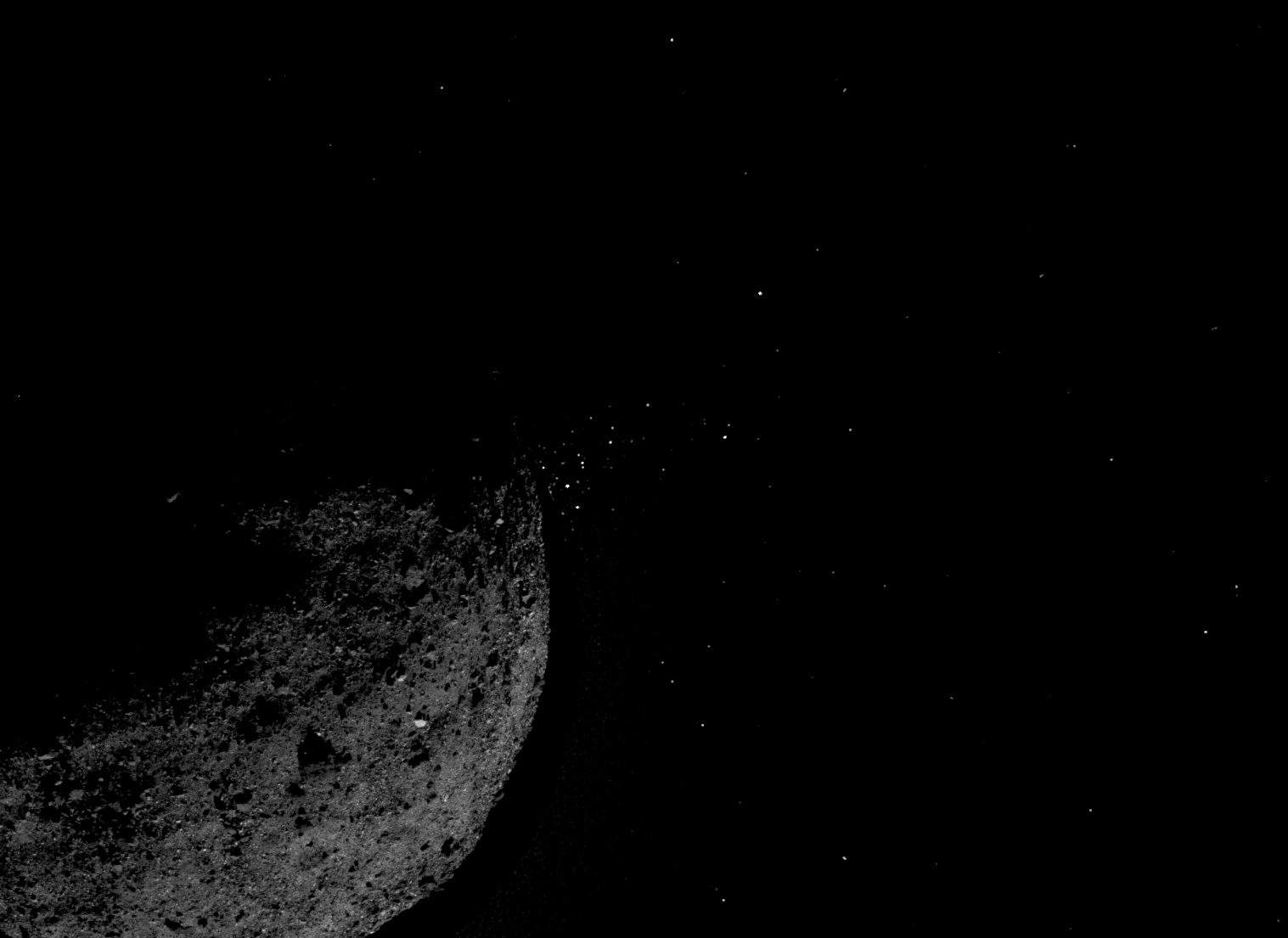
This view of asteroid Bennu ejecting particles from its surface on January 19 was created by combining two images taken on board NASA’s OSIRIS-REx spacecraft. Other image processing techniques were also applied, such as cropping and adjusting the brightness and contrast of each image. NASA/Goddard/University of Arizona/Lockheed Martin

The asteroid Bennu is the target of a NASA mission to collect a sample and return it to Earth, in order to learn about the formation of the early solar system. The OSIRIS-REx craft entered orbit around Bennu on December 31, 2018, and it isn’t scheduled to return until 2023. But the mission is already exhibiting some unexpected findings.

Recommended Videos

The strangest discovery is the plumes of particles which are being energetically ejected from the surface of Bennu. This is the first time that astronomers have observed this kind of activity on an asteroid.

The plumes were spotted on January 6 as the OSIRIS-REx approached the asteroid and captured images from orbit at a distance of one mile (1.6 kilometers). At first the researchers were concerned that the particles could damage the craft so they performed a safety assessment, but to their relief the craft was fine and they could continue their study of Bennu up close.

For the last two months the team has been gathering data on the asteroid and its particle plumes, trying to work out what could be causing them. They saw that while most of the particles were shot out from Bennu and into space, some particles orbited around the asteroid before landing back on its surface.

Bennu had another surprise in store for the researchers: where they had expected to find an asteroid with a smooth surface and a few large boulders, they in fact observed a rough surface densely packed with boulders, requiring a change in OSIRIS-REx’s flight and sample collection plans.

Both of these issues took the research team entirely by surprise, but they are excited by the new findings: “The discovery of plumes is one of the biggest surprises of my scientific career,” Dante Lauretta, OSIRIS-REx principal investigator at the University of Arizona, Tucson, said in a statement. “And the rugged terrain went against all of our predictions. Bennu is already surprising us, and our exciting journey there is just getting started.”

The positive appraisal was echoed by Lori Glaze, acting director of the Planetary Science Division at NASA Headquarters in Washington, who pointed out that unexpected discoveries are the point of scientific exploration: “The first three months of OSIRIS-REx’s up-close investigation of Bennu have reminded us what discovery is all about — surprises, quick thinking, and flexibility,” Glaze said.

“We study asteroids like Bennu to learn about the origin of the solar system. OSIRIS-REx’s sample will help us answer some of the biggest questions about where we come from.”

Georgina Torbet
Georgina has been the space writer at Digital Trends space writer for six years, covering human space exploration, planetary…
DJI’s first 360° drone offers 8K video recording and a freakishly long transmission range
From omnidirectional obstacle sensing to 42 GB of onboard storage, the Avata 360 is DJI doing what DJI does best: raising the bar for everyone else.
DJI Avata 360° drone.

DJI has officially entered the 360° drone arena with the launch of the Avata 360. It’s the company’s first-ever fully immersive FPV drone, and a direct shot at the Antigravity A1, a rival built by an Insta360-incubated brand. Looks like the drone wars just got more interesting. 

What makes the Avata 360 worth looking at?

Read more
I transferred all my chats from other AI apps to Gemini — and it works flawlessly
Google Gemini Graphics Featured

You know that moment when AI assistants like ChatGPT, Gemini, or Claude suddenly lose the plot mid-conversation and start hallucinating like they’re absolutely sure they’re right? Yeah…it’s equal parts funny and painfully annoying. My usual reaction is switching between apps, hoping one of them gets it right. But the real problem is that I have to start over every single time. It feels like I’m stuck in a loop explaining my life story to different AIs, one after the other.

Now with Gemini, I can now jump in from other AI apps without that whole reset conversation. Finally, the Google gods have blessed us. I tried it out expecting the usual hiccups, but it was surprisingly smooth and quick.

Read more
Google expands Search Live globally with voice and camera AI
The feature is now available in 200+ countries with multilingual support
Google Search Live

Google is taking another big step toward turning Search into a full-blown AI assistant. The company has officially expanded Search Live globally, making the feature available in over 200 countries and territories, along with support for dozens of languages.

https://twitter.com/google/status/2037201891130523917

Read more