  1. Home
  2. Emerging Tech
  3. News

Brightest quasar ever seen discovered by Hubble, may be star-producing machine

Add as a preferred source on Google

The brightest quasar even seen in the early Universe has been observed with the Hubble Space Telescope. The quasar was identified using a technique called strong gravitational lensing, and it gives a glimpse into how galaxies were born when the Universe was young.

A quasar is a very bright galactic nucleus, a type of supermassive black hole which lies at the center of a galaxy and which is surrounded by a gaseous accretion disk. When the gases in the accretion disk fall towards the black hole because of its gravity, they are heated to very high temperatures and release enormous amounts of energy as visible light and other wavelengths.

Recommended Videos

The quasar identified by Hubble is called J043947.08+163415.7 and is giving off huge amounts of light. It is as bright as 600 trillion Suns and the supermassive black hole at its center is several hundred million times as massive as our Sun. Scientists were surprised by finding such a bright quasar: “That’s something we have been looking for for a long time,” lead author Xiaohui Fan of the University of Arizona said in a statement. “We don’t expect to find many quasars brighter than that in the whole observable Universe!”
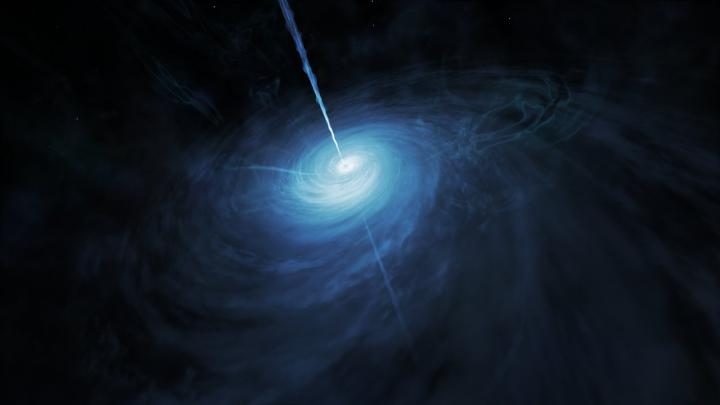
This artist’s impression shows how J043947.08+163415.7, a very distant quasar powered by a supermassive black hole, may look close up. This object is by far the brightest quasar yet discovered in the early Universe. ESA/Hubble, NASA, M. Kornmesser

The quasar was identified using a technique called gravitational lensing, which was possible as there is a dim galaxy which is located almost exactly between Earth and the quasar. The gravity of this dim galaxy bends the light emitted by the quasar, making it appear three times larger and fifty times as bright as it would be normally, allowing Hubble to detect it. You can see how the mass of a galaxy in between Earth and an object of observation creates the lensing effect in this video:

Gravitational lensing of distant quasar

The findings are important because they suggest that quasars may produce stars at a much faster rate than previously believed. This particular quasar may be producing up to an incredible 10,000 stars per year, although it is hard to be precise because of the effect of the gravitational lensing. “Its properties and its distance make it a prime candidate to investigate the evolution of distant quasars and the role supermassive black holes in their centers had on star formation,” co-author Fabian Walter of the Max Planck Institute for Astronomy, Germany, explained in a statement.

Georgina Torbet
Georgina has been the space writer at Digital Trends space writer for six years, covering human space exploration, planetary…
Edge browser on mobile gets a huge upgrade that makes it a worthy pick over Chrome
Edge mobile gets smarter just before Chrome’s big Gemini moment
Microsoft Edge on a phone

Chrome is still the default browser for many smartphone users, but Microsoft’s latest Edge update gives them a practical reason to try something else.

Microsoft has announced a major Copilot update for Edge across desktop and mobile. The rollout comes ahead of Google’s Gemini-powered Chrome upgrade for Android, which is expected in June, giving Edge a chance to stand out on phones before Chrome’s next big AI push.

Read more
After flubbing with Siri, Apple plans to host AI agents on the App Store
One problem is about money Apple won't commit to not charging. The other is about AI agents Apple can't figure out how to control. WWDC needs to solve both.
Electronics, Mobile Phone, Phone

Apple is currently facing a Siri problem that has nothing to do with Siri at all. With WWDC 2026 just weeks away, The Information reports the company is actively courting developers to integrate their apps with the new Siri coming in iOS 27. 

The mechanism powering the overhauled Siri, App Intents, is an API that lets Siri execute actions inside third-party apps without you actively opening them, which sounds quite useful, I’d say. However, some of the world’s largest developers are dragging their feet on it, not because it’s tough, but because Apple left the door open on charging for it later.

Read more
EV batteries just need some AI top-up nudge, and they get a big 23% life boost, finds research
Charging fast and lasting long seemed impossible. A new AI trick says otherwise.
EV Charging

EV battery charging technology has always had to find the right balance between charging speed and battery longevity. If the charging speed is too fast, it wears down the battery. If the charging is too slow, nobody is happy. 

Researchers Meng Yuan from Victoria University of Wellington and Changfu Zou from Chalmers University of Technology in Sweden may have cracked this long-standing problem using an AI technique called deep reinforcement learning, and the results are pretty encouraging.

Read more