  1. Home
  2. Emerging Tech
  3. News

Curiosity says goodbye to the Vera Rubin Ridge with a 360 video

Add as a preferred source on Google

The Curiosity rover has been exploring the Vera Rubin Ridge on Mars for more than a year now, and it is time for the explorer to move on to new areas of the planet. But before it departs, Curiosity has captured a 360 video of its final drill site — an area that scientists have nicknamed “Rock Hall.” The video is a composite of images taken in a panoramic form on December 19, 2018, which you can move around to get a feeling of what the view is like from the rover:

NASA's Curiosity Mars Rover Departs Vera Rubin Ridge (360 View)

If you can’t watch the video, then an image of the panorama is embedded below as well:
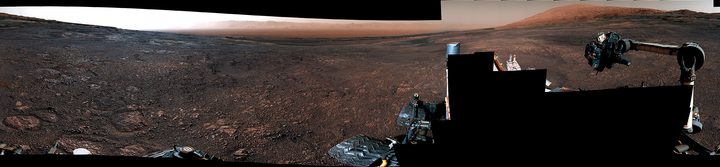
This panorama was taken on Dec. 19 (Sol 2265) by the Mast Camera (Mastcam) on NASA’s Curiosity Mars rover. The rover’s last drill location on Vera Rubin Ridge is visible, as well as the clay region it will spend the next year exploring. NASA/JPL-Caltech/MSSS

In both the video and the image, you can see the surface of Mars and the horizon. The images do not capture the rover itself (though Curiosity’s companion InSight has taken a selfie in the past if you want to see that) or the sky, as these are not the focus of Curiosity’s research. Though you can see Curiosity’s drill and features of the terrain like the most recent drilling site, the Rock Hall Drill Hole, as well as the previous Highfield drill site, and the Gale Crater Rim and Floor. You can also see Upper Mount Sharp in the distance and the area where Curiosity will be moving to study next, called the “clay-bearing unit.”

Recommended Videos

During its time on the Vera Rubin Ridge, Curiosity made some unexpected discoveries about the geology of the area. “We’ve had our fair share of surprises,” Curiosity science team member Abigail Fraeman of NASA’s Jet Propulsion Laboratory in Pasadena, California, said in a statement. “We’re leaving with a different perspective of the ridge than what we had before.” For example, Curiosity confirmed the presence in the bedrock of hematite, an iron-rich mineral which often forms in water, suggesting that in the past there was groundwater on some parts of the ridge.
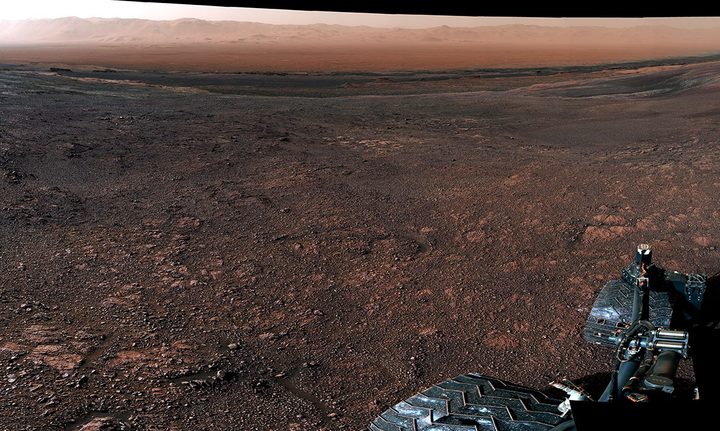
A crop of the Curiosity’s 360 image, showing the edge of the rover and the Martian surface. NASA/JPL-Caltech/MSSS

The rover is now moving on to a trough between the ridge and the rest of the mountain called Glen Torridon. It is called “clay-bearing” because data from orbiters shows that rocks there contain clay minerals which form in water. Scientists hope to learn more about the ancient lakes that formed in the area by examining the rocks in greater detail.

Georgina Torbet
Georgina has been the space writer at Digital Trends space writer for six years, covering human space exploration, planetary…
DJI’s first 360° drone offers 8K video recording and a freakishly long transmission range
From omnidirectional obstacle sensing to 42 GB of onboard storage, the Avata 360 is DJI doing what DJI does best: raising the bar for everyone else.
DJI Avata 360° drone.

DJI has officially entered the 360° drone arena with the launch of the Avata 360. It’s the company’s first-ever fully immersive FPV drone, and a direct shot at the Antigravity A1, a rival built by an Insta360-incubated brand. Looks like the drone wars just got more interesting. 

What makes the Avata 360 worth looking at?

Read more
I transferred all my chats from other AI apps to Gemini — and it works flawlessly
Google Gemini Graphics Featured

You know that moment when AI assistants like ChatGPT, Gemini, or Claude suddenly lose the plot mid-conversation and start hallucinating like they’re absolutely sure they’re right? Yeah…it’s equal parts funny and painfully annoying. My usual reaction is switching between apps, hoping one of them gets it right. But the real problem is that I have to start over every single time. It feels like I’m stuck in a loop explaining my life story to different AIs, one after the other.

Now with Gemini, I can now jump in from other AI apps without that whole reset conversation. Finally, the Google gods have blessed us. I tried it out expecting the usual hiccups, but it was surprisingly smooth and quick.

Read more
Google expands Search Live globally with voice and camera AI
The feature is now available in 200+ countries with multilingual support
Google Search Live

Google is taking another big step toward turning Search into a full-blown AI assistant. The company has officially expanded Search Live globally, making the feature available in over 200 countries and territories, along with support for dozens of languages.

https://twitter.com/google/status/2037201891130523917

Read more