Elon Musk presented his vision of SpaceX’s eventual manned missions to Mars at IAC2016. During his presentation, the entrepreneur made a number of announcements regarding SpaceX’s goals for Martian landfall and colonizing Mars. Musk’s main point of discussion dealt primarily with SpaceX’s new massive Interplanetary Transport System, a system which utilizes three separate vehicles to make the trip to Mars and is key to Musk’s plan of making travel to Mars an obtainable reality for almost anyone.
The system makes use of a massive booster known as the Raptor, a souped-up version of the Falcon 9 which retains the Falcon 9’s multi-use design and thruster landing. The crew transport ship intends to carry 100 people (though Musk plans for more), and features solar arrays and additional thrusters, as well as massive carbon fiber fuel tanks. A refueling craft loaded with methane fuel would also come in use, thus reducing the initial launch weight of the transport ship.
Detailing the launch procedure, Musk says it plans to involve the Raptor booster launching the crew transport in orbit around Earth. The booster would then return to the launch pad where it would be loaded with the refueling craft. After the booster launches again, the refueling craft would dock with the transport before fueling up and beginning the trip towards Mars.
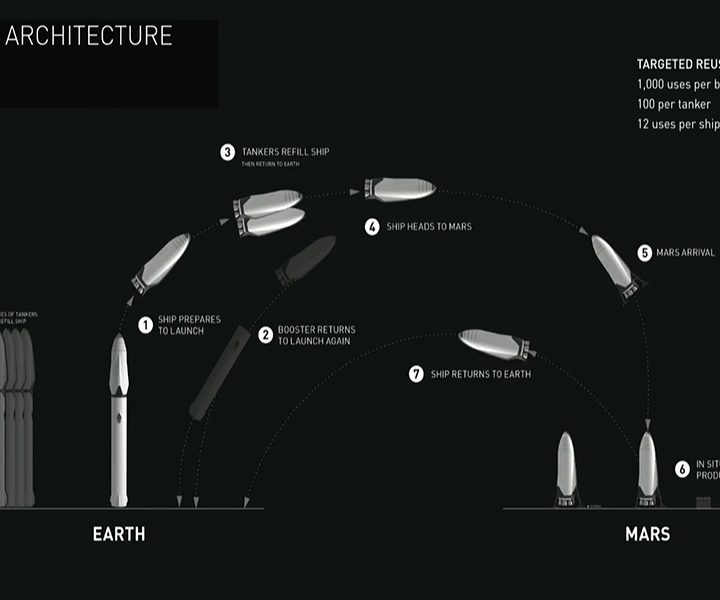
While Musk primarily showed off digital images and videos during the presentation, he stressed the fact each each one comes directly from SpaceX’s CAD design files and will resemble the final versions.
Using this new system, Musk said it would take anywhere from 40 to 100 years worth of manned trips to achieve the agency’s goal of moving 1 million people to Mars and establishing a self-sustaining city. This equates to roughly 10,000 flights carrying 100 to 200 people on each voyage — additionally, trips would take an average of 115 days while fluctuating between 80 and 140 days depending on the given distance between Earth and Mars. These trips would occur once every 26 months during the Earth-Mars rendezvous, otherwise known as when the two planets are closest to each other.
Musk expects the first passenger flights to begin in a decade or so and estimates the cost to run at about $200,000 per ticket — which is incredibly cheaper than what it would currently cost to send someone to Mars.
While these early trips sound like long, arduous endeavors, Musk assures the transport ship intends to feature plenty of entertainment including games, movie theaters, and restaurants. In time, given advancements in technology, Musk believes the trip time to drop to as little as 30 days.
So, that covers getting to Mars, but what happens when the passengers arrive?
Once on Mars, crews expect to get right to work building self-sustaining colonies which could include everything from restaurants to factories. Due to Mars’ resource-rich environment —which includes water, ice, and mineral and metal deposits — Musk assures crews won’t have to worry about a shortage of job opportunities on the red planet. Musk stated he hopes the new system has the ability to make “Mars seem possible.” Citing a desire to make Mars seem fun and adventurous, the SpaceX frontman intends to put the “dream of Mars in people’s heads.” While these manned flights are still several years out, SpaceX remains committed to sending an unmanned mission to mars by 2018, additionally vowing to send a craft to Mars during each Earth-Mars rendezvous from then on.
Travel to Mars was not the only use of this new Interplanetary transport System.

Musk proposed the Raptor booster could see added work by transporting cargo anywhere on Earth within 45 minutes, provided the proper landing location becomes accessible. He also explained how the Interplanetary Transport System’s refueling craft is the precursor to a solar system-spanning fuel depot where craft could have the ability to refuel on their way to the outer reaches of our solar system.
While this won’t enable interstellar travel, Musk did express during the Q&A section he often thinks about interstellar travel — something he believes will most likely be solved with anti-matter drives.
Musk was sure to drive the point home that we face an existential threat as a species: life as we know it will either go extinct or we could choose to become a multiplanetary species, a particularly dark subject he brought up numerous times during his presentation and the following Q&A session.
Musk is not alone in his call to make humans multiplanetary in order to save ourselves. Fellow entrepreneur Richard Branson and retired astronaut and second man of the Moon Buzz Aldrin have both expressed their own visions of humans becoming a dual planet species in the past. SpaceX’s initiative makes Martian exploration and colonization seem attainable in the near future but SpaceX isn’ the only agency working towards this goal. While SpaceX’s plans are by far the most aggressive, NASA, ESA, and the space programs of India, Russia, and China all have Mars missions currently planned or proposed. Given the number of companies and organizations that are invest in making Mars their next conquest, it seems its only a matter of time until Musk’s dreams come true.