  1. Home
  2. Emerging Tech
  3. News

Could Enceladus, the icy moon of Saturn, be capable of supporting life?

Add as a preferred source on Google
 

New research using data from the Cassini probe suggests that Enceladus, the moon of Saturn with an ocean hidden beneath a thick layer of ice, could be capable of supporting life.

Recommended Videos

Cracks in the icy surface of the moon let out plumes of gases and sea spray, and data about these plumes can reveal more about the ocean beneath the ice. “By understanding the composition of the plume, we can learn about what the ocean is like, how it got to be this way and whether it provides environments where life as we know it could survive,” Dr. Christopher Glein of the Southwest Research Institute, lead author of the research, explained in a statement.

“We came up with a new technique for analyzing the plume composition to estimate the concentration of dissolved CO2 in the ocean. This enabled modeling to probe deeper interior processes.”
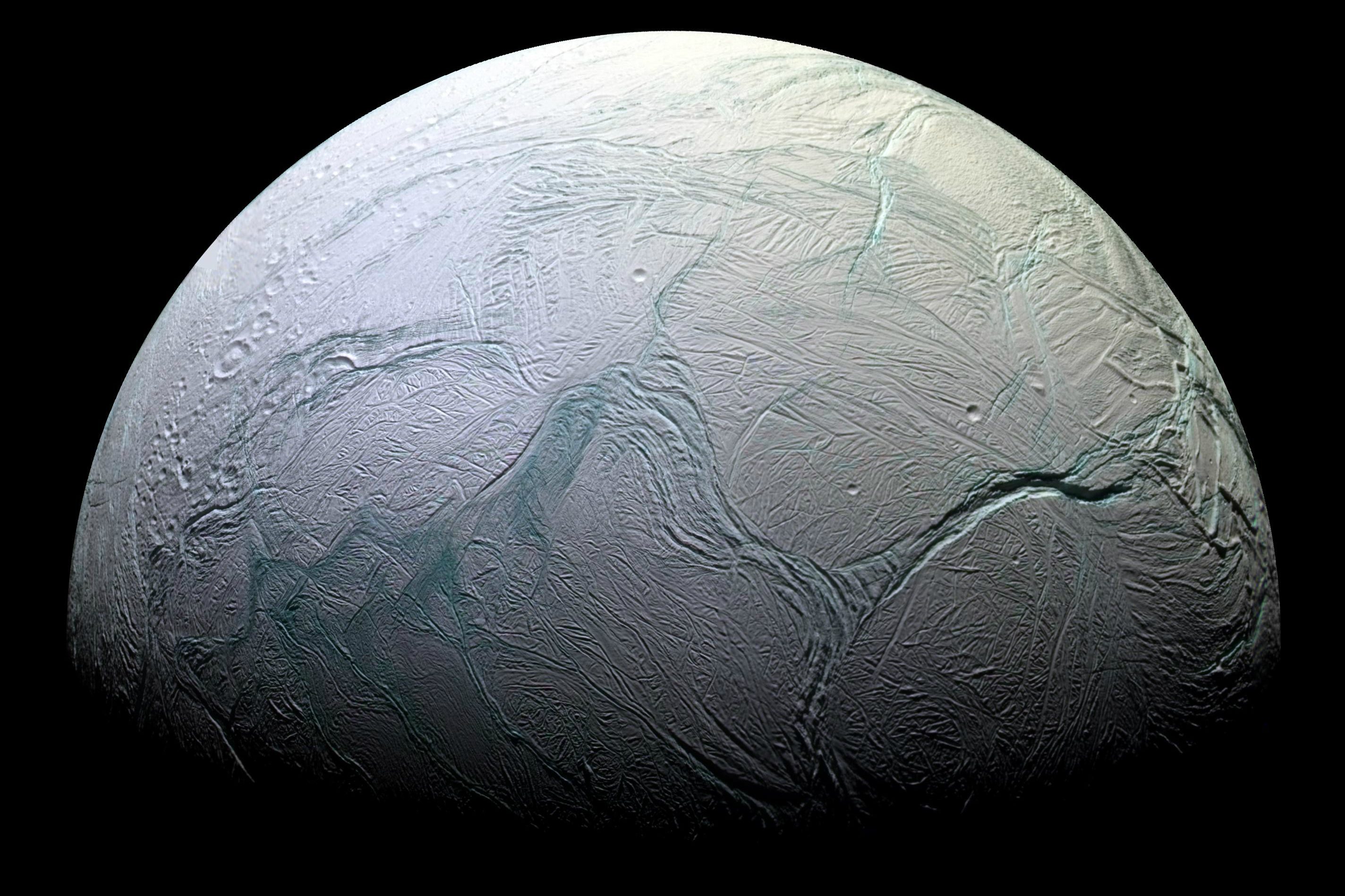
Saturn’s geologically active moon, Enceladus. NASA/JPL

The team found an abundance of carbon dioxide, likely created by chemical reactions on Enceladus’ ocean floor. In addition, there are thought to be hydrothermal vents on the ocean floor which vent hot fluids rich in minerals into the water, similar to those found on the ocean floor on Earth which could have been the starting point of life here.

The big shock of this finding is that it means Enceladus may be capable of supporting life. Although there is no evidence that life is there now, the conditions there could be conducive to the formation of simple lifeforms.

“The dynamic interface of a complex core and seawater could potentially create energy sources that might support life,” said Dr. Hunter Waite, principal investigator of Cassini’s Ion Neutral Mass Spectrometer, an instrument that collected data on the atmospheric composition of Saturn and its moons. “While we have not found evidence of the presence of microbial life in the ocean of Enceladus, the growing evidence for chemical disequilibrium offers a tantalizing hint that habitable conditions could exist beneath the moon’s icy crust.”

The research suggests that the rocky core of Enceladus is more complex than we realized, with what the scientists describe as “a carbonated upper layer and a serpentinized interior.” This core seems to be influencing the carbon dioxide in the ocean through chemical reactions, making the ice moon a hubbub of chemical activity.

“The implications for possible life enabled by a heterogeneous core structure are intriguing,” said Glein. “This model could explain how planetary differentiation and alteration processes create chemical (energy) gradients needed by subsurface life.”

Georgina Torbet
Georgina has been the space writer at Digital Trends space writer for six years, covering human space exploration, planetary…
After flubbing with Siri, Apple plans to host AI agents on the App Store
One problem is about money Apple won't commit to not charging. The other is about AI agents Apple can't figure out how to control. WWDC needs to solve both.
Electronics, Mobile Phone, Phone

Apple is currently facing a Siri problem that has nothing to do with Siri at all. With WWDC 2026 just weeks away, The Information reports the company is actively courting developers to integrate their apps with the new Siri coming in iOS 27. 

The mechanism powering the overhauled Siri, App Intents, is an API that lets Siri execute actions inside third-party apps without you actively opening them, which sounds quite useful, I’d say. However, some of the world’s largest developers are dragging their feet on it, not because it’s tough, but because Apple left the door open on charging for it later.

Read more
EV batteries just need some AI top-up nudge, and they get a big 23% life boost, finds research
Charging fast and lasting long seemed impossible. A new AI trick says otherwise.
EV Charging

EV battery charging technology has always had to find the right balance between charging speed and battery longevity. If the charging speed is too fast, it wears down the battery. If the charging is too slow, nobody is happy. 

Researchers Meng Yuan from Victoria University of Wellington and Changfu Zou from Chalmers University of Technology in Sweden may have cracked this long-standing problem using an AI technique called deep reinforcement learning, and the results are pretty encouraging.

Read more
Alexa for Shopping is a chatty new AI assistant with some cool tricks to make you spend at Amazon
Alexa now remembers your plans and turns them into shopping lists
Logo of Amazon’s new Alexa+ assistant.

After years of using Alexa to answer questions, control smart homes, play music, and handle everyday tasks, Amazon has found a more obvious job for it. Alexa is becoming your personal shopper, meant to help you find what you need faster and get it into your cart with fewer second thoughts.

Amazon is rolling out Alexa for Shopping to U.S. customers on the Amazon Shopping app, Amazon.com, and Echo Show devices. It combines the existing Rufus shopping chatbot with Alexa+ personalization, enabling the assistant to use product knowledge, shopping history, browsing behavior, past purchases, preferences, and Alexa conversations to improve recommendations. The assistant is free for signed-in Amazon customers and does not require Prime, an Echo device, or the Alexa app.

Read more