  1. Home
  2. Emerging Tech
  3. News

Pass the salt please: Table salt found on Jupiter’s moon Europa

Add as a preferred source on Google

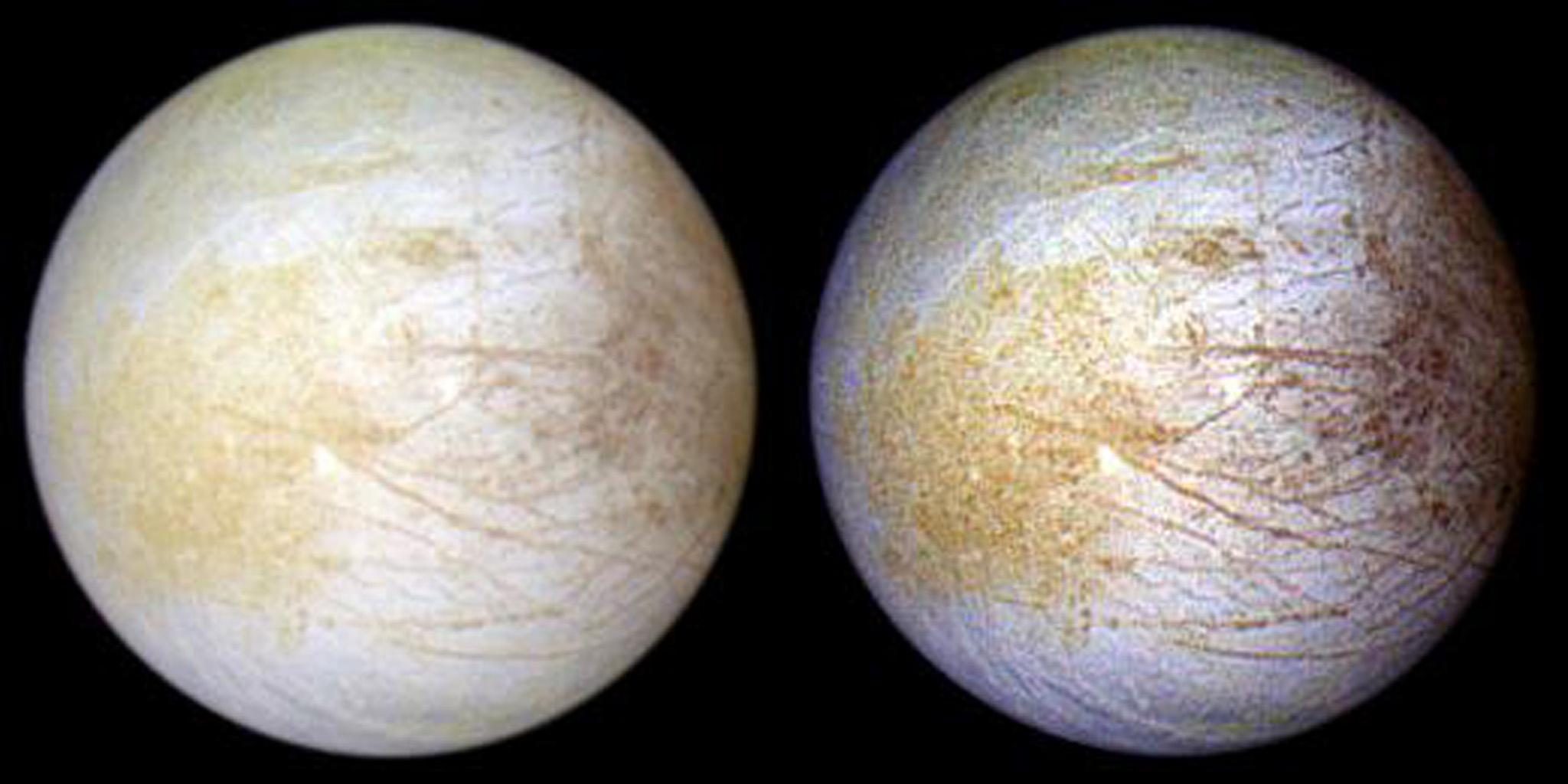
Tara Regio is the yellowish area to left of center, in this NASA Galileo image of Europa’s surface. This region of geologic chaos is the area where researchers identified an abundance of sodium chloride. NASA/JPL/University of Arizona

Astronomers have spotted something unexpectedly familiar on the surface of Jupiter’s moon Europa — sodium chloride, better known as table salt. Europa has been imaged several times over the years, but this is the first time that scientists have found evidence of the compound.

Recommended Videos

The salt is visible in the image above as yellow patches on the surface of the moon, and its presence indicates that Europa could have oceans which are salty like our oceans here on Earth. These oceans are hidden beneath an icy shell, and were previously thought to contain magnesium sulfate salts which are similar to bath salts rather than sodium chloride.

Using near-infrared spectroscopy data from the Galileo spacecraft, scientists were able to see the water ice and some kind of salt. But they couldn’t tell it was sodium chloride until they used higher resolution data from the W. M. Keck Observatory. This is because sodium chloride can’t be seen with near-infrared spectroscopy. It can only be seen using light in the visible spectrum and a special process of radiation has to be present in order to spot it.

“Sodium chloride is a bit like invisible ink on Europa’s surface,” JPL scientist Kevin Hand explained in a statement. “Before irradiation you can’t tell it’s there, but after irradiation the color jumps right out at you.” Hand investigated the irradiation process which makes the sodium chloride should up as yellow patches in the images.

When the team used the Hubble telescope to look at Europa, they were able to confirm the presence of the salt. “People have traditionally assumed that all of the interesting spectroscopy is in the infrared on planetary surfaces, because that’s where most of the molecules that scientists are looking for have their fundamental features,” Mike Brown, Professor of Planetary Astronomy at Caltech and coauthor of the paper said in the same statement. “We’ve had the capacity to do this analysis with the Hubble Space Telescope for the past 20 years. It’s just that nobody thought to look.”

The findings are published in the journal Science Advances.

Georgina Torbet
Georgina has been the space writer at Digital Trends space writer for six years, covering human space exploration, planetary…
Edge browser on mobile gets a huge upgrade that makes it a worthy pick over Chrome
Edge mobile gets smarter just before Chrome’s big Gemini moment
Microsoft Edge on a phone

Chrome is still the default browser for many smartphone users, but Microsoft’s latest Edge update gives them a practical reason to try something else.

Microsoft has announced a major Copilot update for Edge across desktop and mobile. The rollout comes ahead of Google’s Gemini-powered Chrome upgrade for Android, which is expected in June, giving Edge a chance to stand out on phones before Chrome’s next big AI push.

Read more
After flubbing with Siri, Apple plans to host AI agents on the App Store
One problem is about money Apple won't commit to not charging. The other is about AI agents Apple can't figure out how to control. WWDC needs to solve both.
Electronics, Mobile Phone, Phone

Apple is currently facing a Siri problem that has nothing to do with Siri at all. With WWDC 2026 just weeks away, The Information reports the company is actively courting developers to integrate their apps with the new Siri coming in iOS 27. 

The mechanism powering the overhauled Siri, App Intents, is an API that lets Siri execute actions inside third-party apps without you actively opening them, which sounds quite useful, I’d say. However, some of the world’s largest developers are dragging their feet on it, not because it’s tough, but because Apple left the door open on charging for it later.

Read more
EV batteries just need some AI top-up nudge, and they get a big 23% life boost, finds research
Charging fast and lasting long seemed impossible. A new AI trick says otherwise.
EV Charging

EV battery charging technology has always had to find the right balance between charging speed and battery longevity. If the charging speed is too fast, it wears down the battery. If the charging is too slow, nobody is happy. 

Researchers Meng Yuan from Victoria University of Wellington and Changfu Zou from Chalmers University of Technology in Sweden may have cracked this long-standing problem using an AI technique called deep reinforcement learning, and the results are pretty encouraging.

Read more