  1. Home
  2. Emerging Tech
  3. News

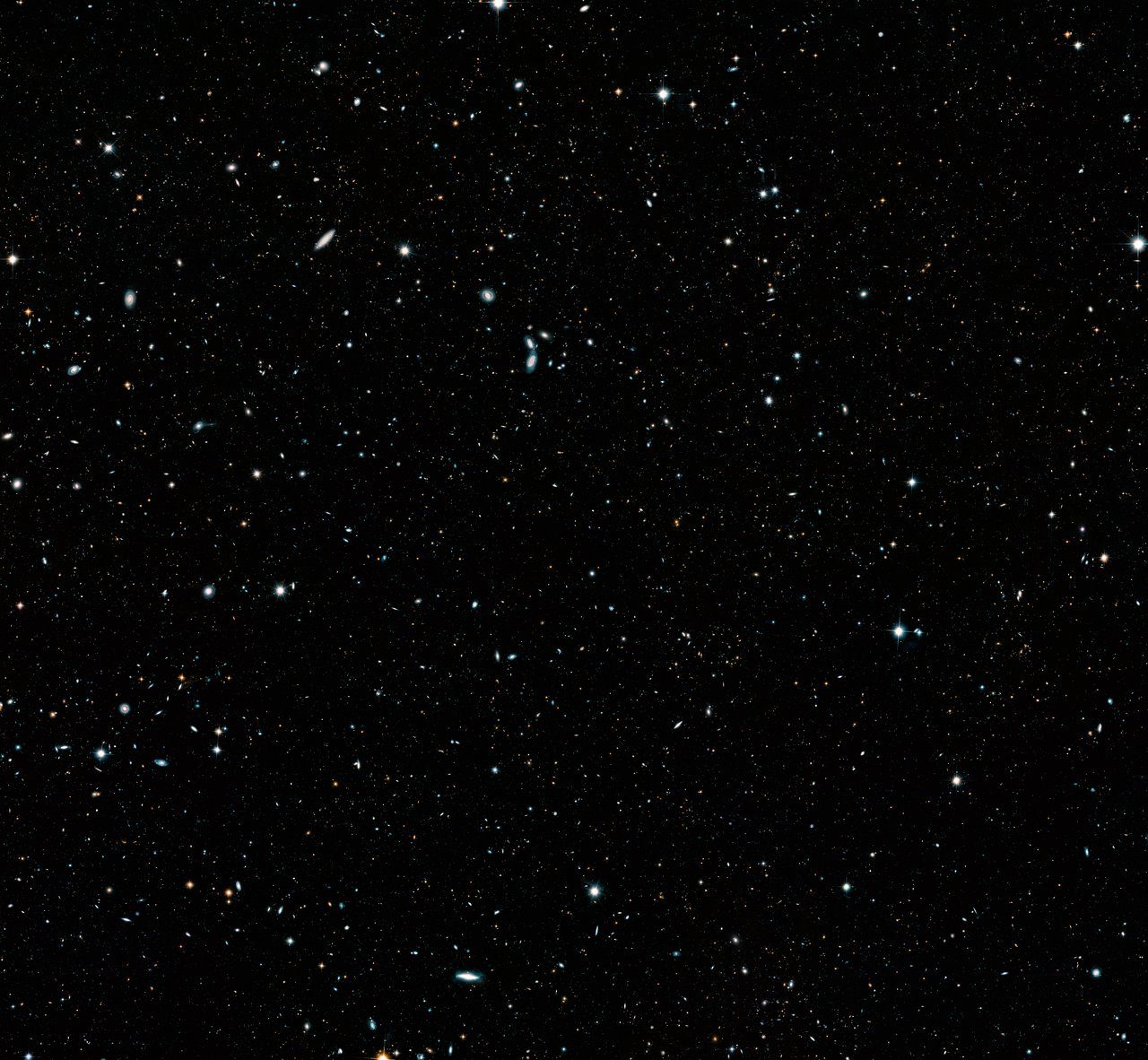
See 265,000 galaxies in the epic Hubble Legacy Field mosaic

Add as a preferred source on Google

A mosaic of the distant Universe, called the Hubble Legacy Field, that documents 16 years of observations from the NASA/ESA Hubble Space Telescope. NASA, ESA, G. Illingworth and D. Magee (University of California, Santa Cruz), K. Whitaker (University of Connecticut), R. Bouwens (Leiden University), P. Oesch (University of Geneva), and the Hubble Legacy Field team.

This stunning image shows an incredible 265,000 galaxies, stretching back in time to the early universe 500 million years after the Big Bang.

Recommended Videos

The image is a mosaic of different images captured by the Hubble Space Telescope as part of its deep-field surveys, arranged into a giant overview called the Hubble Legacy Field. The first of these surveys was the 1995 Hubble Deep Field survey, followed by the 2004 Hubble Ultra Deep Field and the 2012 Hubble eXtreme Deep Field. In total, 7,500 separate exposures went into creating this first Hubble Legacy Field image.

“Now that we have gone wider than in previous surveys, we are harvesting many more distant galaxies in the largest such dataset ever produced,” Garth Illingworth of the University of California, Santa Cruz, leader of the team that assembled the image, said in a statement. “No image will surpass this one until future space telescopes like James Webb are launched.”

Zooming in on the Hubble Legacy Field

The wavelengths shown in the image range from ultraviolet to near-infrared, which allows astronomers to visualize the many different features of the galaxy through time. Some of the galaxies shown are incredibly faint because they are so far away, giving off light that is just one ten-billionth of the brightness visible to the human eye.

“One exciting aspect of these new images is the large number of sensitive color channels now available to view distant galaxies, especially in the ultraviolet part of the spectrum,” explained team member Rychard Bouwens of Leiden University in the Netherlands. “With images at so many frequencies, we can dissect the light from galaxies into the contributions from old and young stars, as well as active galactic nuclei.”

The Legacy Field image and other deep-field images show the expansion of the universe, giving astronomers clues to the state of the early universe and the way that it evolved over millions of years. New telescopes like the upcoming James Webb Telescope will allow astronomers to look even deeper into space, learning more about the development of galaxies through time.

Georgina Torbet
Georgina has been the space writer at Digital Trends space writer for six years, covering human space exploration, planetary…
After flubbing with Siri, Apple plans to host AI agents on the App Store
One problem is about money Apple won't commit to not charging. The other is about AI agents Apple can't figure out how to control. WWDC needs to solve both.
Electronics, Mobile Phone, Phone

Apple is currently facing a Siri problem that has nothing to do with Siri at all. With WWDC 2026 just weeks away, The Information reports the company is actively courting developers to integrate their apps with the new Siri coming in iOS 27. 

The mechanism powering the overhauled Siri, App Intents, is an API that lets Siri execute actions inside third-party apps without you actively opening them, which sounds quite useful, I’d say. However, some of the world’s largest developers are dragging their feet on it, not because it’s tough, but because Apple left the door open on charging for it later.

Read more
EV batteries just need some AI top-up nudge, and they get a big 23% life boost, finds research
Charging fast and lasting long seemed impossible. A new AI trick says otherwise.
EV Charging

EV battery charging technology has always had to find the right balance between charging speed and battery longevity. If the charging speed is too fast, it wears down the battery. If the charging is too slow, nobody is happy. 

Researchers Meng Yuan from Victoria University of Wellington and Changfu Zou from Chalmers University of Technology in Sweden may have cracked this long-standing problem using an AI technique called deep reinforcement learning, and the results are pretty encouraging.

Read more
Alexa for Shopping is a chatty new AI assistant with some cool tricks to make you spend at Amazon
Alexa now remembers your plans and turns them into shopping lists
Logo of Amazon’s new Alexa+ assistant.

After years of using Alexa to answer questions, control smart homes, play music, and handle everyday tasks, Amazon has found a more obvious job for it. Alexa is becoming your personal shopper, meant to help you find what you need faster and get it into your cart with fewer second thoughts.

Amazon is rolling out Alexa for Shopping to U.S. customers on the Amazon Shopping app, Amazon.com, and Echo Show devices. It combines the existing Rufus shopping chatbot with Alexa+ personalization, enabling the assistant to use product knowledge, shopping history, browsing behavior, past purchases, preferences, and Alexa conversations to improve recommendations. The assistant is free for signed-in Amazon customers and does not require Prime, an Echo device, or the Alexa app.

Read more