  1. Home
  2. Emerging Tech
  3. News

InSight’s heat probe will dig 16 feet beneath the surface of Mars

Add as a preferred source on Google

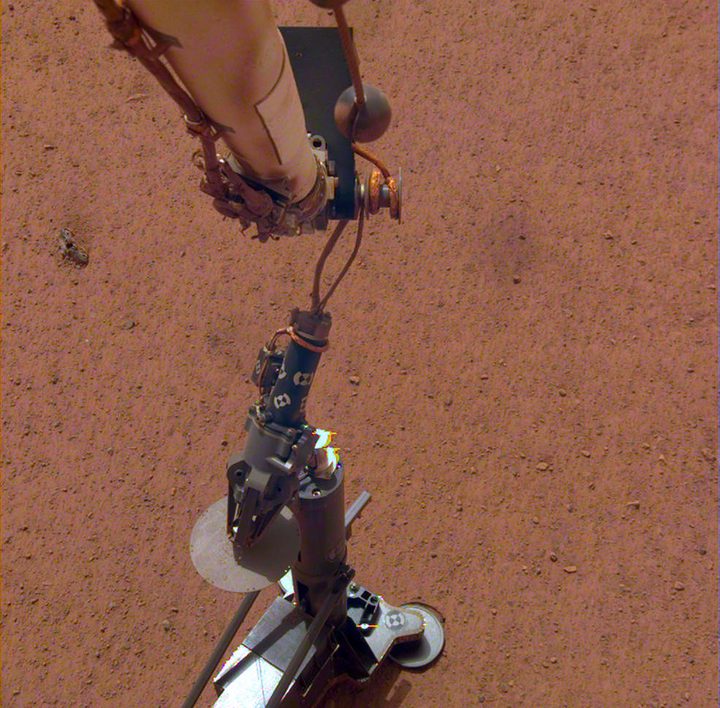
NASA’s InSight lander set its heat probe, called the Heat and Physical Properties Package (HP3), on the Martian surface on February 12. NASA/JPL-Caltech/DLR

Having placed its seismometer onto the Martian surface and covered it with a heat shield to keep it safe, NASA’s InSight mission has moved on to deploying its second instrument. New images from the lander have confirmed that on February 12, InSight succeeded in setting the Heat Flow and Physical Properties Package (HP3) instrument onto the surface.

Recommended Videos

The HP3 is equipped with a scary-sounding “self-hammering spike” which will delve up to 16 feet down into the soil and rock below the planet’s surface. This is considerably deeper than previous missions to Mars, which dug 8.6 inches down in the case of Viking 1m and 7 inches down in the case of Phoenix. The HP3 achieves this using a long vertical metal tube which contains a sharp spike called a mole which will be pushed into the soil. The cord which attaches to the mole has heat sensors to measure the temperature of the subsurface, and the mole itself has sensors to measure the thermal conductivity of the soil.

InSight will use this instrument to learn about temperatures on Mars by measuring thermal conductivity every 19 inches as the probe moves beneath the ground. Because of heat from friction caused by the drilling, the probe has to pause and cool down for a couple of days before a measurement can be taken. Once it is at a stable temperature, the probe is gradually warmed up to 50 degrees Fahrenheit (10 degrees Celsius) over the course of a day, and the temperature sensors measure how long it takes for the soil to conduct that heat.

“Our probe is designed to measure heat coming from the inside of Mars,” InSight Deputy Principal Investigator Sue Smrekar of NASA’s Jet Propulsion Laboratory in Pasadena, California said in a statement. “That’s why we want to get it below ground. Temperature changes on the surface, both from the seasons and the day-night cycle, could add ‘noise’ to our data.”

The biggest problem that could arise is that the mole could hit a rock beneath the surface which would prevent it from being able to burrow deep enough. If there is a rock at less than 10 feet (3 meters) down then there will be considerable noise in the temperature data which would take several years to filter out. But the researchers are optimistic that this will not happen, as the landing site had no surface rocks so hopefully there won’t be large rocks beneath.

Georgina Torbet
Georgina has been the space writer at Digital Trends space writer for six years, covering human space exploration, planetary…
DJI’s first 360° drone offers 8K video recording and a freakishly long transmission range
From omnidirectional obstacle sensing to 42 GB of onboard storage, the Avata 360 is DJI doing what DJI does best: raising the bar for everyone else.
DJI Avata 360° drone.

DJI has officially entered the 360° drone arena with the launch of the Avata 360. It’s the company’s first-ever fully immersive FPV drone, and a direct shot at the Antigravity A1, a rival built by an Insta360-incubated brand. Looks like the drone wars just got more interesting. 

What makes the Avata 360 worth looking at?

Read more
I transferred all my chats from other AI apps to Gemini — and it works flawlessly
Google Gemini Graphics Featured

You know that moment when AI assistants like ChatGPT, Gemini, or Claude suddenly lose the plot mid-conversation and start hallucinating like they’re absolutely sure they’re right? Yeah…it’s equal parts funny and painfully annoying. My usual reaction is switching between apps, hoping one of them gets it right. But the real problem is that I have to start over every single time. It feels like I’m stuck in a loop explaining my life story to different AIs, one after the other.

Now with Gemini, I can now jump in from other AI apps without that whole reset conversation. Finally, the Google gods have blessed us. I tried it out expecting the usual hiccups, but it was surprisingly smooth and quick.

Read more
Google expands Search Live globally with voice and camera AI
The feature is now available in 200+ countries with multilingual support
Google Search Live

Google is taking another big step toward turning Search into a full-blown AI assistant. The company has officially expanded Search Live globally, making the feature available in over 200 countries and territories, along with support for dozens of languages.

https://twitter.com/google/status/2037201891130523917

Read more