  1. Home
  2. Emerging Tech
  3. News

ISS astronauts are fixing a particle physics detector in space

Add as a preferred source on Google

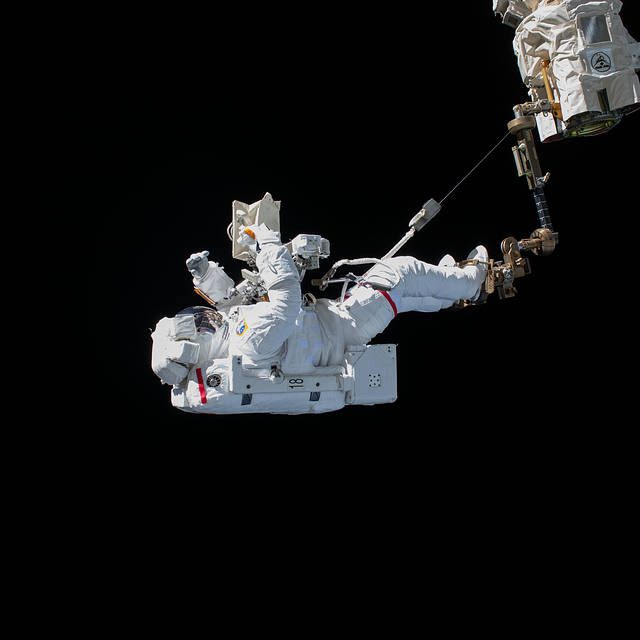
ESA (European Space Agency) astronaut Luca Parmitano is pictured attached to the Canadarm2 robotic arm during the first spacewalk to repair the Alpha Magnetic Spectrometer, the International Space Station’s cosmic particle detector. NASA

Astronauts on the International Space Station (ISS) are attempting to fix an “unserviceable” instrument which could provide insights into the nature of dark matter and many other cosmic questions. The Alpha Magnetic Spectrometer was installed in 2011 and was only supposed to last for three years, so it was never designed to be serviced by astronauts. But the instrument proved so valuable that the ISS crew are taking on the challenge of fixing its cooling system anyway.

Recommended Videos

Last week, Luca Parmitano of the European Space Agency and NASA Flight Engineer Andrew Morgan completed a first six-hour spacewalk to begin repairs on the instrument which is located on the outside of the ISS. They positioned materials, removed a debris cover, and installed the all-important handrails which will allow astronauts to grab on to structures while making repairs.

Then, on Friday, the same pair took another shift to begin the next phase which involves a first for a spacewalk: Cutting and reconnecting fluid lines. On this six-hour spacewalk, they cut eight stainless steel tubes and prepared a power cable for the new cooling system. The repairs will continue over the next few months, with a raft of spacewalks scheduled.

Despite its rather rickety cooling system, the AMS is still being used for scientific experiments and this week a new piece of research using the instrument has been published. Researchers from CERN and other institutes used the AMS to investigate the properties of cosmic helium isotopes, which are abundant in cosmic rays.

Helium-4 (4He)is an isotope created by nuclear fusion within stars and which can be accelerated to high energies by the explosion of a supernova. Helium-3 (3He), on the other hand, is typically produced when Helium-4 interacts with other cosmic materials. The AMS is able to differentiate between Helium-4 and Helium-3 and see how the ratio of these isotopes changes. The researchers found that the isotopes usually vary together over time, but at high enough energies this relationship changes.

“We were also able to see that the solar activity is able to affect the 3He and 4He spectra in a different way, a result that has never seen before,” Alberto Oliva, one of the researchers, said to Phys.org. These findings will help future astrophysicists to understand more about how cosmic rays are created and how they move through the universe.

Georgina Torbet
Georgina has been the space writer at Digital Trends space writer for six years, covering human space exploration, planetary…
DJI ‘s first 360° drone offers 8K video recording and a freakishly long transmission range
From omnidirectional obstacle sensing to 42 GB of onboard storage, the Avata 360 is DJI doing what DJI does best: raising the bar for everyone else.
DJI Avata 360° drone.

DJI has officially entered the 360° drone arena with the launch of the Avata 360. It’s the company’s first-ever fully immersive FPV drone, and a direct shot at the Antigravity A1, a rival built by an Insta360-incubated brand. Looks like the drone wars just got more interesting. 

What makes the Avata 360 worth looking at?

Read more
I transferred all my chats from other AI apps to Gemini — and it works flawlessly
Google Gemini Graphics Featured

You know that moment when AI assistants like ChatGPT, Gemini, or Claude suddenly lose the plot mid-conversation and start hallucinating like they’re absolutely sure they’re right? Yeah…it’s equal parts funny and painfully annoying. My usual reaction is switching between apps, hoping one of them gets it right. But the real problem is that I have to start over every single time. It feels like I’m stuck in a loop explaining my life story to different AIs, one after the other.

Now with Gemini, I can now jump in from other AI apps without that whole reset conversation. Finally, the Google gods have blessed us. I tried it out expecting the usual hiccups, but it was surprisingly smooth and quick.

Read more
Google expands Search Live globally with voice and camera AI
The feature is now available in 200+ countries with multilingual support
Google Search Live

Google is taking another big step toward turning Search into a full-blown AI assistant. The company has officially expanded Search Live globally, making the feature available in over 200 countries and territories, along with support for dozens of languages.

https://twitter.com/google/status/2037201891130523917

Read more