  1. Home
  2. Emerging Tech
  3. News

James Webb telescope undergoes vacuum testing, finally moving toward launch

Add as a preferred source on Google

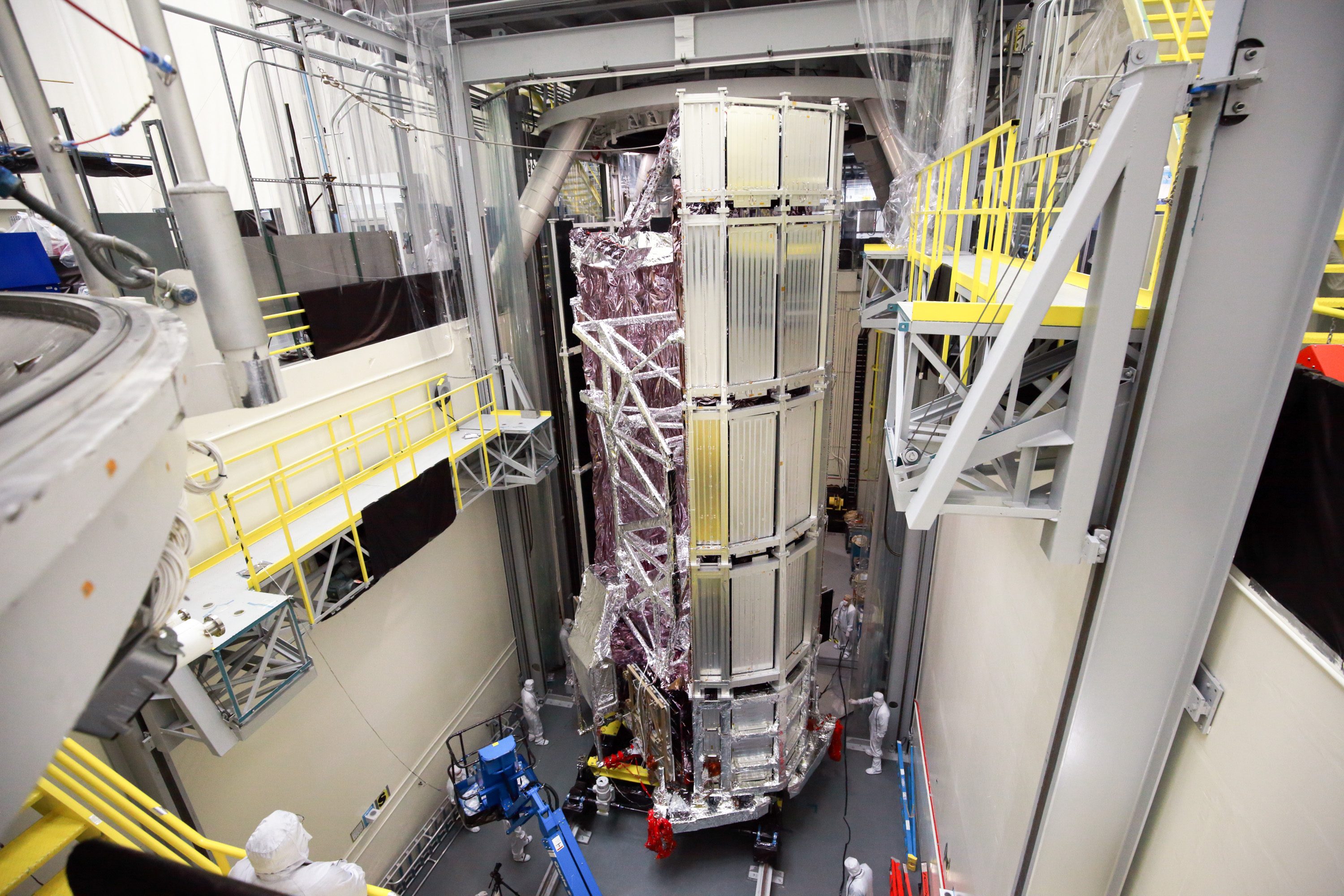
Technicians and engineers needed to take special precautions when preparing and transporting Webb’s spacecraft element for entry into Northrop Grumman’s environmental testing chambers. Northrop Grumman

The long-delayed James Webb telescope is finally moving toward completion. The telescope recently passed a key round of testing ahead of its planned launch in 2021.

Recommended Videos

The vehicle that will launch the telescope into space went through vacuum testing, in which the craft is exposed to a simulation of the space environment. This involves the use of a thermal vacuum chamber into which the spacecraft is placed. Engineers can then test its resilience to the extreme temperatures of launch and space, ranging from minus 235 degrees Fahrenheit (minus 148 degrees Celsius) to 215 degrees Fahrenheit (102 degrees Celsius)

The telescope itself went through vacuum testing last year at NASA’s Johnson Space Center. But now the other half of the project, the spacecraft element, has passed its testing at Northrop Grumman as well.

“The teams from Northrop Grumman and NASA Goddard Space Flight Center are to be commended for a successful spacecraft thermal vacuum test, dedicating long hours to get where we are now,” Jeanne Davis, program manager for the James Webb Space Telescope Program, said in a statement. “This incredible accomplishment paves the way for the next major milestone, which is to integrate the telescope and the spacecraft elements.”

The spacecraft element consists of a “bus,” which is the part that flies the telescope into place, and the unique sunshield that will protect the telescope’s delicate circuitry from the heat of the Sun. The sunshield is made up of five layers and spans the size of a tennis court, and is designed to ensure the telescope instruments are kept at the low temperatures required for successful operation.

Now that both parts of the craft have gone through vacuum testing, the next challenge is for the engineers to join the two together. Then a final round of testing can begin, making sure that every part is ready for its big launch. When it launches, it will be the world’s most powerful telescope and will be the successor to the beloved Hubble telescope. It should be able to collect images at a higher resolution and sensitivity, observing some of the most distant objects in the universe.

Georgina Torbet
Georgina has been the space writer at Digital Trends space writer for six years, covering human space exploration, planetary…
DJI’s first 360° drone offers 8K video recording and a freakishly long transmission range
From omnidirectional obstacle sensing to 42 GB of onboard storage, the Avata 360 is DJI doing what DJI does best: raising the bar for everyone else.
DJI Avata 360° drone.

DJI has officially entered the 360° drone arena with the launch of the Avata 360. It’s the company’s first-ever fully immersive FPV drone, and a direct shot at the Antigravity A1, a rival built by an Insta360-incubated brand. Looks like the drone wars just got more interesting. 

What makes the Avata 360 worth looking at?

Read more
I transferred all my chats from other AI apps to Gemini — and it works flawlessly
Google Gemini Graphics Featured

You know that moment when AI assistants like ChatGPT, Gemini, or Claude suddenly lose the plot mid-conversation and start hallucinating like they’re absolutely sure they’re right? Yeah…it’s equal parts funny and painfully annoying. My usual reaction is switching between apps, hoping one of them gets it right. But the real problem is that I have to start over every single time. It feels like I’m stuck in a loop explaining my life story to different AIs, one after the other.

Now with Gemini, I can now jump in from other AI apps without that whole reset conversation. Finally, the Google gods have blessed us. I tried it out expecting the usual hiccups, but it was surprisingly smooth and quick.

Read more
Google expands Search Live globally with voice and camera AI
The feature is now available in 200+ countries with multilingual support
Google Search Live

Google is taking another big step toward turning Search into a full-blown AI assistant. The company has officially expanded Search Live globally, making the feature available in over 200 countries and territories, along with support for dozens of languages.

https://twitter.com/google/status/2037201891130523917

Read more