  1. Home
  2. Emerging Tech
  3. News

James Webb telescope undergoes vacuum testing, finally moving toward launch

Add as a preferred source on Google

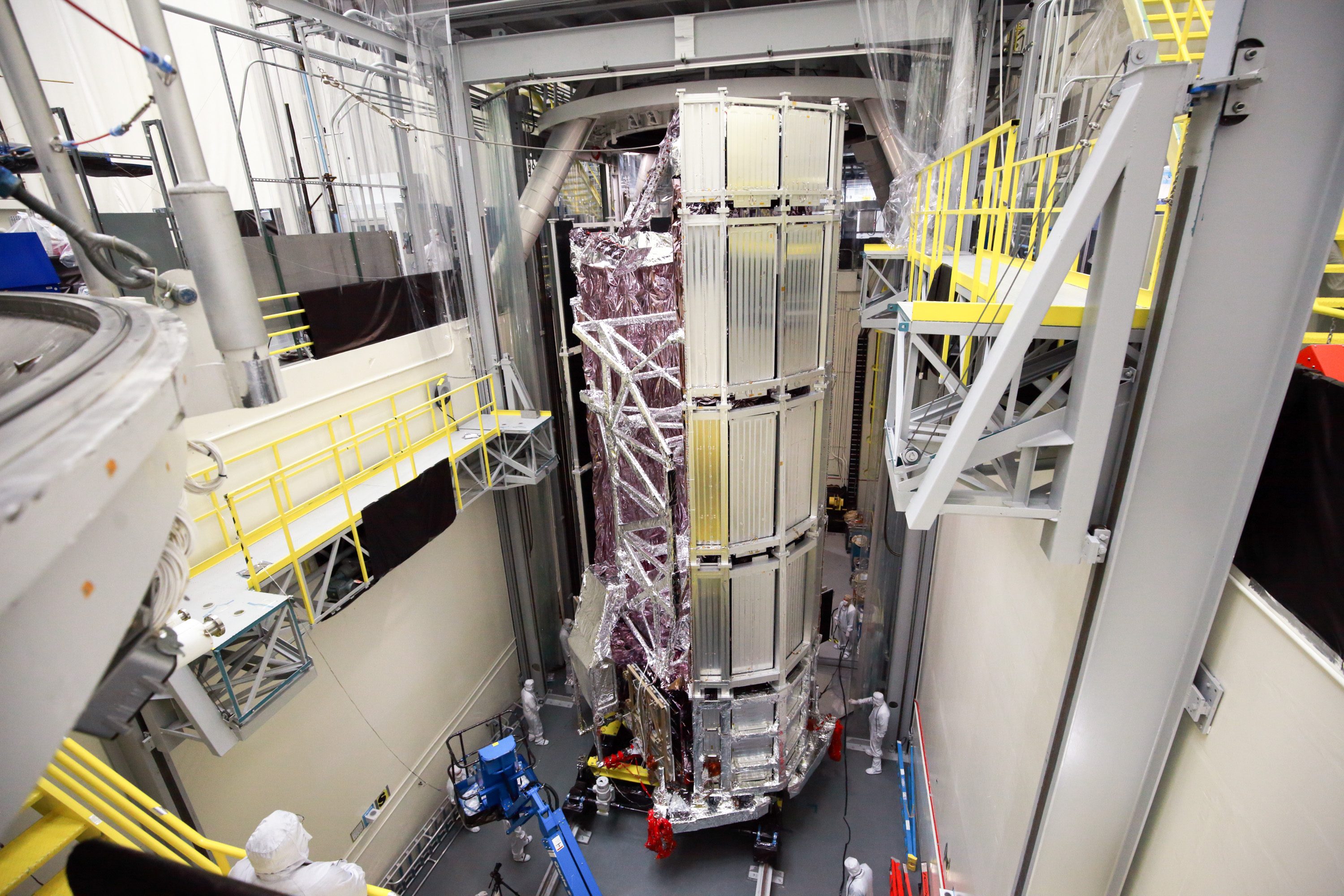
Technicians and engineers needed to take special precautions when preparing and transporting Webb’s spacecraft element for entry into Northrop Grumman’s environmental testing chambers. Northrop Grumman

The long-delayed James Webb telescope is finally moving toward completion. The telescope recently passed a key round of testing ahead of its planned launch in 2021.

Recommended Videos

The vehicle that will launch the telescope into space went through vacuum testing, in which the craft is exposed to a simulation of the space environment. This involves the use of a thermal vacuum chamber into which the spacecraft is placed. Engineers can then test its resilience to the extreme temperatures of launch and space, ranging from minus 235 degrees Fahrenheit (minus 148 degrees Celsius) to 215 degrees Fahrenheit (102 degrees Celsius)

The telescope itself went through vacuum testing last year at NASA’s Johnson Space Center. But now the other half of the project, the spacecraft element, has passed its testing at Northrop Grumman as well.

“The teams from Northrop Grumman and NASA Goddard Space Flight Center are to be commended for a successful spacecraft thermal vacuum test, dedicating long hours to get where we are now,” Jeanne Davis, program manager for the James Webb Space Telescope Program, said in a statement. “This incredible accomplishment paves the way for the next major milestone, which is to integrate the telescope and the spacecraft elements.”

The spacecraft element consists of a “bus,” which is the part that flies the telescope into place, and the unique sunshield that will protect the telescope’s delicate circuitry from the heat of the Sun. The sunshield is made up of five layers and spans the size of a tennis court, and is designed to ensure the telescope instruments are kept at the low temperatures required for successful operation.

Now that both parts of the craft have gone through vacuum testing, the next challenge is for the engineers to join the two together. Then a final round of testing can begin, making sure that every part is ready for its big launch. When it launches, it will be the world’s most powerful telescope and will be the successor to the beloved Hubble telescope. It should be able to collect images at a higher resolution and sensitivity, observing some of the most distant objects in the universe.

Georgina Torbet
Georgina has been the space writer at Digital Trends space writer for six years, covering human space exploration, planetary…
After flubbing with Siri, Apple plans to host AI agents on the App Store
One problem is about money Apple won't commit to not charging. The other is about AI agents Apple can't figure out how to control. WWDC needs to solve both.
Electronics, Mobile Phone, Phone

Apple is currently facing a Siri problem that has nothing to do with Siri at all. With WWDC 2026 just weeks away, The Information reports the company is actively courting developers to integrate their apps with the new Siri coming in iOS 27. 

The mechanism powering the overhauled Siri, App Intents, is an API that lets Siri execute actions inside third-party apps without you actively opening them, which sounds quite useful, I’d say. However, some of the world’s largest developers are dragging their feet on it, not because it’s tough, but because Apple left the door open on charging for it later.

Read more
EV batteries just need some AI top-up nudge, and they get a big 23% life boost, finds research
Charging fast and lasting long seemed impossible. A new AI trick says otherwise.
EV Charging

EV battery charging technology has always had to find the right balance between charging speed and battery longevity. If the charging speed is too fast, it wears down the battery. If the charging is too slow, nobody is happy. 

Researchers Meng Yuan from Victoria University of Wellington and Changfu Zou from Chalmers University of Technology in Sweden may have cracked this long-standing problem using an AI technique called deep reinforcement learning, and the results are pretty encouraging.

Read more
Alexa for Shopping is a chatty new AI assistant with some cool tricks to make you spend at Amazon
Alexa now remembers your plans and turns them into shopping lists
Logo of Amazon’s new Alexa+ assistant.

After years of using Alexa to answer questions, control smart homes, play music, and handle everyday tasks, Amazon has found a more obvious job for it. Alexa is becoming your personal shopper, meant to help you find what you need faster and get it into your cart with fewer second thoughts.

Amazon is rolling out Alexa for Shopping to U.S. customers on the Amazon Shopping app, Amazon.com, and Echo Show devices. It combines the existing Rufus shopping chatbot with Alexa+ personalization, enabling the assistant to use product knowledge, shopping history, browsing behavior, past purchases, preferences, and Alexa conversations to improve recommendations. The assistant is free for signed-in Amazon customers and does not require Prime, an Echo device, or the Alexa app.

Read more