  1. Home
  2. Emerging Tech
  3. News

NASA’s Juno craft captures beautiful swirling cloud formations on Jupiter

Add as a preferred source on Google

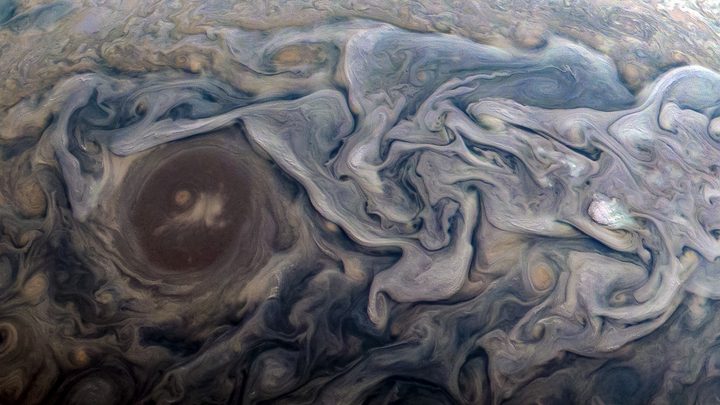
A color-enhanced image was taken by NASA’s Juno spacecraft at 9:20 a.m. PST on February 12, 2019 as the spacecraft performed its 18th close flyby of the gas giant planet. NASA/JPL-Caltech/SwRI/MSSS/Kevin M. Gill

NASA’s Juno spacecraft has captured this gorgeous image of Jupiter during its 18th flyby of the planet. This new perspective shows dramatic circling cloud formations which swirl around a jet stream known as Jet N6. The spot is an example of a high-pressure region in the atmosphere which is believed to be a storm which could continue to rage for hundreds of years.

Recommended Videos

The image wasn’t created by a professional astronomer, but rather by citizen scientist Kevin M. Gill who used data from the craft’s JunoCam imager to put together this new view of the planet. The JunoCam’s raw images are made available for the public to look at and to process into images on the JunoCam website, so if you fancy making some Jupiter images of your own, you can.

The Juno spacecraft was launched in August 2011 aboard an Atlas V 551 rocket, taking two years to travel through the solar system before performing a close Earth flyby in October 2013. It used Earth’s gravity to slingshot towards Jupiter at a high speed, eventually arriving at the planet in July 2016. Getting the craft to its destination was challenging, but getting it into orbit was even more difficult as it had to perform a maneuver called Jupiter Orbit Insertion in which it fired its main engine for about 30 minutes to slow it down enough to enter the planet’s orbit.

The maneuver worked successfully and the craft completed its first flyby of the planet in August 2016. Since then it has been gathering data on Jupiter’s gravity and magnetic fields to learn more about the interior structure of the planet. There is much we still don’t know about Jupiter as the clouds and massive storms in the atmosphere block views of the surface, so Juno uses observations of the atmosphere and magnetosphere to gather data on questions like whether the planet has a solid core and how it generates its large magnetic field.

The JunoCam is just one of the nine instruments on board the Juno craft, though it is unusual as its primary purpose is to gather images for education and public outreach rather than for scientific purposes. By this metric it has been a great success, producing a series of stunning images like the one above which have captured the imagination of space enthusiasts around the world.

Georgina Torbet
Georgina has been the space writer at Digital Trends space writer for six years, covering human space exploration, planetary…
Edge browser on mobile gets a huge upgrade that makes it a worthy pick over Chrome
Edge mobile gets smarter just before Chrome’s big Gemini moment
Microsoft Edge on a phone

Chrome is still the default browser for many smartphone users, but Microsoft’s latest Edge update gives them a practical reason to try something else.

Microsoft has announced a major Copilot update for Edge across desktop and mobile. The rollout comes ahead of Google’s Gemini-powered Chrome upgrade for Android, which is expected in June, giving Edge a chance to stand out on phones before Chrome’s next big AI push.

Read more
After flubbing with Siri, Apple plans to host AI agents on the App Store
One problem is about money Apple won't commit to not charging. The other is about AI agents Apple can't figure out how to control. WWDC needs to solve both.
Electronics, Mobile Phone, Phone

Apple is currently facing a Siri problem that has nothing to do with Siri at all. With WWDC 2026 just weeks away, The Information reports the company is actively courting developers to integrate their apps with the new Siri coming in iOS 27. 

The mechanism powering the overhauled Siri, App Intents, is an API that lets Siri execute actions inside third-party apps without you actively opening them, which sounds quite useful, I’d say. However, some of the world’s largest developers are dragging their feet on it, not because it’s tough, but because Apple left the door open on charging for it later.

Read more
EV batteries just need some AI top-up nudge, and they get a big 23% life boost, finds research
Charging fast and lasting long seemed impossible. A new AI trick says otherwise.
EV Charging

EV battery charging technology has always had to find the right balance between charging speed and battery longevity. If the charging speed is too fast, it wears down the battery. If the charging is too slow, nobody is happy. 

Researchers Meng Yuan from Victoria University of Wellington and Changfu Zou from Chalmers University of Technology in Sweden may have cracked this long-standing problem using an AI technique called deep reinforcement learning, and the results are pretty encouraging.

Read more