  1. Home
  2. Emerging Tech
  3. Cars
  4. News

New Lidar tech uses 128 lasers to help self-driving cars see in high resolution

Add as a preferred source on Google

When it comes to autonomous vehicles, Lidar is one of the driving forces that make it all possible. A laser-based surveying method, Lidar builds up a depth-based image of the world by shining out laser lights and then measuring how long it takes for the reflected pulse to be bounced back to the sensor.

And thanks to the work of pioneering company Velodyne, Lidar just got a whole lot better.

Recommended Videos

Unveiled this week, Velodyne’s new VLS-128 sensor set a new record by doubling the number of laser beams on its previous top-of-the-line Lidar system to a massive 128, while shrinking the overall size of the sensor by 70 percent. By doing so, the system promises to bring a crazy new level of resolution to the myriad applications that call for Lidar technology — from helping cars drive autonomously to mapping sites from the air.

“A 360-degree Lidar sensor such as the VLS-128 is optimal for keeping drivers and passengers safe in all situations,” Anand Gopalan, chief technology officer at Velodyne, told Digital Trends. “It provides the clearest view of both stationary and moving objects on or around the road, and in any direction around the vehicle. In addition, Velodyne’s Lidar sensors are capable of producing up to 3 million data points per second, with a range of up to 300 meters and accuracy [of around] 3 [centimeters].”
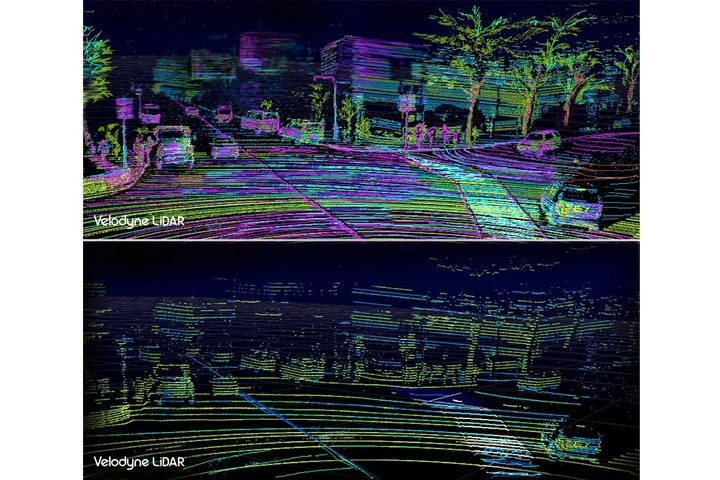
Image used with permission by copyright holder

As can be seen from the above image, the new VLS-128’s resolution is considerably better than its (already highly competent) predecessor. When you factor in faster scanning and better algorithms, it’s anywhere from three to 10 times better than existing technology. In terms of what this means for its use in the real world, Velodyne suggests that it will sideline other sensors, such as cameras and radars, that are used by current autonomous vehicles. While those other sensors will almost certainly stay a part of the next generation of self-driving cars, there’s a good chance that they will be relegated simply to acting as backup devices.

“We are ramping production up now, and we expect to start providing engineering samples to key customers by the end of the year,” Gopalan said. “Production will be fully ramped up in early 2018.”

Luke Dormehl
I'm a UK-based tech writer covering Cool Tech at Digital Trends. I've also written for Fast Company, Wired, the Guardian…
DJI’s first 360° drone offers 8K video recording and a freakishly long transmission range
From omnidirectional obstacle sensing to 42 GB of onboard storage, the Avata 360 is DJI doing what DJI does best: raising the bar for everyone else.
DJI Avata 360° drone.

DJI has officially entered the 360° drone arena with the launch of the Avata 360. It’s the company’s first-ever fully immersive FPV drone, and a direct shot at the Antigravity A1, a rival built by an Insta360-incubated brand. Looks like the drone wars just got more interesting. 

What makes the Avata 360 worth looking at?

Read more
I transferred all my chats from other AI apps to Gemini — and it works flawlessly
Google Gemini Graphics Featured

You know that moment when AI assistants like ChatGPT, Gemini, or Claude suddenly lose the plot mid-conversation and start hallucinating like they’re absolutely sure they’re right? Yeah…it’s equal parts funny and painfully annoying. My usual reaction is switching between apps, hoping one of them gets it right. But the real problem is that I have to start over every single time. It feels like I’m stuck in a loop explaining my life story to different AIs, one after the other.

Now with Gemini, I can now jump in from other AI apps without that whole reset conversation. Finally, the Google gods have blessed us. I tried it out expecting the usual hiccups, but it was surprisingly smooth and quick.

Read more
Google expands Search Live globally with voice and camera AI
The feature is now available in 200+ countries with multilingual support
Google Search Live

Google is taking another big step toward turning Search into a full-blown AI assistant. The company has officially expanded Search Live globally, making the feature available in over 200 countries and territories, along with support for dozens of languages.

https://twitter.com/google/status/2037201891130523917

Read more