

It’s been four years since 3D-printing powerhouse MakerBot began in a small New York office. Since then, the company has produced several different varieties of 3D printers and opened a retail shop in downtown Manhattan. Today, the New York City pride continues with the grand opening of the MakerBot Factory. The 50,000 square foot warehouse space in Sunset Park, Brooklyn is where the majority of MakerBot products will be assembled, packaged, and shipped.
 MakerBot CEO Bre Pettis was joined by NYC’s Chief Digital Officer Rachel Haot and Brooklyn Borough President Marty Markowitz for the ribbon cutting ceremony this morning. In MakerBot fashion, Pettis used oversized scissors that were made with the company’s own 3D printer. Haot, who we last saw at Quirky’s partnership with the city’s plan to revamp public payphones, is excited to see yet another tech company expand. The growth, she says, will help stimulate the city’s economy by providing more jobs, education, and put New York on the fast track to becoming the world’s digital capital. MakerBot joins other Brooklyn startups like Kickstarter and Etsy.
So why not open a factory overseas where labor is cheaper? Pettis explained that in their research, the combination of travel and shipping time with rising outsourcing costs made basing it out of New York a more attractive option. “Also, because Brooklyn is just the best city in the world,” he says – a comment that was met with a factory-wide applause. Markowitz echoed this sentiment, claiming that even if MakerBot did successfully opened abroad, it would never have the “swagger” of this increasingly gentrifying borough.
MakerBot employs a broader set of people than your ordinary tech company. Employees told us they’re loving the new opportunities to work in the desirable tech industry without needing computer science (or related) degrees. Several staffers say they found the jobs off Craigslist or through word of mouth, while one of the current quality managers said he heard of MakerBot via a hackerspace he frequented when he was jobless. “After a year and eight months here, I just worked my way up,” he says.
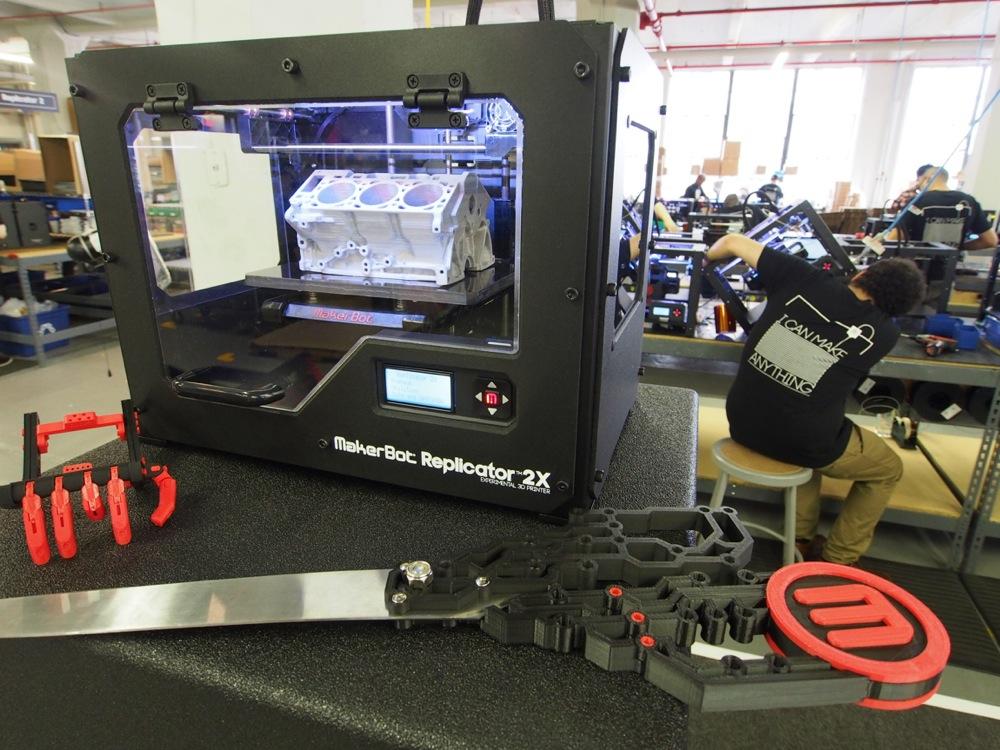 Each of the products are hand-assembled through several work stations before they’re tested for quality assurance and packaged for shipment. As we toured the new factory, we noticed MakerBot-printed products scattered throughout the space, including a familiar rendition of the robohand prosthetic, an at-home duo built to help a child who was born with no fingers.
With a larger space to work out of, Pettis sees continued expansion of his 3D empire. In addition to the company’s current 267 employees, Pettis estimates that the new factory will hire at least 50 more staffers to prepare current orders and new products. During today’s tour, we saw factory assemblymen and women piecing together MakerBot’s latest 3D printer model, the Replicator 2X. Going forward, Pettis says MakerBot will produce a 3D scanner which will allow users to scan any object, edit it, and print a copy right in their home.
“Recently somebody here had a little clay panda bear they made when they were six and were able to print a copy of that,” Pettis tells me of the MakerBot Digitizer Desktop 3D Scanner. “It’s going to allow people to make digital designs from real objects.”
With more 3D printers and objects hitting the Web, it’s easy for the general tech enthusiast to grow tire of the trend. Although the idea of 3D printing may seem more novel than useful, Pettis believes that people won’t understand how revolutionary the technology is until they have it in their homes. “Once you have a 3D printer, you can’t live without one.”


