  1. Home
  2. Emerging Tech
  3. News

Mars 2020 spacecraft survives 8 days in a freezing cold vacuum chamber

Add as a preferred source on Google

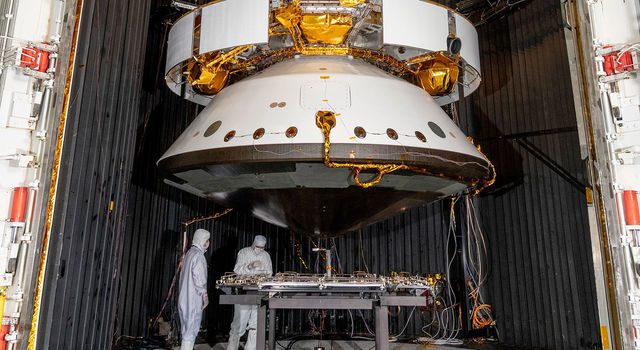
Engineers prepare the Mars 2020 spacecraft for a thermal vacuum (TVAC) test in the Space Simulator Facility at NASA’s Jet Propulsion Laboratory in Pasadena, California.The image was taken on May 9, 2019. NASA/JPL-Caltech

The spacecraft which will carry Curiosity’s little brother, the Mars 2020 rover, has been put through its paces in a further round of testing this week. The NASA Mars 2020 craft underwent acoustic and thermal vacuum (TVAC) tests which simulate the conditions of launch and of space to check it can withstand the extreme environments.

Recommended Videos

“First we blast it with sound to make sure nothing vibrates loose,” David Gruel, the Mars 2020 assembly, test, and launch operations manager at NASA’s Jet Propulsion Laboratory (JPL) explained in a statement. “Then, after a thorough examination, we ‘put it in space’ by placing the spacecraft in this huge vacuum chamber we have here at JPL. We pump out the atmosphere, then chill parts of it and cook others while testing the performance of the entire spacecraft.”

Tests were performed in a 25-foot-wide, 85-foot-tall chamber called the Space Simulator Facility. The near-vacuum environment created within the chamber requires a door that weighs 16 tons to withstand the pressure, and the chamber is chilled to -200 degrees Fahrenheit (-129 degrees Celsius) using liquid nitrogen. In addition, powerful xenon lamps shine on the craft inside the chamber to simulate the Sun’s rays.

The craft survived a grueling eight days of bombardment in the chamber and passed all the tests with no issues. “This is the most comprehensive stress test you can put a spacecraft through here on Earth,” Gruel said. “We flew in our simulated space environment for a week and a day, checking and rechecking the performance of every onboard system and subsystem. And everything looked great — which is a good thing, because next time this spacecraft stack hits a vacuum, it will be on its way to Mars for real.”

And when it comes time for the rover to find a location on Mars on which to land, it will have some help. A tool called the Lander Vision System (LVS) will descend to the surface and collect data about the terrain of the Jezero Crater, where the landing is planned. This week the LVS went through tests of its own, successfully gathering data and images from a test site in Death Valley, California.

Georgina Torbet
Georgina has been the space writer at Digital Trends space writer for six years, covering human space exploration, planetary…
Edge browser on mobile gets a huge upgrade that makes it a worthy pick over Chrome
Edge mobile gets smarter just before Chrome’s big Gemini moment
Microsoft Edge on a phone

Chrome is still the default browser for many smartphone users, but Microsoft’s latest Edge update gives them a practical reason to try something else.

Microsoft has announced a major Copilot update for Edge across desktop and mobile. The rollout comes ahead of Google’s Gemini-powered Chrome upgrade for Android, which is expected in June, giving Edge a chance to stand out on phones before Chrome’s next big AI push.

Read more
After flubbing with Siri, Apple plans to host AI agents on the App Store
One problem is about money Apple won't commit to not charging. The other is about AI agents Apple can't figure out how to control. WWDC needs to solve both.
Electronics, Mobile Phone, Phone

Apple is currently facing a Siri problem that has nothing to do with Siri at all. With WWDC 2026 just weeks away, The Information reports the company is actively courting developers to integrate their apps with the new Siri coming in iOS 27. 

The mechanism powering the overhauled Siri, App Intents, is an API that lets Siri execute actions inside third-party apps without you actively opening them, which sounds quite useful, I’d say. However, some of the world’s largest developers are dragging their feet on it, not because it’s tough, but because Apple left the door open on charging for it later.

Read more
EV batteries just need some AI top-up nudge, and they get a big 23% life boost, finds research
Charging fast and lasting long seemed impossible. A new AI trick says otherwise.
EV Charging

EV battery charging technology has always had to find the right balance between charging speed and battery longevity. If the charging speed is too fast, it wears down the battery. If the charging is too slow, nobody is happy. 

Researchers Meng Yuan from Victoria University of Wellington and Changfu Zou from Chalmers University of Technology in Sweden may have cracked this long-standing problem using an AI technique called deep reinforcement learning, and the results are pretty encouraging.

Read more