
Many hospitals around the world currently have an alarming shortage of mechanical ventilators, which they can use to treat COVID-19 patients. Responding to this crisis, Belgian 3D printing company Materialise has developed a 3D-printable device that transforms standard equipment available in the majority of hospitals into a mask that can help coronavirus patients get the oxygen they desperately need into their lungs. The company’s smart solution promises to create high positive pressure in patients’ lungs without the use of a traditional ventilator.
“The 3D-printed connector converts this standard equipment into a non-invasive PEEP mask that can be connected to [an] oxygen supply to facilitate breathing for coronavirus patients,” Bram Smits, external communication manager for Materialise, told Digital Trends. “This solution gives patients an extended period of time before mechanical ventilators are required for treatment, and helps transition them off ventilators earlier, freeing up these devices for patients in critical need. By using standard medical equipment, including a non-invasive ventilation (NIV) mask, a filter, and a PEEP valve, the solution is simple and familiar to use for medical professionals.”
Like many 3D printing companies and professionals, the folks at Materialise say they were spurred into action by their realization that additive manufacturing can help right now in a way that few other industries can.
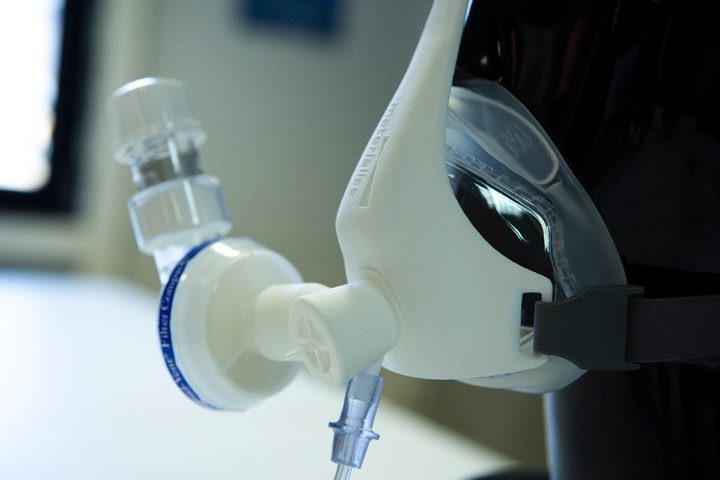
“We looked at various routes, including printing parts for ventilators and printing protective mouth masks,” Smits continued. “We contacted clinicians to better understand what the medical need of the patients was. In these conversations, we understood that the need was to have a solution for patients that need more oxygen and positive pressure before they need to be intubated — and this in a way that the medical staff was protected as well, avoiding air contamination as much as [possible].”
Creating their solution — including prototyping, testing, and iterating — took just a single week. Of course, while 3D printing makes it fast to create medical devices, it’s still crucial that they comply with regulations to ensure safety of patients and caregivers. Currently, the team at Materialise is supporting a clinical trial to put the technology through its paces.
As to what this means for patients, Smits said, “We hope to have it tested, registered, and available on the market by mid-April.”


