  1. Home
  2. Emerging Tech
  3. News

NASA’s charge-dissipating paint provides a potential solution to a dusty problem

Add as a preferred source on Google

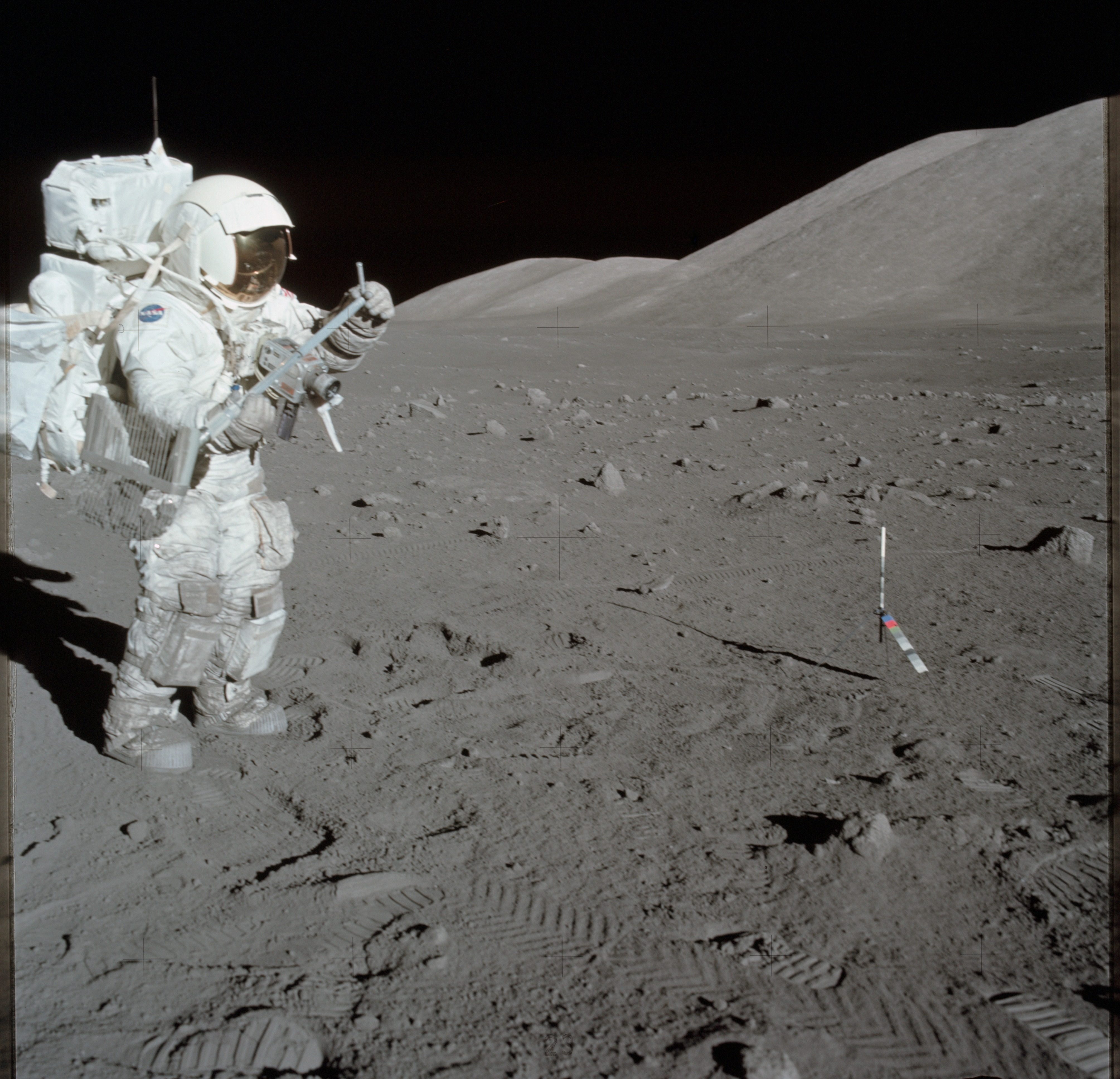
11 December 1972 — Scientist-astronaut Harrison H. Schmitt collects lunar rake samples at Station 1 during the first Apollo 17 extravehicular activity (EVA) at the Taurus-Littrow landing site. Eugene A. Cernan, Apollo 17 Commander

One challenge of lunar landings is something so small you might not even think about it — moon dust. Despite — or perhaps because of — its tiny size, the fine dust that covers the moon’s surface causes a range of technical problems from gumming up electronics to sticking to absolutely everything. It is even potentially harmful to the health of astronauts.

Recommended Videos

Now, NASA has come up with a solution that could help alleviate the dust problem. It has developed a new coating for use on satellite components, using a technology called atomic layer deposition to apply an extremely thin layer of indium tin oxide, which dissipates electrical charges, onto dry paint pigments. Then, the paint can be applied to satellite components to protect them from the build-up of electrical charges. To test the coating, painted wafers are being bombarded with plasma aboard the International Space Station to see how they hold up.

This technique works for components of almost any shape, and it could be applied to lunar exploration components as well. The moon’s dust problem is partly caused by plasma, as it is the ultraviolet radiation from the Sun which positively charges each dust particle and makes them stick to everything. So it occurred to the researchers that their technique could be applied to moon rovers and spacesuits as well.

“We have conducted a number of studies investigating lunar dust,” Bill Farrell, a scientist at NASA’s Goddard Space Flight Center and head of an organization which studies the lunar environment, explained in a statement. “A key finding is to make the outer skin of the spacesuits and other human systems conductive or dissipative. We, in fact, have strict conductivity requirements on spacecraft due to plasma. The same ideas apply to spacesuits. A future goal is for the technology to produce conductive skin materials, and this is currently being developed.”

The research team will now build a bigger oven to create greater quantities of the charge-dissipating pigment, and then they can apply the coating to spacesuit materials for more testing. Eventually, they may be able to apply the same coating to larger areas like rover surfaces as well.

Georgina Torbet
Georgina has been the space writer at Digital Trends space writer for six years, covering human space exploration, planetary…
DJI’s first 360° drone offers 8K video recording and a freakishly long transmission range
From omnidirectional obstacle sensing to 42 GB of onboard storage, the Avata 360 is DJI doing what DJI does best: raising the bar for everyone else.
DJI Avata 360° drone.

DJI has officially entered the 360° drone arena with the launch of the Avata 360. It’s the company’s first-ever fully immersive FPV drone, and a direct shot at the Antigravity A1, a rival built by an Insta360-incubated brand. Looks like the drone wars just got more interesting. 

What makes the Avata 360 worth looking at?

Read more
I transferred all my chats from other AI apps to Gemini — and it works flawlessly
Google Gemini Graphics Featured

You know that moment when AI assistants like ChatGPT, Gemini, or Claude suddenly lose the plot mid-conversation and start hallucinating like they’re absolutely sure they’re right? Yeah…it’s equal parts funny and painfully annoying. My usual reaction is switching between apps, hoping one of them gets it right. But the real problem is that I have to start over every single time. It feels like I’m stuck in a loop explaining my life story to different AIs, one after the other.

Now with Gemini, I can now jump in from other AI apps without that whole reset conversation. Finally, the Google gods have blessed us. I tried it out expecting the usual hiccups, but it was surprisingly smooth and quick.

Read more
Google expands Search Live globally with voice and camera AI
The feature is now available in 200+ countries with multilingual support
Google Search Live

Google is taking another big step toward turning Search into a full-blown AI assistant. The company has officially expanded Search Live globally, making the feature available in over 200 countries and territories, along with support for dozens of languages.

https://twitter.com/google/status/2037201891130523917

Read more