
NASA’s new planet-hunting mission, the Transiting Exoplanet Survey Satellite (TESS), was launched on April 18. After getting accustomed to its new surroundings and doing a quick buzz past the moon, it’s already produced a stunning image that was just released by NASA. As part of the calibration sequence for one of its four on-board cameras, TESS captured a swatch of the sky that includes more than 200,000 stars.
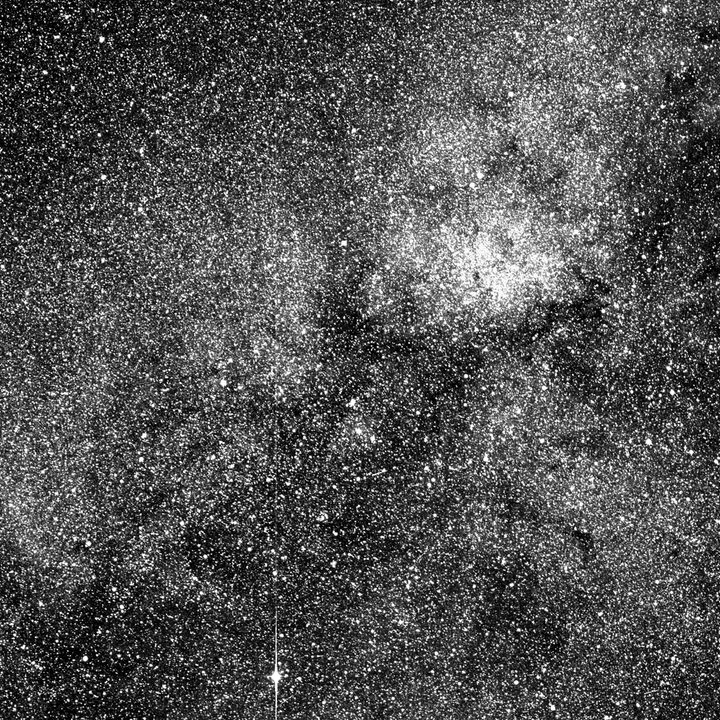
The two-second exposure is centered on the southern constellation Centaurus. The Coalsack Nebula is featured in the upper right quadrant, and the star Beta Centauri can be seen at the lower left edge.
The stunning display has captivated scientists and space enthusiasts around the globe. “We are truly excited about how well the TESS cameras are working,” MIT planetary scientist George Ricker told Forbes. “This beautiful image just popped up on the MIT payload operations display screens right after initial turn-on of the TESS instrument.”
Keep in mind, this image was produced using only one of TESS’s four cameras. Once the mission becomes fully operational, NASA expects future images to cover more than 400 times as much sky. A “first light” image suitable for detailed scientific analysis will be released in June. Meanwhile, here’s everything you need to know about the mission.
The four cameras will scan 26 entire sectors of the sky, covering both hemispheres during its two-year mission. The observations will focus on possible “transits” of exoplanets, where a far-away planet passes in front of its star causing a measurable drop in brightness. (And there’s quite a few way-off worlds; from the Dracula planet to Earth’s bigger, older cousin, here are the 10 best exoplanets discovered so far.)
“We learned from Kepler that there are more planets than stars in our sky, and now TESS will open our eyes to the variety of planets around some of the closest stars,” said Paul Hertz of NASA. “TESS will cast a wider net than ever before for enigmatic worlds whose properties can be probed by NASA’s upcoming James Webb Space Telescope and other missions.”
TESS is on its way to an unusual but highly stable elliptical orbit that takes it around the Earth every 13.7 days. After getting a gravity assist by passing within 5,000 miles of the moon, a final thruster burn on May 30 will finalize its orbit. The satellite will begin its detailed observation mission utilizing all four cameras in mid-June.
The search for exoplanets and ultimately, extraterrestrial life, will kick into high gear in the coming years. The aging Kepler satellite may be on its last legs (and about to run out of fuel), but the launch of the James Webb telescope will help scientists build on the discoveries made by TESS and expand our knowledge of the universe even further. If NASA can ever launch the darn thing.


