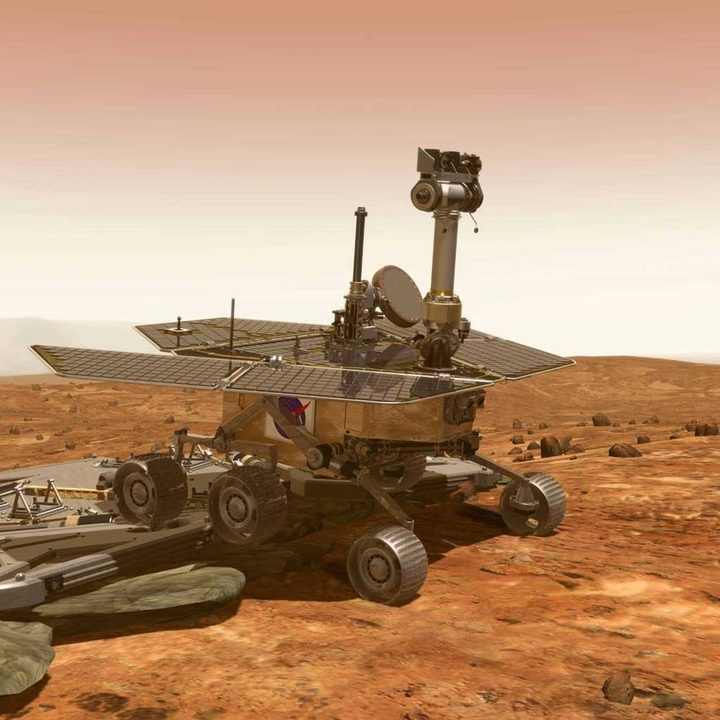
The mission to Mars was only supposed to last about three months — apparently the Opportunity rover didn’t get the message. On February 17, 2018 the golf-cart-sized rover watched the sun rise on the red planet for the 5,000th time.
A “sol” is a Martian day, and it’s about 40 minutes longer than an Earth day. A year on Mars lasts nearly two Earth years. Mission planners didn’t expect Opportunity to survive even one Martian winter; it’s now in the middle of its eighth.
“We’ve reached lots of milestones, and this is one more, but more important than the numbers are the exploration and the scientific discoveries,” said John Callas of JPL in a statement announcing the achievement.
Opportunity and its twin rover Spirit were both launched from Cape Canaveral, Florida, in 2003. They landed on opposite sides of the planet in January 2004. NASA and the engineers at JPL knew there was a good possibility that the missions would last longer than 90 sols, because the rovers could clean away the Martian dust accumulating in their solar panels.
The rovers made some valuable discoveries about Mars during their lengthy stay. Observations confirmed that there was once water on Mars, and that it was once a habitable planet. They uncovered evidence of meteorite impacts and revealed new discoveries about the Martian atmosphere.
The rover Sprint broke one of its wheels in 2004 but continued to drag itself around. In 2009, it became trapped in soft sand and could not extricate itself as dust began to build up on the solar panels. It fell silent in 2010 and NASA declared it officially dead a year later.
But Opportunity keeps on trucking. According to Science Trends, Opportunity has traveled 27 miles since landing on the red planet, beating the previous record for longest distance traveled off our planet, which had been held by the Soviet lunar rover Lunokhod 2. The rover has sent 225,000 images back to its home planet in the past 14 years, including a 360-degree panorama on its 10-year anniversary.
As Space.com reported, it’s still making new discoveries as well. A pattern of rock stripes found in January in an area known as Perseverance Valley has scientists intrigued. “I don’t know what these stripes are, and I don’t think anyone else knows for sure what they are, so we’re entertaining multiple hypotheses and gathering more data to figure it out,” said Robert Sullivan of Cornell University.
“Five thousand sols after the start of our 90-sol mission, this amazing rover is still showing us surprises on Mars,” said Callas.