  1. Home
  2. Emerging Tech
  3. Smart Home
  4. News

We launched a plaque into space 45 years ago, and a replica can now be yours

Add as a preferred source on Google

Back in the early 1970s, when David Bowie’s Ziggy Stardust was the hot album and The Godfather was playing for the first time in theaters, NASA launched its twin spacecraft, Pioneer 10 and 11. Among the items on board were two gold Pioneer plaques, which were designed by Frank Drake and Carl Sagan to serve as an “interstellar greeting card” for any extraterrestrial life they came across.

Now, 45 years after Pioneer 10’s launch, space-obsessed designer Duane King has taken to Kickstarter with replicas of the iconic plagues, which continue to represent the adventurous spirit of humankind at its best. In his own words, it’s “gold-anodized optimism.”

Recommended Videos

“I have been working with the original craftsman from 1972 to create a limited-edition, manually engraved exact replica of the plaque along with a laser-etched reissue to make the plaque available to everyone,” King told Digital Trends. “Through the campaign, I’m hoping to share a lifelong dream of mine with the world. There is nothing like holding in your hands an exact replica of a plaque that is floating in space — over 18 billion kilometers away from Earth.”
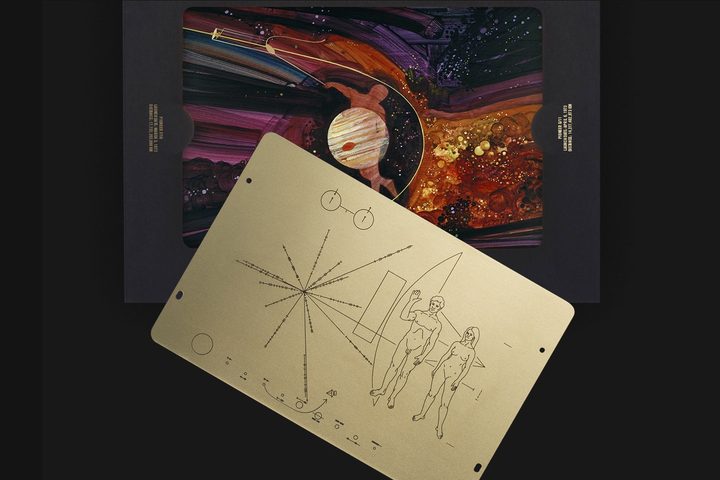
Image used with permission by copyright holder

King said that the replicas are equal in every way to the originals, as well as the versions hanging a bit closer to home in the Smithsonian’s National Air and Space Museum. The accuracy doesn’t end at the plaque, either. The original packaging has been just as carefully reproduced, from the paper engineering through to the foil-stamping.

A limited run of 200 manually-engraved replicas, priced at $399 each, have already sold out. However, a less-expensive laser-engraved edition, priced $99, is still available.

There have, it should be noted, been past examples of space-themed Kickstarter replicas that wound up disappointing customers. King is confident he can deliver.

“As for assurances, I can only say that I have a long history of successfully launching projects of all types,” he said. “I have little fear of fulfilling expectations. I have been running design studios and agencies for over 20 years. My experience ranges from launching Herman Miller’s first websites to concepting the first-ever tin video game package for id Software to introducing parallax to the web with Nike Better World. Turning dreams into reality is normal for me. And working on what is hard is what I do!”

Luke Dormehl
I'm a UK-based tech writer covering Cool Tech at Digital Trends. I've also written for Fast Company, Wired, the Guardian…
Rice grain-sized sensor could give robots a delicate touch and keep them from breaking stuff
Sprout Robot

Robots are incredibly precise, but being gentle is not always their strong suit. A machine that can build a car with near-perfect accuracy can still apply too much pressure when working in places where even the smallest mistake matters, like inside a human eye or during delicate surgery. That is why researchers at Shanghai Jiao Tong University are developing a new type of force sensor that could help robots “feel” what they are touching more accurately.

The sensor is tiny, about the size of a grain of rice at just 1.7 millimeters wide, making it small enough to fit inside advanced surgical tools. What makes it especially interesting is that it does not rely on traditional electronics. Instead, it uses light to measure force from every direction, including pressure, sliding movements, and twisting. Here is how it works. At the tip of an optical fiber sits a soft material that slightly changes shape when it comes into contact with something. That tiny deformation alters how light travels through the sensor. The altered light pattern is then sent through optical fibers to a camera, which captures it like an image. Researchers then use a machine learning model to study those light patterns and translate them into precise force readings. In simple terms, the system learns how to “read” touch through light alone, without needing a bunch of wires or multiple separate sensors packed into such a tiny space.

Read more
Meta’s own employees are having a hard time digesting AI. Who would’ve thought?
Artificial Intelligence

If you wanted a snapshot of what it looks like when a tech giant tries to force-feed its workforce an AI future, look no further than Meta right now. The company that built its empire on knowing everything about its users has turned that same appetite inward, and its employees are not happy about it. Last month, Meta quietly informed tens of thousands of its U.S. workers that their corporate laptops would begin tracking their keystrokes, mouse movements, clicks, and screen activity. The purpose was to feed that behavioral data into Meta's AI models so they could learn how people actually use computers. The reaction was immediate — within hours, internal comment threads were flooded with anger, confusion, and more than a hundred emoji reactions that left little to the imagination about how employees felt.

When an engineering manager asked how to opt out, Meta's chief technology officer, Andrew Bosworth, had a blunt answer: there was no opt-out, at least not on a company laptop. This is the same company that is also tying AI tool usage to performance reviews, running mandatory "AI Transformation Weeks" to retrain its workforce, and building internal dashboards that gamify how many AI tokens employees consume in a day — a metric so aggressively tracked that some workers started building AI agents to manage their other AI agents. The whole thing started to resemble a feedback loop eating itself.

Read more
Sci-fi got the gadgets right, but the vibes wrong
Sci-fi got plenty of consumer tech right, but reality keeps delivering the useful, compromised version of the dream
Officer K looking up at a neon-colored hologram in Blade Runner 2049.

I was recently waiting for an Uber when the GPS decided to lie for sport. The car was somewhere nearby, I was somewhere nearby, and somehow both of us were trapped in that modern ritual of wrong pins, slow turns, vague waving, and "I'm here" messages that help absolutely no one.

That was when I had a very reasonable thought: this is exactly where a hologram of a giant arrow pointing at me would be useful.

Read more