  1. Home
  2. Emerging Tech
  3. Smart Home
  4. Legacy Archives

Plant Link sends you a text message when the plants need water

Add as a preferred source on Google
plant link
Image used with permission by copyright holder

Landing nearly $100,000 through a successful Kickstarter campaign that closed earlier today, a group called Oso Technologies will be manufacturing a device that helps people keep their indoor and outdoor plants alive and thriving. Called the Plant Link, the white cylindrical device is inserted into the soil next to your plant. After the user assigns the device to a specific type of plant through the Plant Link site, the device will have a measurement standard in place to constantly judge the amount of water in the soil. Over time, the Plant Link will be able to use that information to make adjustments to the watering schedule. 

plant link textIf there are multiple plants in a household, the user can connect all of the devices to a single base station. The base station connects to the router within the home and the information about the water levels are sent to the cloud. Users can access the soil data through the Web or receive updates about their plants over email, text messages or push notifications on a mobile device. 

Recommended Videos

In addition to the Plant Link and base station, Oso Technologies has also developed a device called the Smart Valve. Designed for outdoor use, the valve connects to a home’s water source as well as the hose that’s connected to the sprinkler. Using information from the Plant Link, the Smart Valve regulates the flow of water to the sprinkler automatically based off the water levels in the soil. 

According to the Kickstarter page, the Plant Link device measures water levels within the soil every five to ten minutes and utilizes a common algorithm used within the agriculture community to analyze the soil.
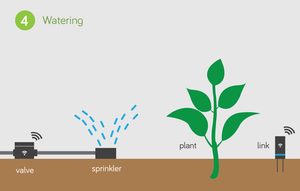
plant link watering
Image used with permission by copyright holder

The software also takes the type of soil into account when calculating the need for more water. The watering schedule is automatically updated after each reading and the schedule is also altered for outdoor plants when specific types of inclement weather are active in the area.

Regarding specific plants, Oso Technologies plans to curate the plant database and add new plants as needed by users. The Plant Link device can be positioned up to the length of a football field away from the base station, potentially ideal for small commercial areas in addition to a standard household. Hypothetically, this device could help businesses save money on the cost of watering landscaping or perhaps completely automate the watering process at a plant nursery. 

Oso Technologies plans to manufacture the device in the central Illinois area and the group currently has prototypes that are ready for the manufacturing stage of development. Beyond the closed round of Kickstarter funding, the group hasn’t created a page yet that will allow a consumer to order the Plant Link device. Assuming the manufacturing schedule stays on track, Oso Technologies plans to deliver the first batch of the Plant Link device into the hands of backers by June 2013. The prices range from $99 for the basic package with the base station and three Plant Link devices up to $149 for the basic system along with one Smart Valve. It’s likely that Oso Technologies will sell the various components separately as well.

Mike Flacy
By day, I'm the content and social media manager for High-Def Digest, Steve's Digicams and The CheckOut on Ben's Bargains…
Rice grain-sized sensor could give robots a delicate touch and keep them from breaking stuff
Sprout Robot

Robots are incredibly precise, but being gentle is not always their strong suit. A machine that can build a car with near-perfect accuracy can still apply too much pressure when working in places where even the smallest mistake matters, like inside a human eye or during delicate surgery. That is why researchers at Shanghai Jiao Tong University are developing a new type of force sensor that could help robots “feel” what they are touching more accurately.

The sensor is tiny, about the size of a grain of rice at just 1.7 millimeters wide, making it small enough to fit inside advanced surgical tools. What makes it especially interesting is that it does not rely on traditional electronics. Instead, it uses light to measure force from every direction, including pressure, sliding movements, and twisting. Here is how it works. At the tip of an optical fiber sits a soft material that slightly changes shape when it comes into contact with something. That tiny deformation alters how light travels through the sensor. The altered light pattern is then sent through optical fibers to a camera, which captures it like an image. Researchers then use a machine learning model to study those light patterns and translate them into precise force readings. In simple terms, the system learns how to “read” touch through light alone, without needing a bunch of wires or multiple separate sensors packed into such a tiny space.

Read more
Meta’s own employees are having a hard time digesting AI. Who would’ve thought?
Artificial Intelligence

If you wanted a snapshot of what it looks like when a tech giant tries to force-feed its workforce an AI future, look no further than Meta right now. The company that built its empire on knowing everything about its users has turned that same appetite inward, and its employees are not happy about it. Last month, Meta quietly informed tens of thousands of its U.S. workers that their corporate laptops would begin tracking their keystrokes, mouse movements, clicks, and screen activity. The purpose was to feed that behavioral data into Meta's AI models so they could learn how people actually use computers. The reaction was immediate — within hours, internal comment threads were flooded with anger, confusion, and more than a hundred emoji reactions that left little to the imagination about how employees felt.

When an engineering manager asked how to opt out, Meta's chief technology officer, Andrew Bosworth, had a blunt answer: there was no opt-out, at least not on a company laptop. This is the same company that is also tying AI tool usage to performance reviews, running mandatory "AI Transformation Weeks" to retrain its workforce, and building internal dashboards that gamify how many AI tokens employees consume in a day — a metric so aggressively tracked that some workers started building AI agents to manage their other AI agents. The whole thing started to resemble a feedback loop eating itself.

Read more
Sci-fi got the gadgets right, but the vibes wrong
Sci-fi got plenty of consumer tech right, but reality keeps delivering the useful, compromised version of the dream
Officer K looking up at a neon-colored hologram in Blade Runner 2049.

I was recently waiting for an Uber when the GPS decided to lie for sport. The car was somewhere nearby, I was somewhere nearby, and somehow both of us were trapped in that modern ritual of wrong pins, slow turns, vague waving, and "I'm here" messages that help absolutely no one.

That was when I had a very reasonable thought: this is exactly where a hologram of a giant arrow pointing at me would be useful.

Read more