
What do a Welsh mezzo-soprano, a castle in the southwest of England, and a quantum computer in Los Angeles have in common? Answer: they all teamed up recently for a musical performance that, according to its creator, represents the “first computer music algorithm implemented on a quantum computer [and] the first live use of explicit quantum processes in an artistic piece.”
Essentially the idea behind the performance was to give an astonishingly powerful quantum computer the opportunity to create music alongside a trained (human) classical singer. In a 15-minute piece, broken into three different movements, mezzo-soprano Juliette Pochin had her voice sent across the internet to the quantum D-Wave machine at the University of South California’s Information Sciences Institute in Marina Del Rey. There, her voice was run through algorithms to create new sounds, which were then sent back to England, and incorporated into the live performance.
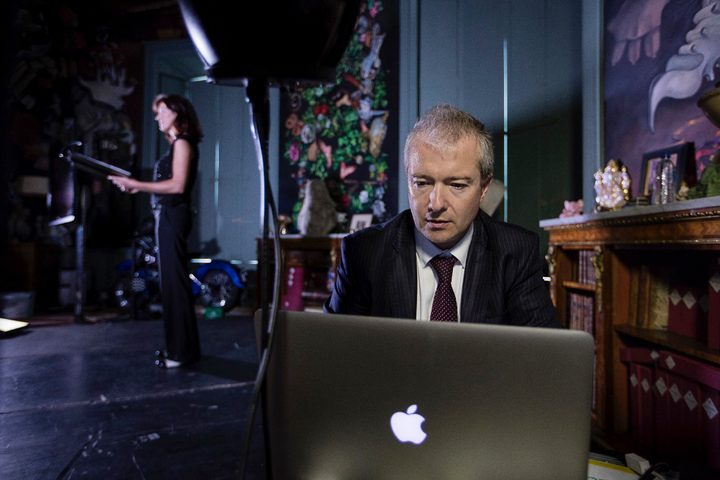
“There are three subsystems [involved],” organizer Alexis Kirke, senior research fellow at the Interdisciplinary Centre for Computer Music Research at England’s Plymouth University, told Digital Trends. “The laptop has a sound generator and communications server in the room with Juliette. The quantum computer is then called every 3 seconds, and has two sets of qubits: one to calculate harmonies, and one for melodic and noise generation. The harmonic qubits are designed musically, and solve a simple harmony problem using quantum annealing. The harmony system is actually sent specific notes by the composer which it then harmonizes. It returns multiple solutions, and in the [performance’s] second movement these are combined into giant ‘superposition’ chords which sonically represent the multiple solutions which were stored in the quantum state before it collapsed.”
Confused? You’d be forgiven for not understanding all the intricacies of the work, but it’s a fascinating example of how even processes as seemingly abstract as quantum computing can be used to create fascinating art. “I was overwhelmed by how well it went,” Kirke said. “The performance went better than all the rehearsals. Juliette sounded wonderful, and the music generated live by the computer, particularly in its solo movement in part two, was great. To be there as an audience heard the giant ‘superposition’ chords being built in that old dark performance place, was something I will always be glad to have experienced.”
And here we were thinking a quantum musical performance would just sound like the yowling of Schrödinger’s cat!


