
“Why you can trust Digital Trends – We have a 20-year history of testing, reviewing, and rating products, services and apps to help you make a sound buying decision. Find out more about how we test and score products.“
You may walk the Razor’s edge … but you’ll never be blown up by one.
That’s the premise behind the new Hovertrax 2.0 from scooter company Razor, which carries a sticker for the brand-new UL 2272 standard, a certification from the authorities at Underwriters Lab specifically designed to ensure that so-called hoverboards meet safety standards. And there are only a handful of boards that meet the standard to date.
“Last year Razor shipped 1.2 million units,” David Kim, director of sales for the company, told Digital Trends. “We know a little something about this stuff.”
The UL 2272 standard evaluates the safety of the electrical drive train, battery, charger, and how the systems work together, the group explains. The new standard focuses on individual lithium-ion cells and multicell battery packs, which are of particular concern. “This is where most of the issues could arise from, because the battery pack carries a lot of energy in a small package. The battery pack is something that, when one of the cells faults, it could involve others,” Consumer Safety Director John Drengenberg, who has worked for UL for more than 50 years, told Cnet. “It has a domino effect that could cause the fires that we might have seen.”


Kim confirmed that it’s battery packs causing the problem. “Most of the fires that we know of are because of the cheap, knock-off batteries and the chargers that are associated with it.” Razor’s product uses only premium batteries from LG, Kim said, another thing that makes them safer, he claims.
You see, hoverboards are awesome. Hoverboards also blow up, which has led to nationwide bans on their use in subways, on airplanes, and in your living room (oh come on, Mom!). The UL 2272 standard aims to guide consumers toward those electric scooter that don’t blow up. This is a Good Thing.
“Most of the fires that we know of are because of the cheap, knock-off batteries.”
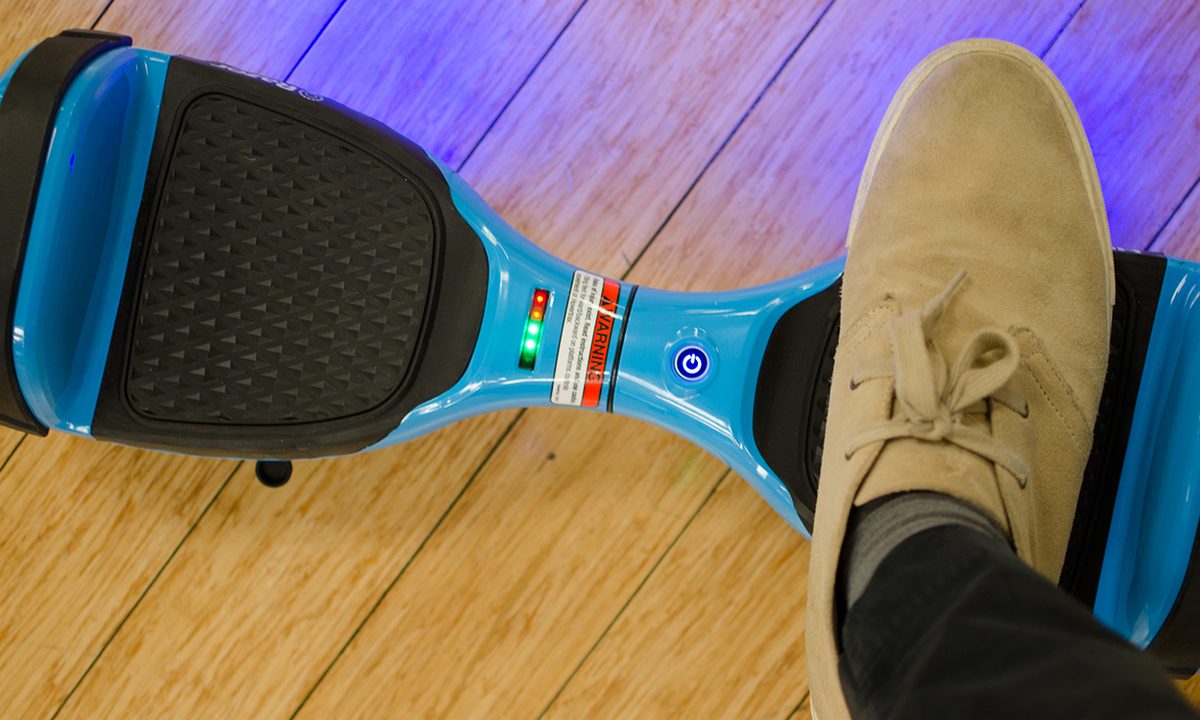
The Hovertrax 2.0 looks like any other electric scooter: It’s two feet wide, with two rubber wheels covered by plastic hoods with bumpers. Our model was a beautiful shade of blue, with LED taillights in front and a battery indicator and power-on switch in the middle, between where your feet fit. It supports up to 220 pounds. Cheap models (and cheap drones, for that matter) come with cheap chargers that don’t shut themselves down when the battery is fully charged. Razor’s will, meaning you can leave it plugged in to charge overnight; a full charge takes four hours and supports up to 60 minutes of continuous riding.
It’s also a self-balancing unit: “All the other products out there don’t self balance — you have to actually get on it and balance yourself,” Kim explained. Getting on and off these devices is the most dangerous (and most challenging) part. Your foot movements control the board’s forward and backward movements: Angle a foot forward and the motor in that wheel housing will start the board going. With models that don’t automatically level themselves, the rider must do that – and it’s easy to activate the motor at the same time.

The entire Digital Trends office has now tested out the Hovertrax 2.0, and with very few exceptions, we’ve become pretty solid riders. We can do tricks. We zip back and forth, and do spins fast enough to make your head start spinning. We’ve fallen off too, of course, but only once or twice. And most importantly, we haven’t exploded.
Remember I said that only a few models meet the standard? One of the others is the Ninebot by Segway miniPRO, which was certified in May, 2016 (along with the Razor product and models from Hangzhou Chic Intelligent Technology Co Ltd., PTX Performance Products, Shenzhen Global E-Commerce Co Ltd., and Wuyi Chuangxin Metal Tools Co Ltd.). You might recall Segway as the company that sought to change the world with its self-balancing two-wheeled vehicles. Hoverboards ate Segway’s lunch, however, as did cheap Chinese knock-offs – one of which ended up swallowing the company whole.
Razor says it’s the only model with an actual license to the patent covering hoverboards, which is owned by Californian inventor Shane Chen. In January, Segway filed its latest lawsuit against Razor (and a company called Swagway), alleging that its patents cover self-balancing scooters, not Chen’s. Meanwhile, Razor has been on a tear too, suing anyone and everyone in order to stem the flow of cheap products.
“In America, we’re the only brand [with a license from Chen], and we will litigate wherever possible,” Kim told me.


