
A smart helmet to protect motorcyclists’ brains is a no-brainer, especially with all the wild and wacky wearables available. Enter what may be the smartest motorcycle helmet in the world, the Skully AR-1.
Well, almost.
Designers hit upon smart helmets as early as 2005, but it’s tech and availability that set the Skully AR-1 apart. We picked up on that when we first took a look at it a couple years ago. As the product nears availability — it’s projected for release in May — we learn more about it. Like the price tag: $1,500, which isn’t so bad considering the features.
Of those smart helmets that are near to market or already available, none of them have the AR-1’s features. Don’t let the looks of a traditional full-face motorcycle helmet fool you; inside the DOT/ECE certified shell, wearers get intelligent audio — helmet-to-helmet communication, hands-free calling, and music streaming — and GPS navigation via Bluetooth to a cell phone, in addition to a wide-angle rear view camera that shows up on a transparent heads-up display built into the visor (fog, scratch, and glare resistant, of course).

The HUD is the star of Skully’s show. Skully Helmet’s founder and CEO Marcus Weller said he came up with the idea for a helmet with a transparent HUD after he was involved in a motorcycle accident, which he believes he could have avoided if he was looking at the road instead of at the road sign.
Managed by Skully’s Synapse system, the helmet’s transparent display conveys turn by turn GPS directions, the rear camera feed with a “near 180 degree” view and, if paired with the right bike, vehicle speed, gear, RPMs, and more. Directions themselves are pulled from crowd-sourced maps as well as commercial providers. Navigation will even be available outside cell coverage thanks to the AR-1’s ability to save maps; users who stay on the beaten track will have access to real-time map updates with traffic readings.
The area of the display itself takes up as much screen (or visor) real estate as the palm of a user’s outstretched hand in the bottom right corner of the screen. Thanks to “Infinite Focus,” the heads-up display focuses to your eye, as opposed to the other way around — or rather, it always looks like its floating clearly in the distance. Turn by turn directions disappear when not needed, further conserving energy and screen space. Riders can also use the app to adjust the rear camera to fit different riding positions.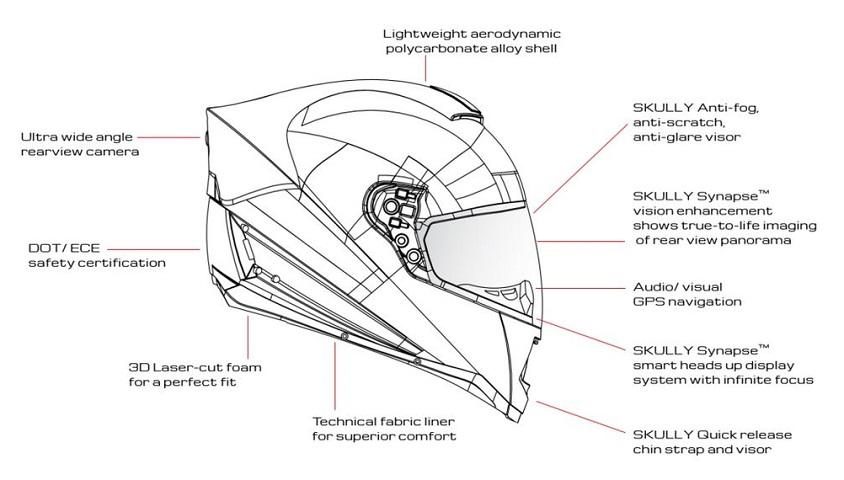
Granted, the Skully AR-1 has a few competitors in the smart helmet arena. Take the Forcite Helmet system designed for winter sports; it too has helmet-to-helmet communication, music, and hands-free calling. It comes with a headlamp and built in HD camera to record video. Of course, it doesn’t have a visor, and hence, no HUD. Since it’s not designed specifically for use with vehicles, it won’t relay vehicle information the way the AR-1 can.
The closest competitor is Nand Logic’s Enchephalon, which looks something like a cyclists’ time-trail helmet but is deigned for multiple sports, and for motorcyclists. It offers comparable features, including some the AR-1 is missing like exterior turn signals triggered by the built in accelerometer and gyroscope. It’s also missing some things the AP-1 already has, like the live feed from the rear camera and the clear, infinite focus HUD. With no release date, it’s still trying to catch up with the Skully AR-1, which smashed funding records on Indiegogo last year.


