  1. Home
  2. Emerging Tech
  3. News

Flying observatory discovers role of stellar winds in star formation

Add as a preferred source on Google

New research using NASA’s Stratospheric Observatory for Infrared Astronomy (SOFIA) suggests that the formation of stars can be regulated by stellar winds, shedding new light on how stars are born.

Previously, it was believed that cosmic processes such as supernovae were responsible for regulating the way in which new stars formed. Now according to the new research, it seems that the stellar winds that are generated when a star is born may prevent new stars from forming nearby. Stellar winds are fast moving flows of material that are ejected outwards from a star, and this new data shows that they can blow away the materials that are required to create new stars, preventing stars from being born too close to other newborn stars in a process called feedback.

Recommended Videos

The findings come from observations of the Orion Nebula, one of the most photographed objects in the night sky and the closest stellar nursery to Earth. Using infrared light, scientists are able to peer through the clouds of dust and gas shrouding the nebula to observe the process of star birth happening within. They saw that a baby star called Theta1 Orionis C (θ1 Ori C) was generating strong stellar winds which were sweeping up large amounts of material from the cloud around the star, “like a snow plow clearing a street by pushing snow to the road’s edges.”
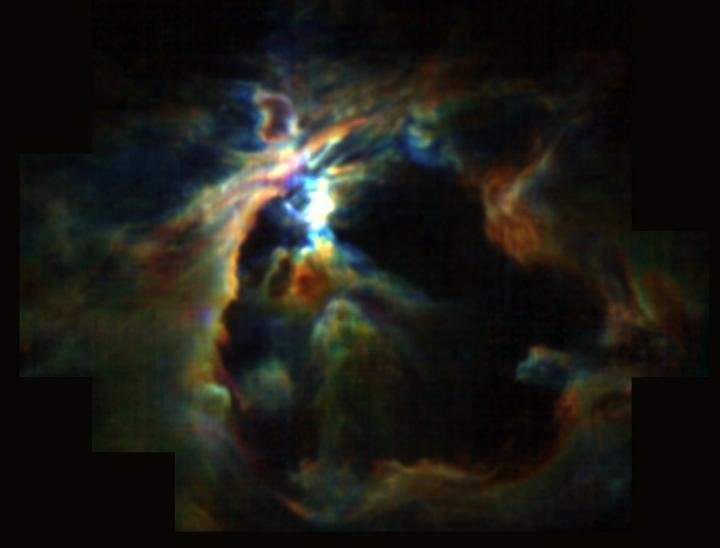
The powerful wind from the newly formed star at the heart of the Orion Nebula is creating the bubble (black) and preventing new stars from forming in its neighborhood. At the same time, the wind pushes molecular gas (color) to the edges, creating a dense shell around the bubble where future generations of stars can form. NASA/SOFIA/Pabst et al.

“The wind is responsible for blowing an enormous bubble around the central stars,” lead author Cornelia Pabst, Ph.D. student at the University of Leiden, the Netherlands, said in a statement. “It disrupts the natal cloud and prevents the birth of new stars.”

SOFIA is a flying observatory in a modified Boeing 747SP jetliner aircraft which can fly above 99 percent of the water vapor in Earth’s atmosphere, allowing instruments like the German Receiver for Astronomy at Terahertz Frequencies (GREAT) to detect infrared light that would otherwise be blocked by the vapor. The GREAT instrument measured the spectral signature of ionized carbon to determine the speed of gas moving in the distant nebula “like a police officer uses a radar gun,” according to co-author Alexander Tielens.
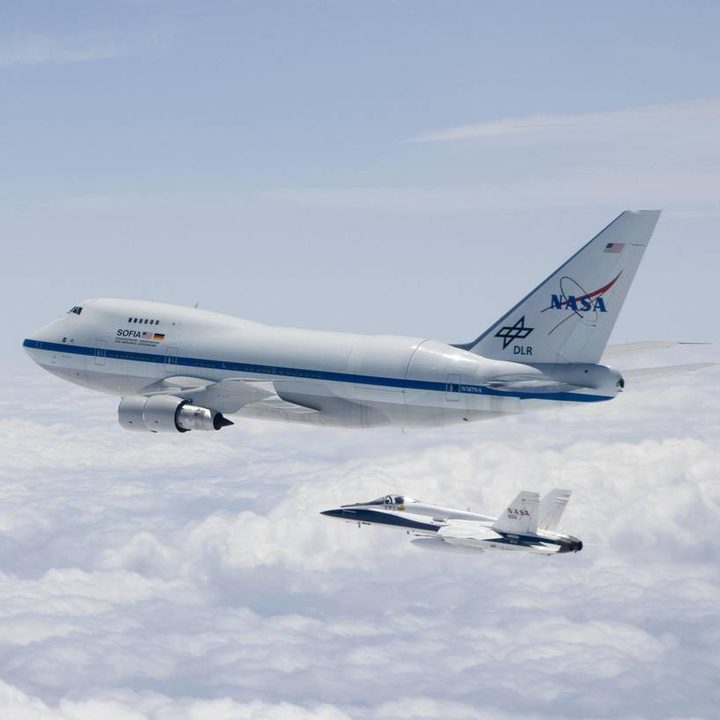
NASA’s SOFIA airborne observatory is shadowed by a NASA F/A-18 safety chase aircraft during its second checkout flight near Waco, Texas on May 10, 2007. NASA

The findings are published in Nature.

Georgina Torbet
Georgina has been the space writer at Digital Trends space writer for six years, covering human space exploration, planetary…
Edge browser on mobile gets a huge upgrade that makes it a worthy pick over Chrome
Edge mobile gets smarter just before Chrome’s big Gemini moment
Microsoft Edge on a phone

Chrome is still the default browser for many smartphone users, but Microsoft’s latest Edge update gives them a practical reason to try something else.

Microsoft has announced a major Copilot update for Edge across desktop and mobile. The rollout comes ahead of Google’s Gemini-powered Chrome upgrade for Android, which is expected in June, giving Edge a chance to stand out on phones before Chrome’s next big AI push.

Read more
After flubbing with Siri, Apple plans to host AI agents on the App Store
One problem is about money Apple won't commit to not charging. The other is about AI agents Apple can't figure out how to control. WWDC needs to solve both.
Electronics, Mobile Phone, Phone

Apple is currently facing a Siri problem that has nothing to do with Siri at all. With WWDC 2026 just weeks away, The Information reports the company is actively courting developers to integrate their apps with the new Siri coming in iOS 27. 

The mechanism powering the overhauled Siri, App Intents, is an API that lets Siri execute actions inside third-party apps without you actively opening them, which sounds quite useful, I’d say. However, some of the world’s largest developers are dragging their feet on it, not because it’s tough, but because Apple left the door open on charging for it later.

Read more
EV batteries just need some AI top-up nudge, and they get a big 23% life boost, finds research
Charging fast and lasting long seemed impossible. A new AI trick says otherwise.
EV Charging

EV battery charging technology has always had to find the right balance between charging speed and battery longevity. If the charging speed is too fast, it wears down the battery. If the charging is too slow, nobody is happy. 

Researchers Meng Yuan from Victoria University of Wellington and Changfu Zou from Chalmers University of Technology in Sweden may have cracked this long-standing problem using an AI technique called deep reinforcement learning, and the results are pretty encouraging.

Read more