
If you’re an enlightened, modern sort of person, you feel that ironing duties should be split 50/50 between men and women. Not so, if you’re a researcher at the Carlos III University of Madrid, Spain. They believe the task of ironing should reside entirely with one member of the household: The domestic robot.
With that in mind, they’ve developed a humanoid robot called TEO that has mastered the art of ensuring your shirts and trousers are wrinkle-free — courtesy of some smart image recognition algorithms.
“Our goal is to develop the first robot household companion that can assist people with their domestic tasks,” David Estévez Fernández, a doctoral student in computer science and technology at the university, told Digital Trends. “While previous works on robotic laundry and ironing focused on just achieving the task, our goal was a bit more ambitious. Other approaches required very controlled environmental conditions to work, such as control of the room illumination to detect wrinkles, or predefined models for garment recognition. The key requirement for us was that our method must be implementable in a real-world domestic scenario, using the same tools as we humans use, without any modifications.”
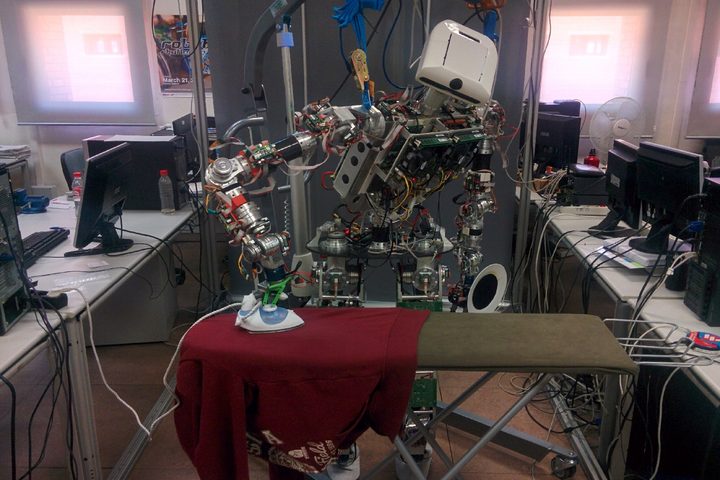
That’s an admirable goal, but it certainly makes life harder for the team. Ironing might not be the most strenuous household chore from a human perspective, but clothes aren’t an easy thing for robots to manipulate. Challenges arise from the deformability inherent in garments. Unlike rigid objects, clothes get wrinkled and entangled, so garment manipulation requires careful planning of the moving trajectory, and a constant tracking of garments’ current shape on a moment-to-moment basis.
To cope with this, TEO gathers its images from a camera built into its head, which generates a high-resolution 3D representation of the clothes and ironing board. It then calculates a “wrinkliness local descriptor” to work out what’s a wrinkle and what’s a desirable crease. It’s smart stuff — and Fernández is hopeful that it will arrive in your home in the not-too-distant future.
“Ironing is just one of the chores that people do on a daily basis,” he said. “To continue our work, we would like to teach the robot to perform other tasks, such as folding garments. For this, we are beginning to use deep reinforcement learning techniques, a recent field that combines traditional reinforcement learning with deep learning. Reinforcement learning is similar to how we learn. The robot perform actions and, when performed correctly, it receives rewards. The robot learns trying to maximize the amount of rewards obtained from its actions. This, combined with our Continuous Goal-Directed Actions method, will allow us to teach the robot how to fold garments just by showing it how we perform the folding task. This way, no programming or technical knowledge would be required to teach the robot how to perform the tasks we want it to perform.”
Coming soon to a house near you. We hope.


