
The idea of treating disease or carrying out surgery using swarms of tiny robots injected into the human body may sound like science fiction, but it is one that is proving increasingly popular. In a new research project, nanoengineers at the University of California, San Diego have added their names to the ranks of researchers working in this area by demonstrating the use of tiny “micromotor” nanobots, capable of treating a bacterial infection in the stomach. The lab’s tiny vehicles, each one around half the width of a human hair, are able to swim rapidly through the stomach, neutralizing gastric acid and releasing a cargo of drugs at the desired pH level.
In experiments involving mice with bacterial stomach infections, the team’s micromotors proved effective at delivering a course of antibiotics daily for five days. An article describing the work was published in the journal Nature Communications.
“This work represents the first study showing in vivo therapeutic efficacy of microscale artificial motors for the treatment of a stomach infection,” Berta Esteban Fernández de Ávila, a researcher on the project, told Digital Trends. “We have developed drug-loaded microscale motors which can be autonomously activated in gastric acid, swim throughout the stomach, stick to the stomach wall where the bacteria is located, and release the antibiotics performing effectively in vivo bactericidal activity.”
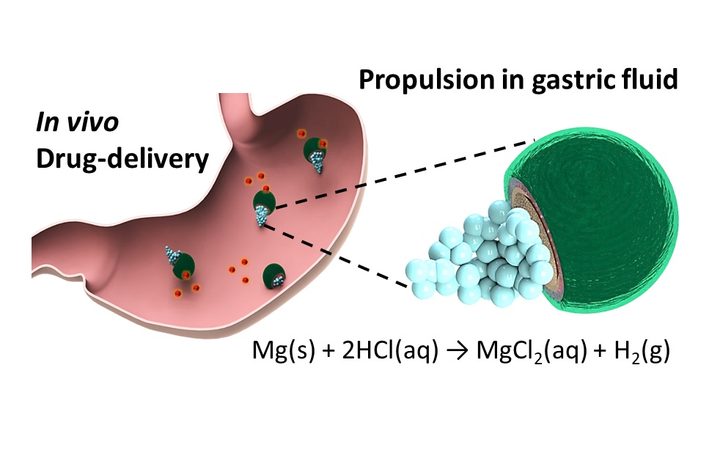
De Ávila said that the tiny bots will simplify treatment since they do not require the administering of proton pump inhibitors (PPIs) to neutralize the acidic environment of the stomach. PPIs are required by current gastric antibacterial treatments. You don’t need to worry about leaving swarms of tiny robots floating around in your guts, either, since the micromotor design is based on biodegradable materials, which are ultimately dissolved in the gastric acid, leaving only non-harmful residues.
In the future, the researchers hope to develop new designs of micromotors, combining cocktails of different drugs. These could be used for treating multiple diseases in the stomach or in different sections of the gastrointestinal tract.
“We are really happy with the promising results we got, but our work is still at an early stage,” De Ávila said. “We are planning to do different studies to further evaluate the therapeutic performance of the drug-loaded micromotors in vivo, and compare it with other standard therapies against stomach diseases. Despite more evaluations being needed before implementing these micromotors in real treatments, [however] we think that our work opens the door to the use of synthetic motors as an active delivery platform for in vivo treatment of diseases.”


