
“It doesn’t unseat Sony’s RX1 as the best point-and-shoot, but it takes darn good pictures with accurate colors and sharp resolution. Users will be pleasantly pleased.”
- DSLR-equivalent APS-C sensor
- 28mm fixed focus prime lens
- Beautiful, sharp stills
- Excellent low-light shooting
- Difficult to access video mode
- Battery life of a compact cam, not DSLR
- Video quality isn’t up to par with stills
“Why you can trust Digital Trends – We have a 20-year history of testing, reviewing, and rating products, services and apps to help you make a sound buying decision. Find out more about how we test and score products.“
Small cameras packed with large imaging sensors are one of our favorite new imaging trends. And digicams with prime (fixed focus) lenses are also very cool. The new Nikon Coolpix A ($1,100) combines both of these features in an extremely compact package. But for a compact-on-steroids that costs as much as a really good DSLR, does it have the chops to dethrone Sony’s Cyber-shot RX1 as the “best point-and-shoot”?
Features and design
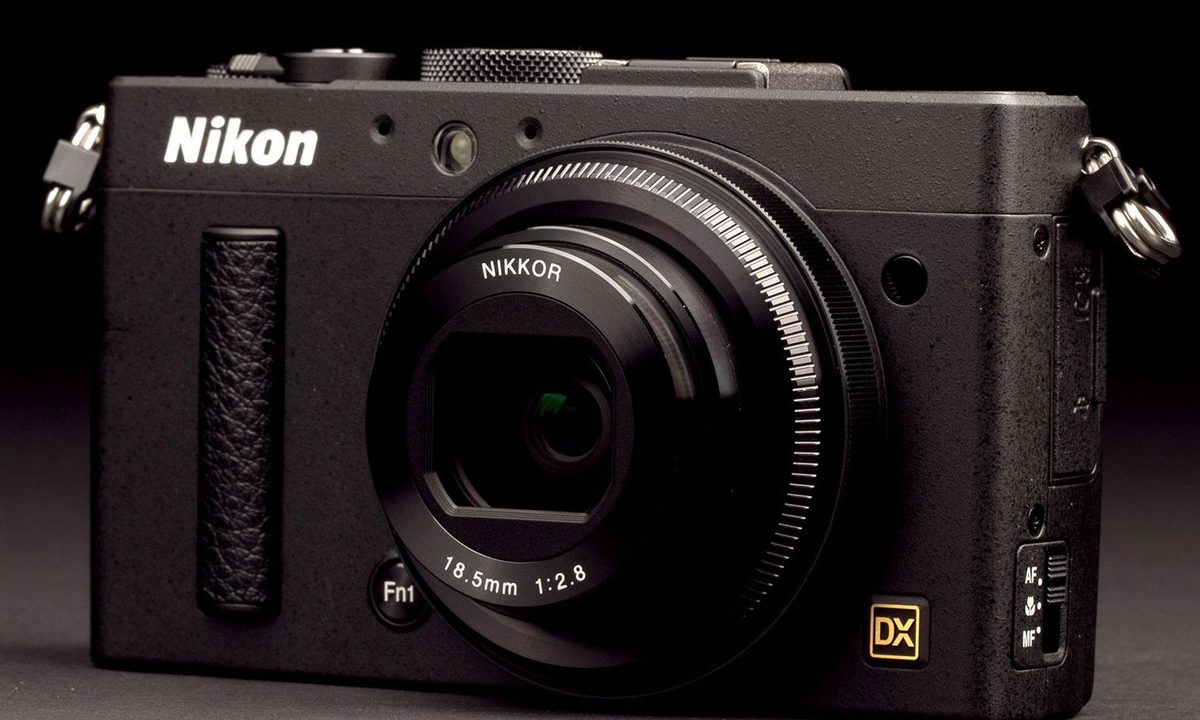
The Coolpix A – measuring 4.4 x 2.6 x 1.6 inches and weighing 10.6 ounces – is very similar in size to the Sony Cyber-shot RX1, the best point-and-shoot camera we’ve tested to date. That $2,800 camera has a 24.3-megapixel full-frame sensor that delivers outstanding picture quality. In the case of the Coolpix A, Nikon uses a smaller APS-C sized chip that’s similar to those found in DSLRs and many mirrorless compact system cameras (CSC). In other words, this unassuming camera offers the same quality as some those much bulkier models. Like the RX1, this Nikon has a fixed focus lens but it’s an f/2.8 28mm prime lens versus the Sony’s f/2.0 35mm prime glass. It also doesn’t have the dedicated aperture ring we liked so much on the Sony.
This unassuming camera offers the same quality as some of those much bulkier DSLRs.
In case you missed this bit of text earlier, let us emphasize again – there’s no zooming with this baby other than using your feet. As most of us are used to having a zoom lens in a compact camera, it begs the question, Why would anyone want to give up that convenience? Compact fixed-lens cameras with large sensors are especially appealing to pros and street photographers who want a camera they can carry everywhere to quickly grab superior images, even if it means giving up a zoom lens. For the rest of us, these types of cameras are also great everyday cameras since they’re much lighter than DSLRs and CSCs but deliver the high-quality goods.


On the surface, the Nikon Coolpix A looks like many enthusiast point-and-shoots such as Panasonic Lumix LX7 or Canon PowerShot G15 but those sub-$500 cameras do not have large sensors or prime lenses. The all black (or silver, if you prefer) digicam has a nice raised finger grip on the front and some low-key logos with one indicating the DX (APS-C) chip – a moniker, usually reserved for Nikon’s DSLRs, used to suggest its advanced attributes. The key feature on the front is the retractable f/2.8 28mm lens. Unlike point-and-shoots with zooms, this lens offers a full range of aperture settings from f/2.8-f/22 when you’re in aperture priority mode. Now you can really have some fun blurring backgrounds, if you desire that effect achieved with wide-open settings. The Nikkor lens also has a focus ring to fine-tune adjustments if you use manual focus. Also on the front are stereo mics, an AF assist lamp, and a Function 1 button that can be adjusted to various preferences (flash is the default) but there are many others (burst, self-timer, AE lock, and so on).
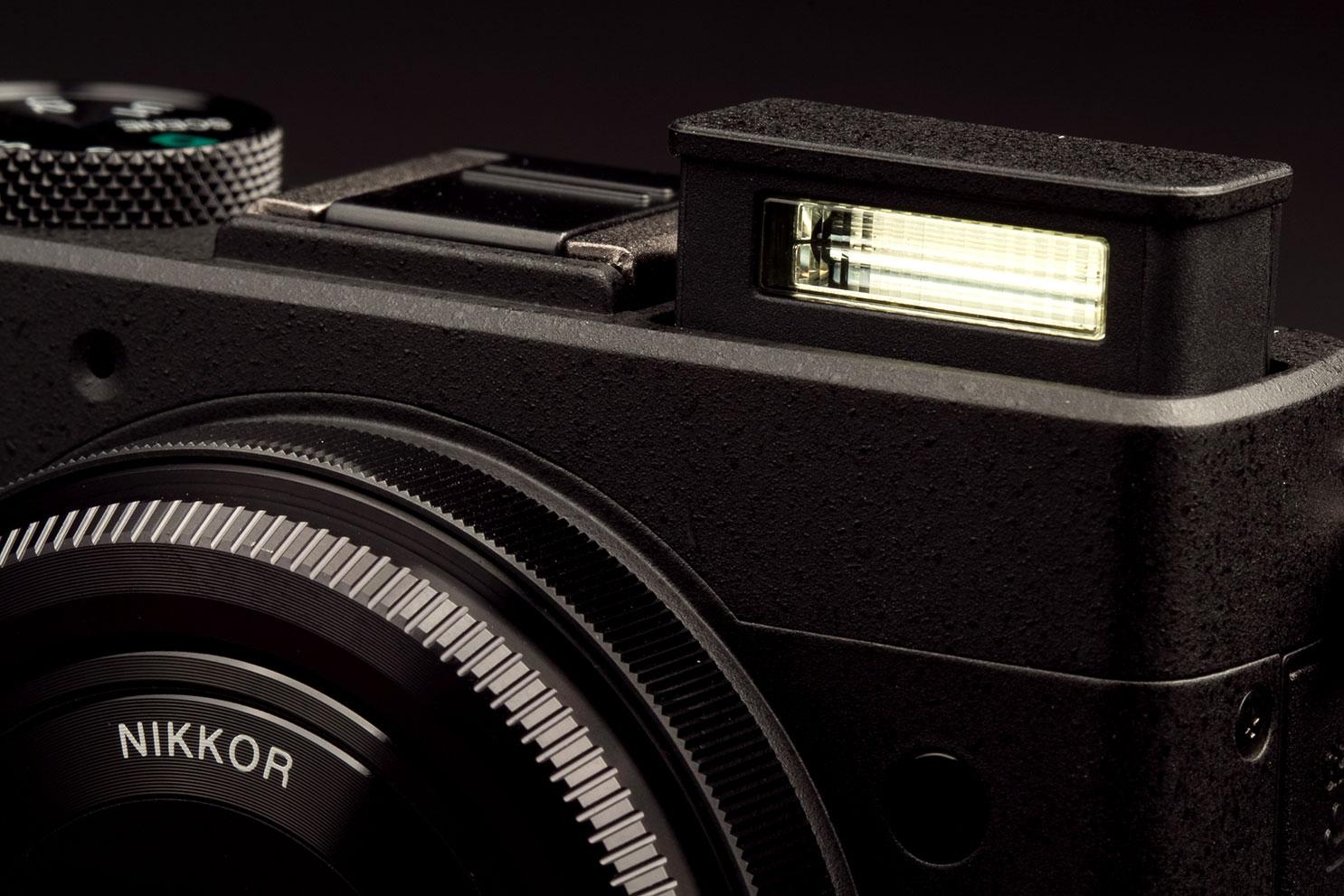
On the top deck is a small manual pop-up flash with a tiny switch behind it, a hot shoe, mode dial, combo shutter/on-off switch, and a control dial for making menu adjustments. The mode dial contains Auto, PASM, two user-configurable settings, as well as Scene (19 options). What is missing here and anywhere else on the surface of the camera is a movie mode or dedicated red-dot video button. We know this camera is intended for serious photography but even the most hardcore user wants to take a video on occasion. (To get to video, you have to read the manual [ha!], press the “I” button, then scroll into the release mode, changing it to Movie.) This feature really seems like an afterthought rather than part of the integral design. One would hope this will be rectified when the camera is refreshed.
The Nikkor lens is very sharp, even without the help of built-in optical image stabilization.
Other rear buttons include Playback, Menu, Info, Delete, as well as a jog wheel with a center OK button. Within a relatively short time you should get the hang of it but keep that user’s manual handy during your initial forays, just as we did.
On the right side is an HDMI-out while on the left is an accessory terminal and USB-out. The bottom of the Coolpix A has a metal tripod mount and a compartment for the battery and SD card (be sure to use high-speed, high-capacity media).
What’s in the box
The Coolpix A is supplied with a strap, USB cable, lithium-ion battery rated 230 shots (okay, but not great), wall charger, and a CD-ROM with Nikon’s View NX2 software for handling RAW and JPEG files. Buying a spare battery makes sense if you plan on an all-day shoot since this the battery is clearly point-and-shoot level rather than more robust DSLR or CSC ratings. The camera is also supplied with a 58-page user’s manual; you’ll definitely need it, as there are some perplexing issues with the Coolpix A as we’ve already noted.
Performance and use
We recently reviewed the Nikon D7100, a really fine DSLR. For all its pluses, the camera is very heavy and bulky. The Coolpix A, by comparison, is a featherweight, a digicam you can easily carry around without feeling like there’s an anchor around your neck. We did exactly that over the course of several weeks, during various travels through the Southwest. It was a lot of fun taking out this unassuming camera and firing away.
Since this is a 16.2-megapixel camera, it captures 4928×3264 pixel files in JPEG and RAW. We did most of our shooting in best quality JPEG with noise reduction and Nikon’s Active D-Lighting (a feature that brings out shadow and highlight details in high-contrast images) off, just to see how it performed without these aids. We took the camera out to the Arizona desert and the faux jungles of Las Vegas. The camera is so easy to carry that at no time did we have a second thought about toting it with us everywhere.
As the lens extends upon powering up, the Coolpix A comes to life quickly and has fairly rapid response. The camera rarely hunted for focus and has pretty peppy performance of 4 frames per second with the flash off. Although it’s fast, you won’t catch a fastball for the cover of SI. The top shutter speed is 1/2000th of second, compared to an enthusiast’s DSLR like the D7100 which reaches 1/8000th. But the Coolpix A is not a pro’s first camera, anyway – it’s probably their third. For everyone else looking for a compact point-and-shoot with excellent image quality and doesn’t want to spend three grand on a DSLR, the Coolpix A goes to head of the list.
Besides lackluster video, our biggest hesitation is the price.
As with any camera, you’ll get your best results with lots of light and the Coolpix A is no exception. As we reviewed our images, we could clearly see the dust on the hood of an old Chevy pickup, desert sunsets had all the beauty of the original events, and cactus needles looked as nasty as ever. We tried out the Monochrome special effect on some of the aforementioned cacti and enjoyed the results. As noted up top, we like the added distortion of a 28mm lens and by underexposing a bit we grabbed some nice renderings of Vegas skyscrapers in bright sunshine.


The Coolpix A has an ISO range of 100-25,600, and thanks to the large APS-C sensor, noise was well under control up to ISO 3,200. Beyond these numbers, you’ll definitely see speckles galore but this is a solid camera for low-light shooting.
Unfortunately we found noise to be an issue during our movie shooting, even in bright light. There were some problems with jitter as we panned and the stereo mics made a breeze sound like the back-end of a plane. Colors were okay but without the richness of the stills. Now we can understand why Nikon makes it so hard to take videos!
Conclusion
The Nikon Coolpix A is another camera we have no problems recommending. It takes darn good pictures with accurate colors and sharp resolution. Besides lackluster video, our biggest hesitation is the price – especially since you can get the similar 28mm prime Ricoh GR with a 16.2-megapixel APS-C sensor that sells for $799.
You’re probably saying, “Wait a minute, the RX1 is even more expensive for a fixed-lens solution!” But the RX1 is a full-frame camera that captures amazing photos, with few operational flaws – truly a breakthrough. Cost aside, the Coolpix A has just enough issues that prevented it from earning an Editor’s Choice award, but it was close. The Coolpix A doesn’t beat the RX1 for the title, but it deserves a very respectable second place. With that said, anyone with the cash or the desire to own such a camera will be pleasantly pleased.
Highs:
- DSLR-equivalent APS-C sensor
- 28mm fixed focus prime lens
- Beautiful, sharp stills
- Excellent low-light shooting
Lows:
- Difficult to access video mode
- Battery life of a compact cam, not DSLR
- Video quality isn’t up to par with stills


