
“Astro Bot is a triumphant and expertly designed return to PlayStation's more playful days.”
- Airtight platforming
- Wildly inventive level design
- Toy-like world
- Takes full advantage of the DualSense
- Heartfelt PlayStation cameos
- Last world repeats itself


“Why you can trust Digital Trends – We have a 20-year history of testing, reviewing, and rating products, services and apps to help you make a sound buying decision. Find out more about how we test and score products.“
It was a prime beach day in Cape Cod, but I couldn’t pry myself away from my cousin’s PlayStation. He had brought it over to my parent’s summer home one day in the late ’90s and hooked it up in the back bedroom. We drew the blinds to block out the glare and spent hours playing a new game instead: Spyro the Dragon. I was transfixed. When I pressed a button to spew fire, it was like the controller disappeared. The colorful 3D world transported me to my own personal playground, a place beyond my imagination. What other frontiers were out there for me to explore?
At one time, this was a fundamental video game experience; a 3D platformer was just about the coolest game you could have. These were tightly designed adventures that understood the ways that digital play could activate creativity, even through a silly little cartoon with nothing to say. In recent years, major video game publishers have abandoned that idea. While Nintendo still reveres that power, once great sanctuaries for kids have crumbled as publishers have set their sights on courting “mature” audiences through photorealism and weighty themes. Video games are richer for that change, but young — and young at heart — are getting left behind, stuck wandering the vast desert of Roblox games with nothing but their parent’s credit card in their pocket.
It’s as if we’ve forgotten that the first word in PlayStation is “play.”
That’s why Astro Bot feels as consequential as it does even if it just looks like your average 3D platformer full of collectibles and clever power-ups at a glance. The expertly designed PS5 exclusive plays like an intervention with its own publisher. It brings the PlayStation platform on an intergalactic journey through its history to rediscover its long lost sense of wonder. It’s not just a very effective ad for Sony; it’s an exuberant adventure that remembers that there’s power in play.
Pitch-perfect platforming
While Astro Bot is the third game in a series, it feels like the first. I believe that Astro Bot: Rescue Mission is the greatest 3D platformer of this generation, but its PSVR exclusivity meant that few experienced it. Many more got to try the series through Astro’s Playroom, a short and sweet pack-in game that comes pre-installed on every PS5, but that’s more of a great tech demo for the DualSense controller. Astro Bot, on the other hand, is a full-fledged 15-hour platformer that’s loaded with levels, collectibles, and secrets. It earns its statement title; it’s a proper start for what’s previously been treated as a B-series.

The general structure is identical to Astro’s Playroom, but delivered on a grander scale. The adventure starts when a PS5-shaped spaceship full of adorable robots gets attacked by a gooey green alien. It crash lands in the desert but its parts fly off to different planets, as do all of its bots aside from Astro. It’s a simple setup that gives the hero a reason to travel to six different worlds filled with distinct levels, bosses, and optional challenge stages to recover the ship parts and his pals. Right from the start, it’s clear that Astro Bot is committed to being an almost classical platformer. It isn’t aiming to turn an old-school genre into a Hollywood blockbuster, like Insomniac’s superhero-like Ratchet & Clank: Rift Apart. It’s fully focused on exploring the good-natured joys of poking around a delightful digital world.
What elevates that beyond a bit of throwback nostalgia is that developer Team Asobi may be the most skilled studio working today when it comes down to game feel. Astro Bot plays like a dream thanks to its ultra precise movement. Part of its secret weapon is Astro’s hover jump, which lets him float in the air a bit longer before landing. That allows me to always land exactly where I want to. I never lose my momentum because of a mistimed jump and can usually recover if I misjudge a spinning platform’s trajectory. Basic combat is similarly pristine. In addition to a punch and spin attack, the jets from my boosters can fry enemies below me. That means that I rarely need to stop moving to take care of a few pesky bots. Platforming and fighting are one in the same.
I feel like I’m always discovering something new in almost every level.
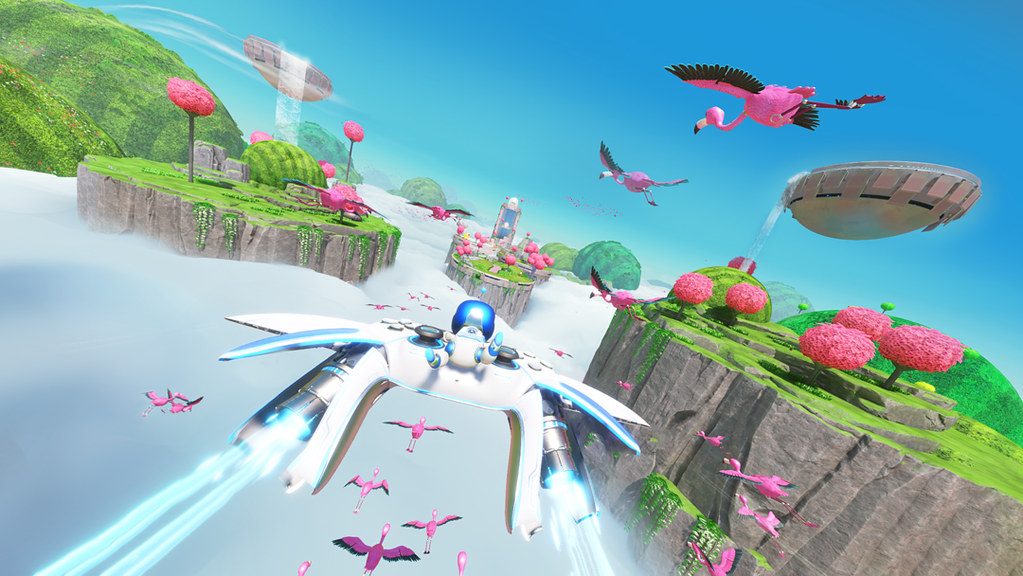
With the basics on lock, Team Asobi lets players focus on Astro Bot’s wildly inventive level design. Each of the 80 or so stages is teeming with creative energy. In one level, I get a power-up that lets me shrink Astro down to the size of an ant on command. That leads me through a fantastic puzzle-platformer gauntlet where I need to shrink down to climb into a lock or hop up a tree’s leaves. Another level drops me in a casino and puts a time-slowing PSVR on Astro’s head. I use that ability to freeze a giant slot machine as it rains down chips, turning them into platforms. Ingenious one-off mechanics like this feel like they could serve as the basis for an entire game; that’s how well-crafted they are.
The worst sin that a game like this can commit is repetition, and Team Asobi firmly understands that. Platformers like Kirby and the Forgotten Land are at their best when they’re introducing new ideas that consistently surprise players. They tend to lag in their back halves when they’ve played all their cards, but have more levels to go. Even Astro Bot dips into that in its final world as it begins repeating power-ups and enemy types. It doesn’t have trouble keeping its double dips to a minimum, though. Whether I’m platforming up a singing tree’s branches, freeing a giant robot from its restraints, or busting through glass walls with my bulldog jetpack, I feel like I’m always discovering something new in almost every level.
Toy-like charm
Airtight platforming and level design give Astro Bot a strong foundation, but its real secret sauce is its toy-like appeal. If you talk to a parent who has played a game with their child, you’ll likely hear them outline how differently kids and adults interact with games. While adults tend to barrel forward with a focus on the end goal, kids are more likely to interact with as much as they can, picking up on more subtle animation details. Astro Bot embraces that by turning each of its levels into playgrounds that give players plenty of space to poke around in the name of fun.
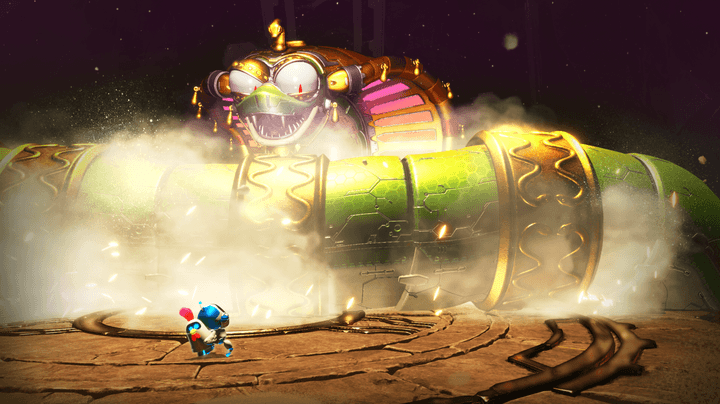
In one level, I’m dropped into a desert town. To proceed, all I have to do is run forward and rub a magic lamp by moving left and right. When I slowed down, though, I began to appreciate just how much I could play with in the little town before moving on. I could knock over a stack of buckets, sending hundreds of bolts into the sand. I jumped on a clothesline and watched as I skidded over towels, which fell from their wooden pins with a satisfying cartoonish twang. I saved a hidden bot after spotting a group of enemies off to the side, suspiciously gathered around a defenseless monkey. What could have been a 30-second moment turned into a 20-minute one as I gleefully interacted with every detail I could, just as a kid might.
While “toy” has become a derogatory term when talking about video games, Team Asobi sees no shame in embracing it. I can see that when I find a cardboard standee in a construction site level. I poke my head through it, only to summon a flock of pooping pigeons. There’s no tangible reward for doing it as it’s not a tracked collectible; it’s just a purely entertaining moment that gets an honest laugh out of me.
One of the only PS5 games that really feels like it was built around the DualSense.
Team Asobi further drills down on the toy-like charm of gaming by fully committing to the DualSense’s unique features. I feel pronounced haptic feedback when I hop into a stormy level and feel each raindrop in my palms. When I turn into a metal ball to stop a ceiling from crushing me, I can feel the resistance of the adaptive triggers pushing back on me. I even use the microphone to blow into a giant horn, a kind of delightful gameplay interaction that even Nintendo has moved away from in recent years. This is one of the only PS5 games that really feels like it was built around the DualSense, and it shows.
Astro Bot still takes advantage of the console’s power too, but not by dipping into photorealism or needlessly flashy spectacle. Incredibly smooth performance means I’m never taken out of the flow by frame hiccups. Vibrant colors make me feel like I’m in a cartoon, but Team Asobi doesn’t flatten its environments or skimp on detail. In fact, it only emphasizes them with the DualSense. In one level, I start by walking across swaths of bright green foliage. I feel the crunch of the grass between my metal feet and hear the sound from my DualSense’s speakers. Then I move on to a metallic checkerboard floor, where I hear my legs lightly click-clacking on the tiles. At some point during your playthrough, I recommend muting your TV and leaving your controller audio on. You’ll immediately feel and hear just how much Team Asobi uses the controller to sell its visuals.
Astro Bot likely won’t be the game players point to when discussing the most technically proficient games of the PS5 generation. The temptation will be to point to Black Myth: Wukong or Marvel’s Spider-Man 2 with its instant fast travel. Though Astro Bot may not present itself as an obvious graphical powerhouse, I firmly believe that it’s the defining game of the PS5 era so far. No other game outside of Returnal has shown us just how much advanced audio, tactile feedback, and clean performance can make an old formula feel entirely modern.
Play has no limits
For those hoping to get as much playtime as possible out of the package, Astro Bot packs in plenty to do. There are secret levels to find, puzzle pieces in each level, a gacha machine filled with outfits, and a home base that evolves into a full-on playground over time. The most alluring feature, though, is its PlayStation-themed collectibles. Every level has a set of hidden bots that Astro needs to rescue. A few in each stage are themed after PlayStation characters. That would be a charming Easter egg hunt, but Team Asobi isn’t just investing in empty references. It uses the opportunity to show its love for PlayStation history.
I won’t spoil what characters appear here, but know that it isn’t just your average Kratos and Aloy cameos. There are shocking deep cuts here from every corner of PlayStation’s history, including its indie partners. If you have a seminal PS1 game in your mind or a semi-obscure PS2 horror game, there’s a good chance it’s represented here. Aside from a lack of Final Fantasy representation, Astro Bot pays its respects to several generations of formative games. A handful of excellent stages even go one step further by paying tribute to some key games themselves — expect gaming history nerds to go positively feral over them.

As I collected them, I found myself getting surprisingly emotional as deep-cut games I grew up with got their lovingly crafted due. Every time I found an old friend, I was transported back to that kid in the backroom of my parent’s house playing PS1. The unbridled joy I felt when firing up a game I’d never seen before came flooding back to me. I remembered why games were so important to me growing up and how they shaped my creativity. Naysayers will say that no childhood memory comes from sitting in front of a TV, but that was never true for me. Games only made me more curious about the real world. Astro Bot brings that feeling back to the forefront.
As I wistfully reflected on that, I was hit by a pang of bittersweet sadness. Most of the colorful mascots I was reuniting with simply don’t exist anymore. Over the past 10 years, PlayStation has entirely narrowed its focus on a few key franchises. God of War and The Last of Us have become standby franchises, while the Crash Bandicoots and Ape Escapes of the world die out. You can count the first-party PS5 games geared toward kids on one hand — and two of them are Astro Bot games.
In its never-ending chase for maturity and realism, the video game industry is leaving kids behind. It makes me sad to think that today’s young players have so few options if they want to play something like Spyro the Dragon. Outside of Nintendo, it feels like the landscape is dominated by a few free games that are built to exploit parents with microtransactions. Too few games embrace the joys of play, and I fear that we’re building a more cynical generation of players because of it.
It presents a picture of the past where PlayStation spoke to a more vibrant audience.
It’s unlikely that Astro Bot will save the world, let alone be successful enough to appease a company chasing endless growth, but it’s a game that we so desperately need. I don’t read the PlayStation history references as brand advertisements so much as Team Asobi trying to remind Sony of what it has lost in the PS5 era. It presents a picture of the past where PlayStation spoke to a more vibrant audience across different ages and tastes. Astro Bot confidently shows us that we don’t need to abandon that thinking just because tech has changed and the industry has grown. There’s still room for an expertly designed collect-a-thon platformer that’s filled with love and wonder.
Four years ago, Sony introduced the tagline “play has no limits” to advertise the PS5. Astro Bot is the first PlayStation exclusive since then that truly believes in that mission statement.
Astro Bot was tested on PS5.