“Armature Studio sticks to its strengths in the team's first Batman adventure, building an interconnected world that even bests certain aspects of Rocksteady's games.”
- Brings the claustrophobic exploration of Arkham Asylum back to the series.
- Impressive freedom in how you explore the prison.
- Most rooms feel like puzzles themselves.
- 3D Arkham combat and traversal not suited to a 2D game.
- Navigating the environment can sometimes be frustratingly illogical.
- Dark art style makes it sometimes difficult to see environmental features.
“Why you can trust Digital Trends – We have a 20-year history of testing, reviewing, and rating products, services and apps to help you make a sound buying decision. Find out more about how we test and score products.“
Batman: Arkham Asylum didn’t inspire confidence when it was announced for one reason: Batman games were usually terrible. Rocksteady Studios, hoping to avoid making another bad Bat game, used Retro Studios’ classic Metroid Prime as a model for capturing the Batman comics sense of suspense and mystery. It borrowed almost all of Prime‘s parts. The Detective mode for scanning environments, the interconnected island sanitarium that forced Batman to acquire new skills, the secrets and hidden items; Rocksteady used Metroid Prime‘s tricks to grand effect.
It’s fitting that Armature Studio – which was founded by Metroid Prime designer Mark Pacini, engineer Jack Mathews, and artist Todd Keller – was brought in to develop Batman: Arkham Origins Blackgate, a handheld prequel to Asylum. Armature sticks to its strengths in Blackgate, building an interconnected world that bests even Rocksteady’s games in some respects. Blackgate isn’t quite the success it could have been, though, due to a slavish commitment to capturing the feel of the console Arkham games.
Another fine mess
Picking up shortly after the events of Arkham Origins — spoiler warning, Batman lives through that game and arrests all the bad guys — Blackgate finds the Dark Knight thrown into an uneasy alliance with Catwoman for the first time. The setting for their team-up is Blackgate Prison, an island facility housing most of Gotham City’s more colorful sociopaths and psychopaths.
What the story lacks in novelty, it makes up for with utility.
Batman heads to Blackgate after both a breakout and a massive explosion rock the penitentiary. With Catwoman’s help, he moves to subdue Black Mask, the Penguin, the Joker, and their respective gangs after each takes over a wing of the prison. Easier said than done when other creeps, like Deadshot, are roaming around. There are also bigger forces at work behind the scenes, possibly manipulating Batman for their own questionable ends.
Not the most original premise in the world. If this weren’t positioned as a prequel, Armature would have had to include some lines for Batman acknowledging how common these criminal insurrections are. “Great! Costumed lunatics have taken over yet another correctional facility in Gotham. And the whole, heavily armed staff has been taken hostage… again. Come on!”
What the story lacks in novelty, it makes up for with utility. The explosion leaves Blackgate a wreck of burning hallways, collapsed cellblocks, and all kinds of unstable architecture, fine justification for why Batman can follow some paths and not others until he gets some fresh equipment. It helps, of course, that Wayne Enterprises provided the security technology and construction tools used at Blackgate, so Batman can find all the handy accessories he needs to get through.
Closed, surprisingly open world
Getting through is what you’re doing most of the time in Blackgate. Batman does have to fight the various gangs controlling the prison, but to the game’s benefit, far more time is spent exploring, trying to figure out how to sneak your way to the next room. This is a tricky process, in more ways than one. Unlike Arkham Asylum, Blackgate is a 2.5D game, meaning Batman can’t freely move wherever he wants. He can go right and left, and even into the background and foreground of the screen, but he’s not roaming around a 360-degree space. This turns most of Blackgate‘s interconnected rooms into puzzles in and of themselves.

An example: multiple guards patrol the Joker-controlled library when you enter. There are grates in the floor that Batman can hide under, and he can use his Batclaw to move between the upper and lower parts of the room. Since he can only go right or left, your options for hiding are more limited by the constraints of a 2D space.
Once the guards are down, it’s not immediately clear how to move on. There’s a vent in the background, so you press the PS Vita’s touch screen to enter into Detective Mode. Much like the bigger Arkham games, Detective Mode is a visual overlay that highlights points of interest in the environment. The grate glows yellow, meaning you can walk up to it and hold the X button to tear it free, clearing your path forward. There’s also a second vent in the library that isn’t at ground level, and it can’t be opened until you come back later with the extra-strength Batclaw.
What elevates Armature’s puzzle box world over even Arkham Asylum‘s is how free you are to explore it in your own way.
What elevates Armature’s puzzle box world over even Arkham Asylum‘s is how free you are to explore it in your own way. Infrequent story scenes trigger when Batman radios Catwoman for help in getting around an obstacle, and they end with the map highlighting your next goal. Really though, the game lets you wander Blackgate however you want. At one point, Batman needs to find a secret entrance to the warden’s office, where the Joker’s hiding. To get there, you have to infiltrate the generator facilities controlled by Black Mask. Instead of chasing the Joker immediately, you can start chasing Black Mask down, and in the process explore the sewers of Blackgate, find new tools, and even uncover an unexpected boss fight.
The natural flow of this game is precisely what made Metroid Prime a classic. Arkham Asylum mimicked that freedom well, but it regularly felt like you could only overcome one obstacle at a time, and those were always clearly marked. A wall that Batman could blow up was always a little cracked. Blackgate keeps its secrets close and lets you discover them. Just scanning the environment with the touch screen, done with pleasingly palpable ease on PS Vita, reveals otherwise unmarked paths to discover. The world is rigidly constructed, but you’re able to take a surprisingly open approach to uncovering it.
Flies in the ointment
Exploration feels fluid, but the physicality of Batman’s world doesn’t always make sense. There are some places where, if you’ve grappled up to a ledge from a hole in the wall, you won’t be able to climb back down, even though it’s just a few feet away. The game interface literally blocks the most athletic hero in the world from jumping down just a few inches.
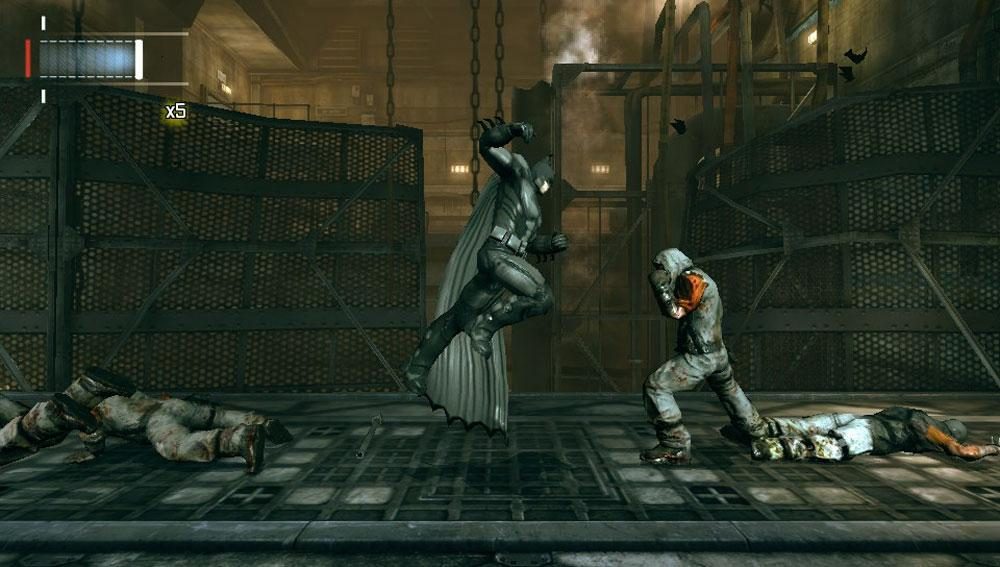
Navigation isn’t the only problem. Combat, infrequent as it is, works well when facing off against just two or three thugs. Combat feels identical to the console games, with Batman bouncing between enemies as he builds up combos and counters at key moments. It’s when you’re up against four or more enemies that the combat falls apart.


In 3D, it’s easy to position Batman where you want him when enemies surround him. In Blackgate‘s side-scrolling design, you have to rely instead on the game to interpret positioning in crowd conditions… and it doesn’t work. Three enemies on your right and Batman will swing right into the guy holding an electronic baton, taking damage, when you meant to hit the other enemy standing in more or less the same spot. Try to flip over the tazer-wielding baddie and attack from behind – a necessary step in taking those particular enemies down – and you’ll flip over the guy next to him, leaving you open to attack.
There are many niggling moments like these throughout Blackgate, and they’re almost all caused by the decision to make this Batman control on a two-dimensional plane just like he does in a 3D space. These deeply frustrating moments don’t break Blackgate, or take away from the sincere pleasure of wending your way through the dank prison, but it feels like they could have been avoided had Armature not felt so beholden to capturing the feel of the Arkham console games.
Conclusion
It’s been five long years since Armature Studio opened for business, and four since Rocksteady released Arkham Asylum, making the world’s first truly great Batman game in the process. Blackgate captures that style well in its grim little prison, and Armature proves that the Metroid Prime games were no fluke; this team can still make a quality world of puzzles that’s pristinely fun to unfold.
All that’s missing in Blackgate is the level of polish and consideration that was brought to Nintendo’s series. The designers at Armature realized that Samus couldn’t move exactly the game way in 3D that she did in 2D, and they made the appropriate adjustments. Blackgate didn’t benefit from the same insight. Even still, it’s good enough that Armature deserves another chance to lock Batman up with a gaggle of criminal scum.
This game was reviewed on a PlayStation Vita using a copy provided by Warner Bros. Interactive Entertainment.
Highs
- Brings the claustrophobic exploration of Arkham Asylum back to the series.
- Impressive freedom in how you explore the prison.
- Most rooms feel like puzzles themselves.
Lows
- 3D Arkham combat and traversal not suited to a 2D game.
- Navigating the environment can sometimes be frustratingly illogical.
- Dark art style makes it sometimes difficult to see environmental features.
This game was reviewed on a PS Vita using a retail copy provided by the publisher.