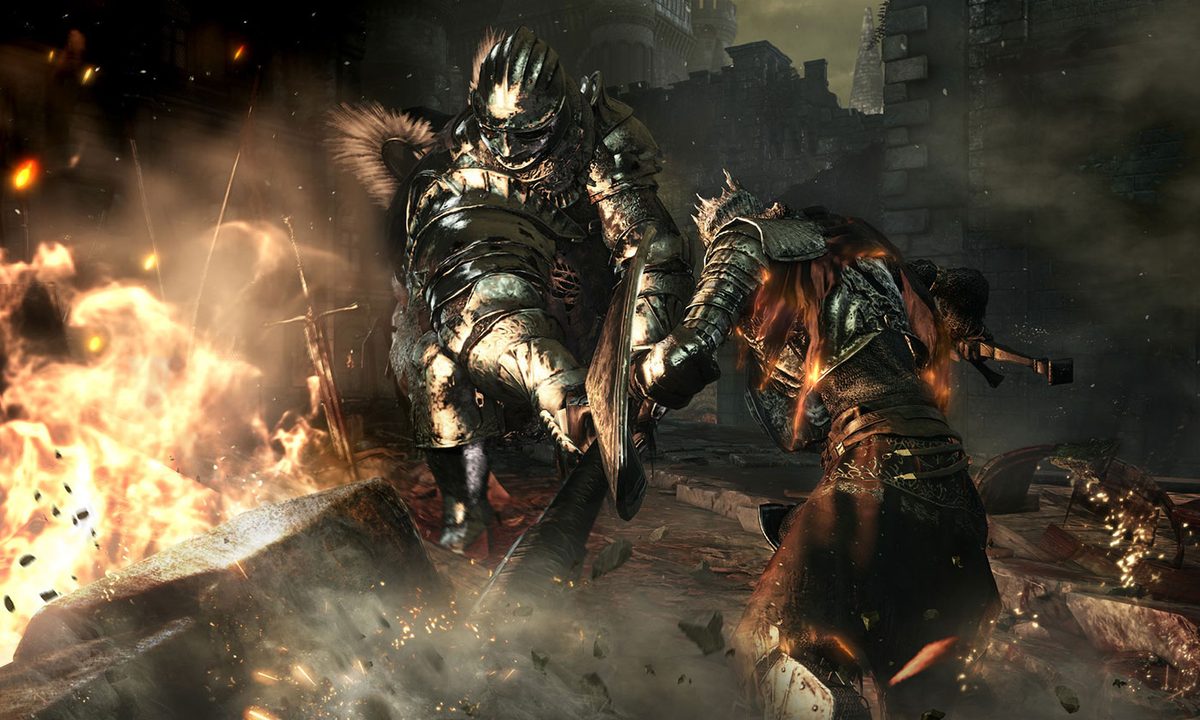

“Dark Souls III is tough as nails, and the most rewarding Dark Souls game yet.”
- Rewards hard work with forward progress
- Tough, but never insurmountable
- Smartly designed levels
- Gives players plenty of chances to fast travel
- More welcoming, but still very tough
- Menus and some mechanics are still hard to understand
- Earliest level is the most challenging
“Why you can trust Digital Trends – We have a 20-year history of testing, reviewing, and rating products, services and apps to help you make a sound buying decision. Find out more about how we test and score products.“
Long ago, I attempted to make my way through Dark Souls. Eventually, intimidated, infuriated and impatient, I gave it up and never looked back at the series again. Though I appreciate Dark Souls’ ideas and design, guiding players through a mazelike world and forcing them to take their time to become good enough at the game to overcome its often-ridiculous challenges, it didn’t seem like something for me.
Dark Souls III, then, is an interesting experiment for me in pushing out of a comfort zone, and despite an experience that ended in abandoning the series all those years ago, I’m sticking it out with From Software’s latest entry into its action-role-playing series. This is largely due to a strength of design that seems determined to challenge players while always offering them forward progress. It doesn’t feel like Dark Souls is out to get me anymore, and that makes it a lot more fun.
Once more into the undead horror world
At its heart, Dark Souls III isn’t too different from previous entries into its series. You play an undead warrior who heads out into a strange world seeking to defeat several Lords of Cinder to return them to their thrones. For some reason, this is very important and you’re duty bound to do it. There’s more to the story, but like everything in Dark Souls, it will require a lot of time and patience on the your part to understand.


The gist of the experience is a simple one. Regardless of whether you play a sorcerer or a knight, an archer or a brawler, several stat bars dictate your abilities. Stamina is often the most important: It depletes as you take actions like swinging your sword, blocking with your shield or weapons, or rolling to dodge. Though the bar refills fast, you can only swing away at an enemy or dodge its attacks so many times in a given period, which means fighting is more of a strategic dance than a button-mash.
As you defeat enemies, you collect their souls, and those souls are used to buy everything from arrows to level increases. If you die, you drop all your souls on that spot; die again and they disappear. Though that makes for an incentive to move through the world with caution, Dark Souls always provides you with more souls, provided you can earn them.
That’s because every time you rest at waystations marked by bonfires, which restore health, stats, weapon durability, and stash of life-restoring potions called Estus, enemies you’ve killed rise from the dead. Every trip away from a bonfire is rewarding, but risky. Exploring slowly and carefully is always the way to go.
That’s true of everything in Dark Souls III. The series is known for its insane difficulty, but it’s more methodical than diabolical. Dark Souls III wants you to learn its nooks and crannies, its enemies’ idiosyncrasies, and its many paths and shortcuts. You learn those things by exploring and dying. You’ll die a lot — over and over and over again.
A little easier this time
All Dark Souls games are like this, but Dark Souls III feels a little easier on players. Bonfires are actually placed relatively close together throughout the game, meaning that every stretch of a few hundred yards of hard-fought battles is generally rewarded with a place to rest and regroup, or fast-travel somewhere else. And because areas are large, but not sprawling, you always feel like you’re making progress.
Some may say Dark Souls III is easier than its predecessors. I prefer to believe that it’s smarter.
The biggest reason the Dark Souls III disc is still in my Xbox One is because even if I get stuck, I’m never stuck for long, and I’m usually rewarded soon after.
Dark Souls has always been known for having feel like dense, maze-like levels that loop back on one another and are filled with clever shortcuts. In Dark Souls III, every level seems enormous until you actually begin to conquer it. The game excels at making you feel like you’re earning it and accomplishing tangible goals. For the most part, it’s tough but not frustrating.
The exception to that in the first 30 hours or so that I’ve played so far might be the opening area, the High Wall of Lothric. Chalk it up to an overly cautious play style, perhaps; it wasn’t that the area felt insurmountable for a newb, but the High Wall contains more roadblocks than what lies beyond, and it was only after a few hours that I got past the worst baddies. Dark Souls III throws you directly into the fire, and the heat only dissipates once you’ve cleared that first section and the Voldt Hound that guards its exit.
Desperate fights, awesome victories, many defeats
Even during the stressful earlier areas, Dark Souls III makes sure to provide measurable, satisfying forward progress, with bonfires and shortcuts that reward players for pushing ever forward. And though the High Wall is tougher than other areas, forcing players to invest in and really learn to handle this area benefits them for the rest of the game. But if there is a place that seemed like it might turn people off, it was this one.
Throughout the early going of Dark Souls III, the game has continued to be as fascinating, obtuse, deep, and — seemingly — tough as its predecessors. It still fails to properly explain some of its systems, leaving you to puzzle out how to get things like a better sword, and don’t be surprised if you learn magic from an online wiki. Still, Dark Souls III is at least great at providing a crazy scale of battles, without crushing you under its boot heel.
Conclusion
Dark Souls III is still tough, but it tries harder than its predecessors to avoid turning players away. For the first time, I’m really enjoying adventuring through a Dark Souls world. I don’t feel like the game is preparing to laugh at me with a “gotcha” moment of nonsense difficulty the way the original Dark Souls did, From Software’s faster-paced Bloodborne. Some may say Dark Souls III is easier than its predecessors. I prefer to believe that it’s smarter.
(Editor’s Note: We’re about 30 hours into Dark Souls III and will update the review in the future with more thoughts.)