  1. Home
  2. Gaming
  3. Trash
  4. News

Digital Trends may earn a commission when you buy through links on our site. Why trust us?

Nvidia will give PlayStation PC games the DLSS treatment

Add as a preferred source on Google

With more PlayStation games coming to PC, graphics card manufacturer Nvidia has been working on making the PC versions of titles better than their console counterparts. Horizon Zero Dawn is getting the DLSS treatment, while God of War will get the same, along with a suite of other graphical improvements.

God of War | PC Features Trailer

Starting today, anyone with one of Nvidia’s beefier cards in their computer can play Horizon Zero Dawn on PC with Nvidia’s DLSS tech. DLSS, or Deep Learning Super Sampling, boosts frame rates in-game without reducing resolutions by using A.I. rendering. The technique lets players run their games at high resolutions, with maxed-out settings, or even with ray tracing enabled, without shedding too many frames. While Horizon Zero Dawn doesn’t have ray tracing, the game is quite demanding, although Nvidia claims that DLSS can boost the game’s performance by “up to 50%.”

As for next year’s PC rerelease of God of War, the blockbuster title will receive numerous changes and improvements when it moves off of consoles. Along with Nvidia’s DLSS, anyone playing God of War on PC with an Nvidia graphics card will be able to use Nvidia Reflex, which reduces latency. The game will also have a full bevy of graphics settings options, letting players turn on high-resolution shadows, higher rendering resolutions, and more. And thanks to an uncapped frame rate, players can finally play God of War at 144 frames per second.
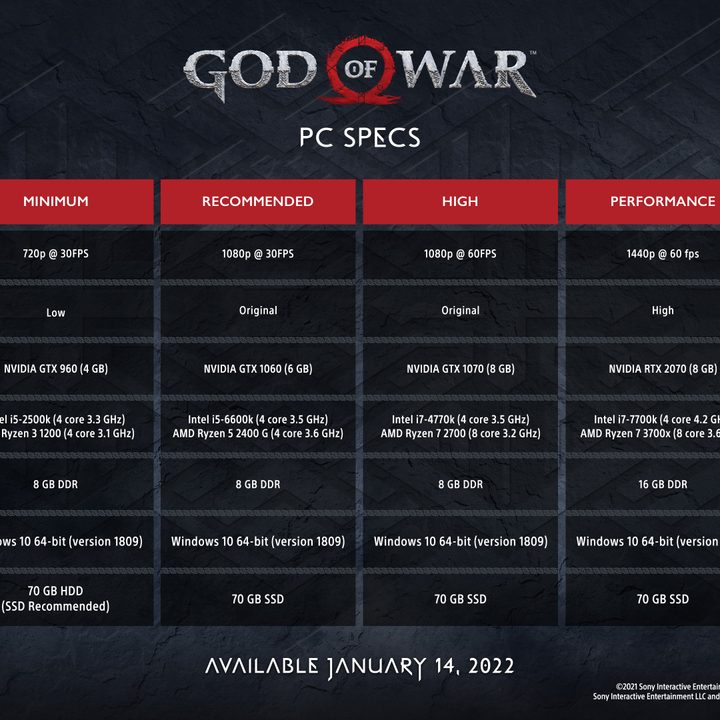
God of War's PC specs.
Image used with permission by copyright holder

Nvidia also shared God of War‘s PC system requirements, revealing that the title won’t be too demanding to run. God of War is set to launch on PC on January 14, 2022.

Otto Kratky
Former Digital Trends Contributor
Otto Kratky is a freelance writer with many homes. You can find his work at Digital Trends, GameSpot, and Gamepur. If he's…
Don’t breathe easy just yet. Apple and Microsoft aren’t done with price hikes.
Xbox and Apple device price hikes could be a warning for the rest of the tech industry.
Apple logo glass building

Earlier today, Microsoft raised the price of its Xbox consoles by up to $150 in the U.S. Just a few hours before that, Apple announced a similar move for its Mac and iPad portfolio, while also raising the sticker price of its Vision Pro headset and several other products except the iPhone. But it seems these two giants are not done with price hikes yet.

Neither company has explicitly said that more price hikes are coming, but their statements suggest otherwise. Take, for example, this statement that Apple shared with The Washington Post earlier today.

Read more
As Xbox gets pricier, Microsoft launches Buy Now, Pay Later scheme for consoles
The buy now, pay later scheme available on the Microsoft Store is applicable on new as well as refurbished Xbox Series S and X models.
xbox Series s and Buy Now Pay Later scheme

Earlier today, Microsoft raised the price of its Xbox consoles by up to $150 in the US. Following the price hike, the asking price for the Xbox Series X 2TB edition has climbed all the way up to $800. The 1TB model now costs $650, while the Xbox Series S with 512 GB storage will now cost $400 in the US market. 

What's the game plan?

Read more
Microsoft just raised the price of Xbox consoles by up to $150 
Microsoft Stores will offer a buy now, pay later scheme at zero interest, and a similar 12-month financing system will also be available through Amazon.
An Xbox Series X sits next to both Series S models.

Microsoft has just announced that the price of Xbox consoles is going up in the US as the company stares at an unprecedented industry-wide crisis. The price of the 512 GB models is going up by $100, and if you are interested in buying the 1 TB models, expect to pay $150 above the current asking price. Additionally, Microsoft is also discontinuing the 2 TB storage model, and it's not surprising why. 

What's happening?

Read more