
While the bulk of HBO’s The Last of Us adaptation retells the story of the first game, The Last of Us episode 7 is a special exception. That’s because it dives into DLC territory to bring The Last of Us: Left Behind to the small screen and give Bella Ramsey’s Ellie an hour to shine.
Left Behind is a 2014 expansion for The Last of Us that would later be purchasable as a standalone release. It’s set in the middle of The Last of Us, as Ellie hunts for medical supplies for Joel in an abandoned Colorado mall. That setup acts as a frame tale, as the bulk of the game is a playable flashback. In it, we get to see a slice of Ellie’s life before she met Joel, as she explores another mall with her friend and budding love interest, Riley. It was a significant chapter of the series, as it confirmed Ellie’s sexual identity, but its also an important moment for games in general. Lesbian relationships weren’t generally depicted in AAA video games in 2014, and the idea of a tender kiss between two women was especially unheard of.
Episode 7 of the game’s TV adaptation will tell that story in its own way, but the DLC is a must-play for fans of the show who’ve yet to try the games it’s based on. In fact, Left Behind is the perfect entry point; that’s because it’s the best Last of Us game, if not developer Naughty Dog’s best pound-for-pound game, period.
Keeping it tight
On a fundamental level, Left Behind stands out by telling a strong story, plain and simple. The focus here is on thoroughly building out a relationship between Ellie and Riley in a short time frame, which Naughty Dog accomplishes with ease. That’s thanks to a string of memorable beats that span the spectrum of emotions you get in a full-length Last of Us game. It’s essentially a playable romance movie about two young girls on a date, and it uses interactivity to create some particularly intimate moments.
In one standout sequence, Ellie and Riley find an old fighting game arcade cabinet. When Ellie disappointedly discovers it doesn’t work anymore, Riley tells her to close her eyes and then narrates an entire fight, telling Ellie which buttons to press as the camera tightly focuses on her face. The act of executing basic fighting combos becomes sentimental; it’s an act of love. Another sequence tosses the two into a photo booth and tasks players with choosing what faces they want to make in each shot, and it sincerely simulates a very real childhood mall memory. The DLC still includes puzzle-solving, stealth, and combat like the main game, but moments like that are special. They imagine how interactivity can be used to communicate a much wider range of emotions.
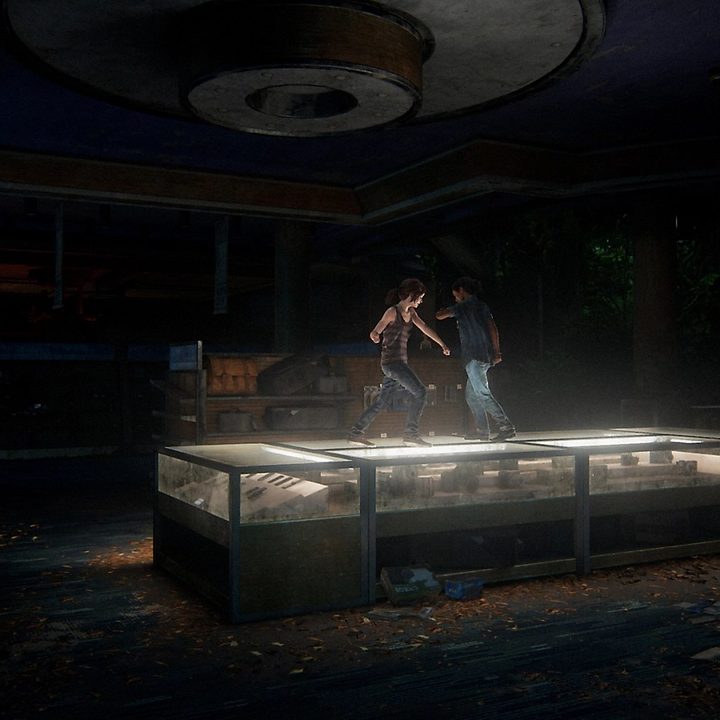
What’s most notable about Left Behind is that there’s no filler between its beats — something that’s rare in a Naughty Dog game. While the studio crafts excellent stories that are as well-written as a lot of prestige TV (a reason why The Last of Us works so naturally as an HBO show), it still carries the baggage of the medium. Audiences want to get their money’s worth out of expensive games, so something like The Last of Us can’t be a tight, two-hour experience like a movie. The studio has to link together its best beats with complications that provide more opportunities for action, and that’s where Naughty Dog’s worst instincts tend to come out.
The Last of Us Part II, for instance, reuses the same narrative complications over and over just to get another level in. There’s a glut of scenes where Ellie walks over an unstable bridge or structure that collapses, dropping her into a set piece that she has to navigate to get back to where she was going. Those moments rarely move the plot along so much as they add a point A2 between points A and B. That can make some of the studio’s best games sag in places, as its video game and cinematic pacing clash with one another.
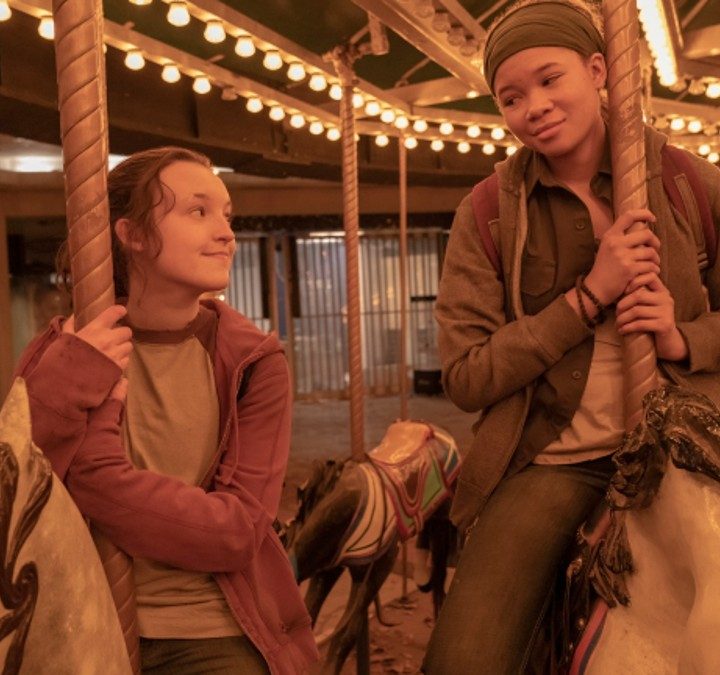
With its positioning as a low-priced DLC, Left Behind had a great excuse to avoid those (literal) pitfalls. Every second counts, with each gunfight or stealth encounter serving a specific purpose that moves Ellie’s story along. That keeps the emphasis on character growth and emotional beats rather than bogging players down with systems-heavy digressions. That more digestible narrative pace makes for a game that I imagine would be a stronger starting point for any fans of the HBO series looking to ease into games. It’s the missing link between director Neil Druckmann’s cinematic ambitions and video game instincts.
While it may be an optional piece of side content, Left Behind deserves to be celebrated and discussed just as much as the two mainline Last of Us games. It’s a hyperfocused work that perfectly balances tragic moments with tender ones, all while remembering the special ways interactivity can enhance a story. In a perfect world, more video games would be as confidently streamlined as this, rather than looking like one of The Last of Us’ bloaters.
A remade version of Left Behind is available to play as part of The Last of Us Part I on the PlayStation 5.


