
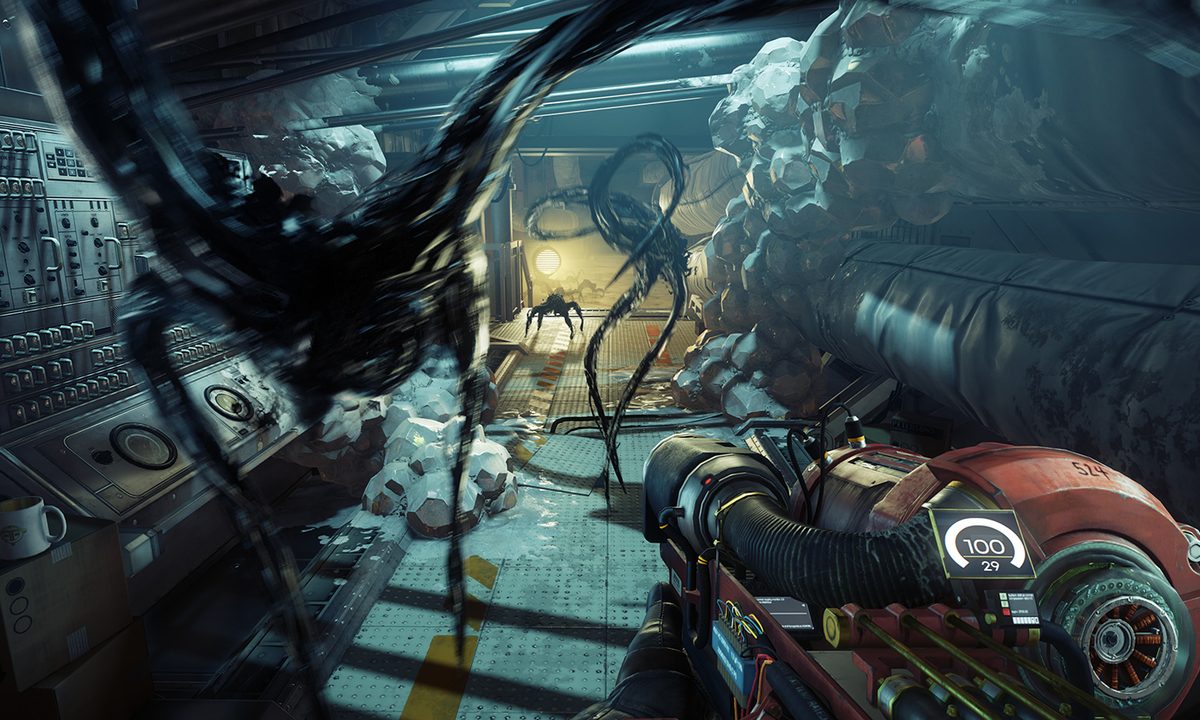

“Arkane Studios’ Prey is a master class in the immersive simulation, and perhaps its breakout title for this generation of consoles.”
- True successor to System Shock 2
- Rich, dynamic systems
- Taut horror
- Story is an engrossing mystery
- Uneven pacing
- Difficulty spikes toward end
“Why you can trust Digital Trends – We have a 20-year history of testing, reviewing, and rating products, services and apps to help you make a sound buying decision. Find out more about how we test and score products.“
Good morning, Morgan Yu! Take your time to check a few emails and rifle through the drawers of your sunny studio apartment. There’s no rush: Your commute to work is an immaculately soundtracked helicopter ride through the future skyline of San Francisco. We just have to run a few quick tests to prove how wonderful you are before you can resume your very important work. Wait, something isn’t right…
[This is not my beautiful house! This is not my beautiful wife!]
“Immersion” is one of the most delicate acts in modern gaming’s repertoire — an ever-moving target, just as defined by technical criteria as it is aesthetic and experiential. Prey (2017) works really hard to bring you under its spell in its opening minutes, just so it can bring the whole thing crashing down, turning your Groundhog Day-dream into a Total Recall nightmare.
After a couple of “surprises,” you learn to walk with your wrench readied above your head.
On it’s face, Prey is a narrative-driven first-person action-horror game, but the game is, perhaps, easier to understand through its lineage: Prey’s developer Arkane Studios was founded by co-creative directors Raphael Colantonio and Harvey Smith, who had formative roles in creating Deus Ex, Half-Life 2, and the Dishonored franchise. Though the name comes by way of ID Software’s 2006 first-person shooter, the game shares no DNA with that game’s long-dormant sequel.
Prey is Arkane’s confident riff on the Immersive Simulation — a system-rich “play your way” RPG designed to empower players to shape their own narratives. Which is to say, a first-person shooter sprinkled with character progression, inventory management, and a healthy dollop of scanning other people’s’ emails for lore (and passwords), that somehow tricks us into believing in another world.
Through the Looking-Glass, and what Morgan found there
This spell is at its most powerful in the game’s opening hours. Without giving it all away, you control Morgan Yu, a scientist who winds up aboard Talos-1, a privatized space station near Earth. Before too long, it becomes clear that something horrible has happened — the station has been trashed, there are corpses on the ground and inky alien creatures running around.
While all of this information is dispensed quickly, it is surrounded by a thick haze of confusion. Right from the get-go, you are imbued with the fear and urgency of a person in imminent danger. Exploring Talos-1, teasing out the mystery of what happened in fits and starts, along with the logic of the game’s systems, is intense and intoxicating.


The game bolsters that confusion through fear: Any enemy encounter can be deadly, and pop off at any time. One of the first and most common foes you encounter aboard Talos-1 is the Mimic — a skittering, four-legged shadow that can take the form of any nearby inanimate object. After a couple of “surprises,” you learn to stalk the halls of Talos-1 with your wrench readied above your head –a paranoid, defensive posture well-merited by the extent to which this space station wants to vent you into the cold vacuum of space like a parasite.
Yet, despite the constant tension, Prey wills you forward. Like other immersive sims, the world of Talos-1 is the real star of the show: An Art Deco utopia built on the bones of a joint Soviet-American space station, its extremely detailed features convey the depth and history that compel you to scrutinize its every nook and cranny. The inter-connected world — open, but gated off by story checks and abilities — is a stunning work of reflexive level design that would be rightly compared to Dark Souls, if it wasn’t marred by annoying loading screens between every bulkhead.
Like Rapture, Talos-1 is the real star of the show.
Once you’ve found a stray shotgun or absorbed a few alien telekinetic abilities, you’ll go from acting cautious to becoming overconfident. The station reacts to your abilities, keeping your growing power in check.
This is where the game stumbles: The first act is perfectly taut because you have to avoid combat at all costs in order to survive, but the game escalates unevenly as you progress through the station. Gaining new weapons and powers, including telekinesis and the ability to “mimic” objects like your attackers, is fun, but the second act is unexciting because you are more than capable of blasting your way through any reasonable threat. You’ll then find yourself lulled into a false sense of complacency before the game’s action-packed finale, which overcompensates by throwing swarms of robots and non-stop set pieces that will overwhelm anyone who isn’t insanely prepared. In short, the game’s difficulty is uneven.
From a wrench to a physics-based multitool
A wrench may be the first weapon you find, but your signature sidearm in Prey is undoubtedly the GLOO cannon, a physics-based multitool in the proud tradition of the Aperture Handheld Portal Device and the Zero Point Energy Field Manipulator from Half-Life. Like its predecessors, the GLOO cannon allows you to manipulate the environment and address your problems with indirect physics rather than brute force. In the GLOO cannon’s case, it shoots out balls of quick-hardening caulk that can be used to block off hallways, entomb skittering enemies, or reach new heights with improvised handholds.

Bolstering your equipment are a wide array of “neuromod” upgrades spread across six skill trees. Three are available from the beginning: broadly, Science for hacking, Engineering for crafting, and Security for combat. Once you’ve acquired the psychoscope, however, and the ability to scan alien lifeforms, you will unlock three additional trees of alien-derived skills: Energy, which confers fire and electric attacks; Morph, which gives you the ability to “mimic” objects like your enemies; and Telepathy, which gives you the ability to move objects with your mind.
The breadth and depth of skill available to you over the course of play forces you to make specific choices about what sort of protagonist you want Morgan to be: a resourceful human survivor, a telepathic alien nightmare, or something in between? The game takes great pains not to push you in any direction, gracefully accounting for all of these possibilities without moralizing or railroading the player too badly.
More than choice, Prey is a game about consequences
The range of possible builds may be partially to blame for the game’s uneven tempo — it’s tricky to balance a game around such a wide range of styles. As you enter new parts of the station you are met with new threats to match your newfound abilities, but this is nearly impossible to time perfectly when you can’t control player’ choices with those abilities. On more than one occasion we encountered insurmountable threats that could have been easily dispatched had we chosen a different loadout.
Depending on how you look at it, the issue is either Prey’s most glaring fault, or an example of its crowning achievement. More than choice, Prey is a game about consequences. Your choices help and hurt and you, often in ways you can’t predict. If the immersion — the spell Arkane’s cast — has you entranced, you’ll take it in stride.
Our Take
Despite its rushed final act, Prey is an impressive accomplishment. It’s a successor to System Shock that allows for modern conveniences without sacrificing depth. It may not have the philosophical underpinning of BioShock, but it manages to bring you to essentially the same place, questioning agency and identity, all without hammering Ayn Randian Objectivism down your throat. Prey is a game defined by its references to other games, and it has more than its fair share of game-developer humor (a golden gun, a cheekily-named protagonist, “Looking Glass” terminals). Nevertheless, the experience is immersion par excellence, justifying the extensive lineage within the genre.
Is there a better alternative?
Prey comes from a rich history of obsessively-crafted games. Students of the medium will want to go back and play through Warren Spector’s foundational work (Ultima Underworld, System Shock, Thief, and Deus Ex), but otherwise Prey is a great jumping-off point for the genre.
How long will it last?
Our first playthrough took roughly 30 hours from start to finish, with plenty of room for additional exploration, side-questing, and alternate narrative paths.
Should you buy it?
Yes. Prey is a master class in one of PC gaming’s core genres.


