

Almost nine years later, Bethesda is returning to the chaotic world of Rage, and with the help of some new blood, it’s possible we’ll see the series finally step out of the shadow of its publisher’s more well-known titles.
Developed by id Software in collaboration with Avalanche Studios, the team behind the Just Cause series and Mad Max, Rage 2 promises a chaotic open-world and fast-paced, explosive combat. But can two studios with such distinct styles pull it off?
Digital Trends had the opportunity to chat with Studio Director Tim Willits about what it was like establishing and building on Rage 2’s id-style combat, the role Avalanche played in its development, and why you’ll find no sniper rifles in the game.
It’s a marathon, not a sprint
Visceral, brutal combat is a staple across shooters from Bethesda, specifically those born from the id Software teams. Games like Quake, Doom, and Wolfenstein may all have their own flavors, but still feature the studio’s signature first-person combat. This trend continues with Rage 2.

“It was our first milestone,” Willits said when asked about Rage 2 adopting id-style combat. “That was the first goal that we needed to hit. And you know, we spent about a year on it, and we got the gunplay fast, and we got the weapon switching, and the sounds, and everything.”
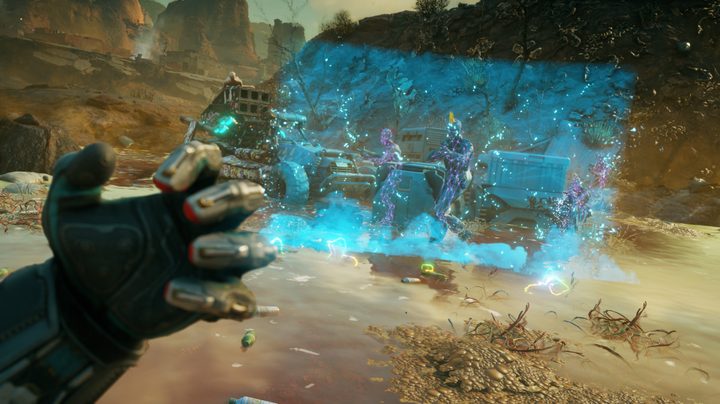
The true turning point, he tells me, is when a developer in the Sweden office found a way to arrange Rage 2’s controls so players could flow quickly between movement, Nanotrite abilities, and guns. Nanotrite abilities are the main character’s powers, and they add a fresh layer to combat, enhancing offense, defense, and movement. In some situations, they can even overpower the weapons.
“That allowed you to combo your abilities,” Willits said. “And it really opened up that kind of speed that we wanted to go with. We knew we were going to have great guns. We knew we were going to have great sounds and great animations. But for us, specifically for Rage 2, it was the quick deployment of the Nanotrite abilities that really was the turning point.”
Keeping your enemies closer
Willits tells me there are two key pillars to id-style conflict: Situational weapons and push-forward combat.
“Every situation you’re in, there’s a weapon for you,” he explains. “The rocket launcher is a very typical id rocket launcher and the assault rifle has a good feel. There’s the pulse cannon which is kind of like a rail gun. These are the weapons that I expect to use in these types of combat situations.”
In games like Doom, Quake, and now, Rage 2, using the best weapon for the job will get you out of a hairy situation quicker. For instance, if you’re being attacked by a group of weaker enemies up close, switching to a shotgun would be the most effective tactic for taking them out in droves. Alternatively, if an enemy is taking shots at you from behind cover, switching to a pistol or assault rifle would offer the ranged precision needed to take them down.
The 2016 Doom reboot is the game Willits points to as the best example of push-forward combat, and he believes the team behind the game actually “mastered” it. In Doom, the key to gaining an advantage in a fight was always getting in an enemy’s face and destroying them. Everything in the game is built around up close and brutal encounters, and Rage 2 brings more ways to do it beyond the use of weapons.
“That push forward combat really plays into the powers. Ground slam. Shatter. With those you’ve got to get close up,” Willits explains. “Even [with] the weapons. We have the Hyper Canon which is our rail gun type weapon, but we have no sniper rifle. Even with [the Hyper Canon], you can’t do combat from a great distance.”
The lack of long-range weapons, especially the sniper rifle, is something that would stand out in any first-person shooter. In this case, it comes down to staying true to the id Software style, and it seems the team’s belief is that the inclusion of a sniper rifle, or any long-range weapon for that matter, would only slow down the pace of the game.
Finding Rage 2’s identity

While Rage 2 is still being developed under the Bethesda umbrella, even we made the mistake of understating how much this new game is a creation of Avalanche’s design. “Avalanche is the primary developer,” Willits responded when I asked about the Just Cause studio’s most significant contribution to Rage 2. “We brought some people in here and there but that team made the game.”
The Avalanche team brings its knowledge of creating dynamic open worlds and the Apex Engine, which is better suited for executing the more ambitious vision for Rage 2 and is the same one used for Just Cause 4.
“So it’s everything from their experience with open world games to the technology,” Willits said. “The way they approach mission design, I’ve learned a lot. If you played Mad Max you know those guys can make vehicles really well. They’ve done a lot. The question is, more specifically, what we have done to help them. They definitely knocked it out of the park.”
Bethesda has a second chance to establish a long-running series and Avalanche has an opportunity to take an experience built on id-style combat and give it its own identity. We’ll learn on May 14, when Rage 2 launches on PS4, Xbox One, and PC, how all of these fascinating elements come together in the final package.


