
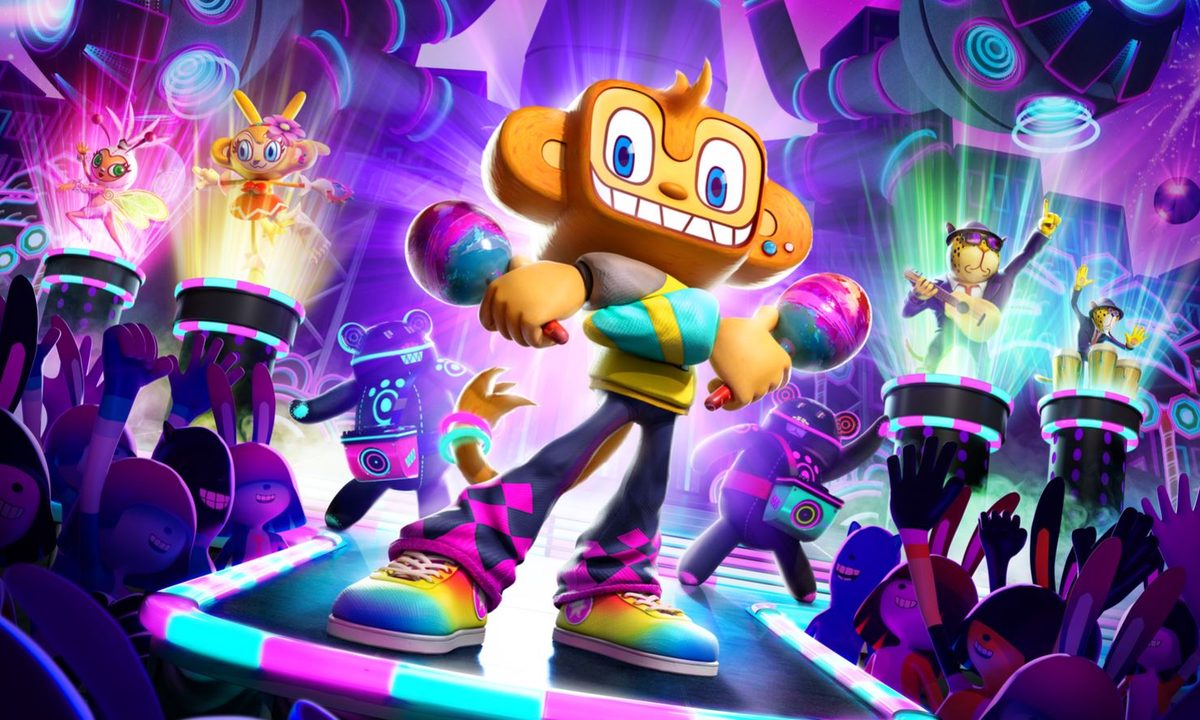
“Samba de Amigo: Party Central is a charming hit of motion-controlled nostalgia, though inconsistent controller detection can be a buzzkill.”
- Fun core rhythm gameplay
- Eclectic track list
- Creative modes
- Unreliable motion controls
- Awkward button controls


“Why you can trust Digital Trends – We have a 20-year history of testing, reviewing, and rating products, services and apps to help you make a sound buying decision. Find out more about how we test and score products.“
As soon as I begin Samba de Amigo: Party Central, I’m transported back to 2008. I was in college and working on a video game review show when I was tasked with reviewing the Nintendo Wii remake of Samba de Amigo. It was already charmingly dated by then thanks to a Dreamcast-era soundtrack featuring hits like Mambo No. 5 and Tubthumping, and has become a double time capsule all these years later. When I nostalgically think back to the days I spent waggling Wiimotes, my brain returns to the series’ little monkey mascot rather than Mario.
So, it’s with an unexpected surge of delight that I find myself shaking my Joy-Cons like maracas in Sega’s latest IP revival. Sure, the motion-controlled music game is just as sloppy as it was on the Nintendo Wii, but that makes it an effective portal to the past. If I wanted to give someone an accurate picture of what play felt like during a crucial moment in gaming history, I’d pass them my controllers and queue up La Bamba.
Samba de Amigo: Party Central is a charming throwback to the Wii waggle era, and that comes with all the same fun and frustration. Inconsistent motion controls can get in the way of an enjoyably physical core rhythm experience. Even with that major frustration, it still gets the job done as a multiplayer game that feels custom-made for family members of all ages who want to share both their musical and gaming eras with one another. It’s a multigenerational party.
A doubled-edged Joy-Con
The core Samba de Amigo rhythm experience remains largely unchanged in Party Central. On-screen, I see a hexagon, with each corner representing a direction in which I’ll need to shake my controllers when a circle passes by. When a song plays, I shake along to the beat while stopping to hit specific poses and complete “slides” that have me drawing a pattern around the hexagon with one controller. It’s easy as easy to grasp as ever and Sega hasn’t tried to overcomplicate too much. The only real twist comes in the inclusion of random events that can happen during a song, like goofy minigames or sudden speed changes.
Motion controls are both Party Central‘s greatest strength and its biggest weakness.
While it isn’t all that deep or new, there’s an immediate, undeniable fun to Party Central — especially if you’re willing to be uninhibited. I went all-out in my motion-controlled sessions, letting the music guide me as I wildly waved my arms around. Even if you’re not interested in music games, I can attest that it makes for a surprisingly good workout when using motion controls.
Those motion controls are both Party Central‘s greatest strength and its biggest weakness. Like the Wii version, motion detection is disappointingly spotty. My shakes don’t always register, which becomes a problem on higher difficulty levels where the beats become far more complex. That’s a major buzzkill, one that I imagine will stop Party Central from gaining a dedicated rhythm game audience looking to rack up high scores on its hardest difficulties. That cements it as a casual party game, but that’s an area where it works. A few missed notes don’t matter much when you’re just trying to laugh with your kids.

You don’t have to use motion controls, mind you, but I’d strongly recommend it. While Party Central does feature button controls, they’re not nearly as fun or easy to use. Due to the hexagonal beat map, I always found myself instinctively moving my joysticks at angles rather than up and down. That led to me missing a lot of notes as my control stick would register too far up or down. Longer shakes simply don’t work on joysticks either, as flicking a stick a bunch of times to simulate a rattle just feels awkward.
Though the controls are a significant pain point, Party Central gets something else very right: the all important track list. I’m surprised by how much I love the 40-plus songs included in the base game, which range from Latin classics to Carly Rae Jepsen, to Sonic Adventure 2‘s Escape from the City. It’s all over the place and that actually works in its favor. It doesn’t just feel like its catering to one generation, but aware of the fact that people of all ages will gravitate toward it. Older players will come to it for the Dreamcast nostalgia, while young kids will be drawn in by its bright colors and peppy presentation. I can see the scenario where a parent and their kid takes turns picking songs, sharing their respective era’s music with one another.
Creative modes
In addition to its standard rhythm mode, Party Central includes a surprisingly creative suite of extra modes that are worth digging into. Its primary single-player mode comes in the form of the charming StreamiGo. Here, players take on the role of a fictional streamer trying to build up their following. To do that, they need to complete different challenges, like getting a certain score on a song or hitting a certain rank. It’s a cute bit of packaging for a standard challenge mode, giving Party Central some modern personality (and another area where TikTok savvy kids get to introduce their parents to their worlds).
While it’s an enjoyable solo mode, the unreliable controls do put a damper on it. Missions that task players with getting long perfect note streaks or finishing a song with minimal “boos” feel downright impossible to complete. No matter how many times I tried some challenges, there was simply no way I was going to clear Kesha’s Tik Tok with only one or two missed notes. That had me bouncing off the mode quicker than I wanted, as I simply wasn’t interested in grinding out missions over and over.

What’s more successful is World Party mode, which is a clever online mode that draws inspiration from battle royale games. Here, 20 players compete in an elimination dance-off that lasts three rounds. It’s similar in structure to survival bowling in Nintendo Switch Sports, a simple formula that maps nicely onto a rhythm game. Inconsistent controls can still be a pain here, and the inclusion of Mario Kart-like items can cause a lot of visual clutter, but it’s a smart way to give competitive players a long-tailed mode to play around with online.
In addition to standard two-to-four player online options, Party Central also throws in a few local two-player modes that further twist a strong rhythm foundation. Love Checker is co-op-focused, testing how well players can keep in sync, while Show Down splits songs into segments and has players competing to win the majority of them. Toss in some fairly throwaway minigames, like a rhythmic home run contest, and you’ve got a few ways to get some extra hours out of the game.
Samba de Amigo: Party Central has an infectious sincerity to it.
All of that is topped off by some character customization hooks, as players can unlock outfits with in-game currency. With post-launch support planned, which will bring more songs and content down the line, there’s a fair amount to do here for anyone who really wants to dig into the package. It’s just hard to imagine anyone getting too invested when shoddy controls take some skill out of it. I imagine that the upcoming VR Samba de Amigo game will be the better option for those looking for a more precise game, while this will function more as a serviceable party game.
Though its overarching flaw is hard to ignore, Samba de Amigo: Party Central has an infectious sincerity to it. It’s a good-natured party game that seems determined to make sure players of all ages will have a fun time with it. My optimistic hope is that it gives gamers who grew up with the Dreamcast or Wii a good reason to connect with their kids, showing them both the games and music that were important to them growing up.
Samba de Amigo: Party Central was tested on a Nintendo Switch OLED in handheld mode and on a TCL 6-Series R635 when docked.


